















(This column first appeared in the October print edition of the Hendersonian.)
Many a glass of happiness flowed from the garage at 1465 S. Main St., which once stored thousands of gallons produced by the “wine king” of Henderson.
That’s what the Evansville Courier called John Bauerle June 29, 1892, when he was in town preparing for the grand opening of his “Hill Wine Garden.”
It was a very big deal. Bauerle took advantage of steamboats and railroads bringing July 4th revelers from Evansville and the countryside, where they could catch a Henderson streetcar to the end of the line on South Main Street. From there, “conveyances will be waiting,” according to Bauerle’s newspaper ads.
But let’s set the stage before lighting the fireworks. Bauerle was born in Baden-Baden, Germany, June 23, 1847, and immigrated to New Jersey about 1865. He then made stopovers in Cincinnati and Evansville (where he was naturalized) before he came to Henderson in 1872 and got married.
On Jan. 9, 1877, he bought 26 acres—from the Ohio River to Green Street—from Edward Atkinson for $5,300, which included a two-room log cabin, two mules, a horse and “every utensil on the place,” according to the deed.
He used the cabin as the core of a large house and planted a variety of grapevines. On July 26, 1892, Henderson County Court issued him a “coffee house” license, which authorized him to sell all types of alcohol by the drink.
It appears he wasn’t entirely legal when he held his grand opening July 4.
But no one raised a fuss; Bauerle’s was a high-class establishment. A circular pavilion protected 50 tables, and the free lunch was varied and plentiful. Along with ham sandwiches, there were beet, potato, herring, radish, and cabbage salads, “sugar for the ladies,” cake, ice cream, green cheese, and a host of other delicacies.
“Good order will be preserved and no improper characters allowed in the garden.”
If that weren’t enough, a “grand display of fireworks” was planned in the evening.
Every table was filled, according to the next day’s Henderson Journal, which estimated the crowd at up to 500. “Mr. Bauerle’s wine is pronounced the best and his place is incomparably beautiful.”
Bauerle was absent from his home a year later when there was some bloodshed there, according to the Gleaner of June 20 and the Journal of June 21, 1893.
The fracas involved one of his sons, Theo, and the young man’s grandfather, Joe Yaney. “High words led to blows and Yaney, seizing a large butcher knife, stabbed Bauerle in the back.”
The Gleaner published a different account, with young Bauerle taking the knife from Yaney and slashing him in the cheek and in the side.
The Gleaner of June 22 attempted to bandage the blot on the wine garden’s reputation. “Certainly nothing of the kind will ever occur again as it is (Bauerle’s) intention to refuse admission to any belligerents or ill-behaved characters in the future. He is determined to supply a resort at which every lady and gentleman may feel absolutely secure from insults from unworthy characters.”
Theo Bauerle was again in the Gleaner Sept. 6, 1895, after he was nearly electrocuted. Along with his winery, John Bauerle grew vegetables for the local trade. Theo was driving the market wagon on First Street near the courthouse when one of his horses contacted a broken telephone wire that had fallen across a transmission line for the Henderson Streetcar Co.
The horse was immediately killed by the voltage. Bystanders managed to keep the other horse free of the wire, which was quickly cut with a hatchet.
John Bauerle sued the streetcar company; a year later it agreed to settle for $80.
Sadder stories followed in 1900 and again in 1912. His oldest son, John Bauerle Jr., married in Evansville Feb. 27, 1900, but died of kidney trouble at his father’s house less than a week later.
It’s not clear how long Bauerle continued making wine, but it was close to three decades. By 1910 he began advertising vegetables. (He won awards at the county fair for such things as cantaloupe and beets.)
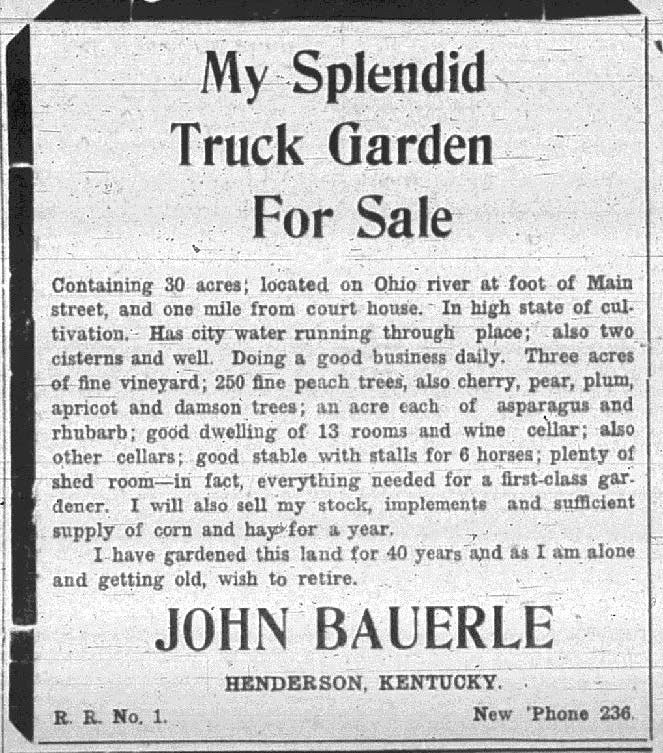
But by March 1, 1911, he clearly was tired. He began running advertisements offering to sell his “splendid truck garden,” listing three acres of vineyards, 250 peach trees, equipment, stock, etc. “Everything needed for a first-class gardener….
“I have gardened this land for 40 years and as I am alone and getting old, wish to retire.”
His wife, Mary Elizabeth (better known as Lizzie), came down with tuberculosis about 1910 and died at a daughter’s house, according to the Journal of Aug. 1, 1912.
The day after Christmas 1912, Bauerle got a telegram saying Theo had died of appendicitis in Cape Girardeau, Missouri.
It was a familiar story. Bauerle’s plot in St. Louis Cemetery contains the graves of three infants and a toddler who died between 1877 and 1889: Theresia, George, and two named Carolina who died five years apart. They may have been children of John and Lizzie Bauerle.
Eight children survived into adulthood. They were John Jr., Theo, Christina Stocker, Mary Ann “Annie” Kemmerich, Henry, William Fred, Joseph James, and Andrew Wilbert.
Bauerle was sexton at St. Louis Cemetery for 44 years, according to Gleaner stories in 1922 and 1930. He apparently began that job in the 1870s, considering the county paid him $3 Oct. 30, 1879, to dig a pauper’s grave.
Having been unsuccessful in selling his place, on Jan. 1, 1912, Bauerle leased it to his son, Henry, for five years. It essentially was a sharecropping agreement, and John Bauerle made it clear he would help only as he felt like it.
On Aug. 12, 1913, a year after his wife’s death, Bauerle married Margaret Lindsay, an Irish woman who was 26 years younger. (Jacob Alles—founder of the local furniture store—was a witness; he was also a pallbearer at Bauerle’s funeral.)
The Journal of Aug. 13, 1913, reported the couple had just returned from their honeymoon. “Mr. Bauerle served the crowd with some of his best wine and home-made cake.”
Throughout the 1920s, Bauerle periodically advertised grapes and produce for sale, as well as his need for farmhands or sharecroppers.
Friends and four generations of family gathered at the farm to celebrate his 75th birthday, according to The Gleaner of June 27, 1922, which noted he had been sexton at St. Louis Cemetery 44 years. “He has been engaged in market gardening, and his vineyard is known to be among the best in the state.”
The Gleaner’s last major story, except for his obituary, appeared Feb. 20, 1929, after an airmail plane en route from Atlanta to Evansville was forced down there by bad weather. The plane sustained damage to its landing gear and tail skid.
The pilot used Bauerle’s phone to arrange the transfer of twelve bags of mail to be taken to Evansville by vehicle.
Bauerle died of heart trouble Dec. 30, 1930. He was 83. Survivors included his wife, six children, 25 grandchildren and 12 great-grandchildren.
He left his entire estate to his wife … but it really wasn’t much: $13.25 in cash and 22 acres encumbered by nearly $1,800 of debt. (He had sold the area between Main and Green streets Oct. 21, 1919.)
George Clay and wife paid the master commissioner $2,700 after a bank had sued the widow and other heirs. Arch Clark, a buyer for Imperial Tobacco Co., and his wife Louise bought the remaining 18.4 acres of the property from the Clays for $4,000 in April 1938 and almost immediately began razing Bauerle’s house to build anew.
That process revealed the old log cabin that had been its nucleus. “The well-constructed brick basement of the old house will be utilized and will include the garage and a recreation room,” according to the Gleaner of April 10, 1938.
“The cellars of the old house … recall the wine making industry conducted by the late John Bauerle, who put up four or five thousand gallons of wine each year. A vineyard still stands between the house and the river.”
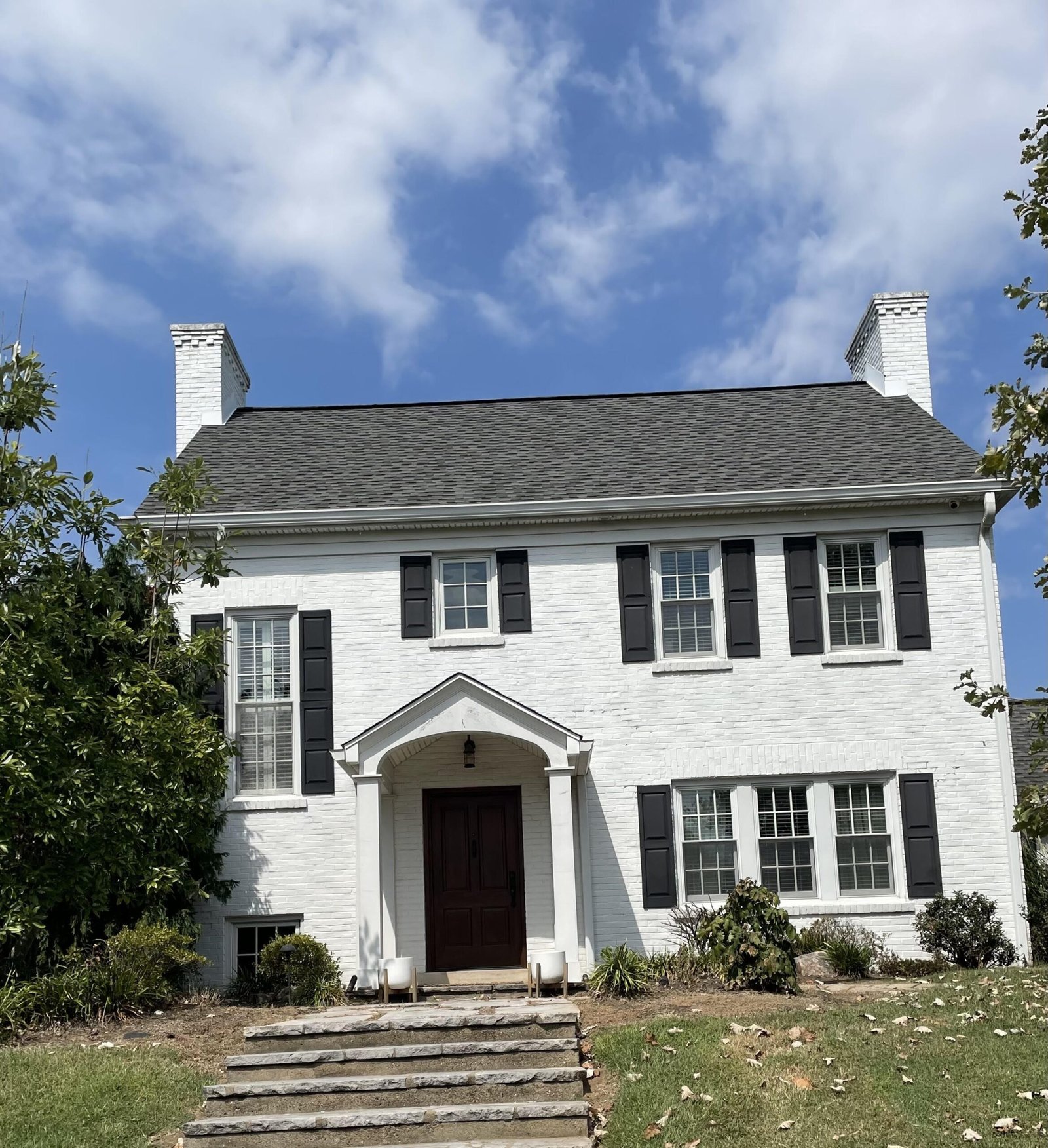
The Gleaner of June 19 reported work had begun on 1465 S. Main St., currently owned by Aaron and Callee Meuth.
On Nov. 6, 1938, the paper noted it was nearing completion. It carried stories, a column, and advertisements from those contributing to its construction.
“Built at a reported $20,000 investment in building alone, many modern features, a number of them new in Henderson, have been installed.” It was all electric, for instance, and the radiators were built into the walls.
“An electric range, refrigerator and dishwashing sink are included. The latter has an electrical knife system that grinds garbage for disposal through the sewerage system.” (That may have been Henderson’s first garbage disposal, considering 1935 was when General Electric began selling them.)
It also featured a guest room and maid’s quarters, both with separate entrances.
The Bauerle name is not well recognized these days, but in 1938 the building site was called Bauerle Hill, according to Francele Armstrong’s column in The Gleaner of Nov. 6, 1938, and Ewing Galloway’s columns of April 17, 1938, and Jan. 1, 1939.
“We rejoice with the Arch Clarks that their new home atop the Bauerle hill is now nearing completion,” Armstrong wrote. “To our mind, (it is) the loveliest river-view site in the locality….
“The new house is lovely—but we feel that none but a Yankee architect (Walker Anderson of Evansville) could have had the heart to disturb the ghosts of the past that dwelt on Bauerle hill.”
Galloway also called it “Bauerle Hill” in his Jan. 1 column but focused on the ghosts across the road in St. Louis Cemetery.
“The Catholic cemetery to the east does not detract from the picturesqueness of the Clark place. On the contrary, it adds to the beauty of the neighborhood and people in their final sleep are sometimes less troublesome than neighbors walking around on their two feet.”