



















(This article first appeared in the January print edition of the Hendersonian.)
In the deep of winter, when we’re looking for experiences and educational enrichment to get our new year off to a fresh start, a day trip to explore nature in the great outdoors can be an exhilarating choice.
Very close to us in western Kentucky—to the southwest and to the southeast—there are two opportunities that fit that goal perfectly.
Eagle watching tours

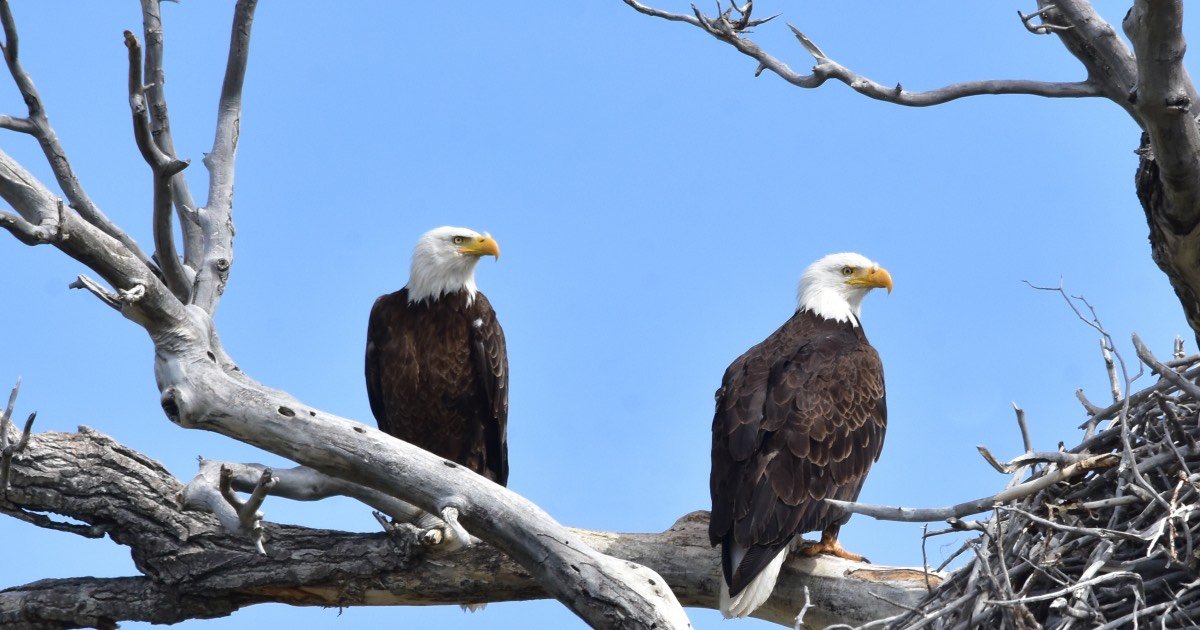
At Land Between the Lakes, the U.S. Forest Service hosts eagle watching tours to take visitors into the wild to see both resident nesting eagles and the “snowbird” visitors who have migrated from the frozen north in search of open water and good fishing.
Sounds like human snowbirders, huh?
The LBL tours launch from the Woodlands Nature Center at Golden Pond on several dates from mid-January to mid-February.
Traveling on land in a van, eagle watchers explore the nooks and crannies of LBL discovering wildlife hotspots and scenic vistas that are known to attract the great birds.
Sure we can see them from time to time along our own little stretch of the great Ohio River as the resident eagles cruise along looking for dinner, but the numbers present at LBL can be impressive and can spark conversation about what has been driving the resurgence of an avian population that was once an endangered species.
Some tidbits about eagles from the U.S. Department of Fish & Wildlife:
• Adults measure from 30 to 40 inches from head to tail, with a 7-8 foot wingspan, and weigh from 8 to 14 pounds. The female is larger than the male. To identify a perched bird as an eagle, look for a distinct football shape. When it’s in flight, the wings are flat, unlike the upturned wings of a turkey vulture.
• The distinctive white head and tail feathers appear when the eagles mature at 4 or 5 years old.
• Bald eagles are believed to live 30 years or longer in the wild. They mate for life, building huge nests in the tops of large trees near rivers, lakes, and other wetlands. The adults will often return to the same nest year after year making additions to the nest each year. Some nests can reach up to 10 feet across and weigh up to 2000 pounds.
• Eagles feed primarily on fish, but will also feed on ducks, rodents, snakes and carrion.
• Both the male and female build the nest, but the female chooses the nest tree. Both will defend the nest territory which is usually several square miles, depending on habitat and the proximity of other nesting eagles.
• The female will lay 1 to 3 (usually 2) eggs 2 to 3 days apart. The eggs are about 3 inches long and are an off-white color. Incubation is done by both parents and lasts about 35 days.
• The young will stay in the nest about 11 to 12 weeks when the adults will start encouraging them to fly. The eaglets can often be seen exercising their wings on the nest or on a nearby branch several days prior to fledging (first flight from the nest).
• The young will stay at or near the nest for the next 6 weeks while the adults continue to feed them and teach them to hunt and fish on their own. Young eagles are believed to return to within 100 miles or so of their own nest site when they reach maturity and are ready to mate.
• Bald eagle populations started to decline in the late 1940s coinciding with the introduction of the pesticide DDT. Breeding pairs dropped to about 450 in the lower 48 states. This led to their being designated as an endangered species in 1978. The use of DDT in the United States was banned in 1972. This and other recovery efforts have helped the bald eagle to recover. They were downgraded to threatened status in 1995. On August 9, 2007, the bald eagle was removed from the federal list of threatened and endangered species. A wintering population survey of North America in 1997 resulted in a count of 96,648 individuals, with about 75 percent occurring in Alaska and British Columbia. Bald eagle populations in the mid-Atlantic region have been increasing dramatically in the last 10 years.
Registration is required for the eagle watching tours at LBL, and you should definitely dress for the weather.
Find the dates and registration info at: www.landbetweenthelakes.us/calendar/eagle-viewing-van-tour-7/
Sandhill Crane Tours
Late January is the time (Jan. 24-25 this year) and Barren River State Resort Park is the place for sandhill crane tours.
What’s that like, you ask. You’re out early on a sandhill crane excursion.
It’s sunrise, in fact, and everyone is still sleepy (especially the birdwatchers … at least until they get energized by seeing these great birds in large numbers).
Slowly the avian visitors snoozing by the side of a lake wake up, and soon there’s a cacophony of early morning greetings as they gather their family members to go out for breakfast. Because they do travel as families.
They leave their overnight spot on the mud flats and head out for harvested fields where leftover corn, seeds, frogs, snakes and other foods are in abundance.
The visitors, greater sandhill cranes, begin arriving near Barren River Lake State Resort Park in late November and stay over until February, visiting from their summer homes in northern Michigan and beyond.
Some choose to travel farther south, even to Florida, depending on the conditions they find when they stop for a break.
If the temperature is tolerable and the food is good and plentiful, they’ll stick around.
Thousands are perfectly happy to stay around the mud flats and cornfields in Barren County for their entire winter vacation.
They congregate at this state park between Scottsville and Glasgow because it’s on their natural flyway and because vast areas of mud flats are exposed when the lake is lowered to its winter pool.
They roost on mud flats because it makes it easier to watch and listen for their natural predators — foxes, coyotes and even domestic dogs.
In recent years, Kentucky Department of Fish & Wildlife Resources officials have counted as many as 18,000 Sandhill cranes at the peak of Barren River populations.
On the sunrise tours you’ll first see cranes at their roosting site, then observe them feeding in fields. The sunset tours turn it around and visit fields first, then to see them return to roost.
The tours last 4 to 5 hours and go out rain, snow or shine. Dangerous icy conditions, however, may cancel a tour.
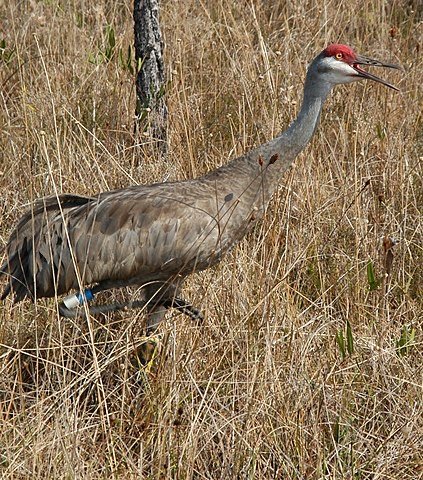
Sandhill cranes are tall, gray birds reaching heights up to 4 feet, weighing up to 12 pounds with a wingspan of 6 to 7 feet. They have two distinct features about them: one is their appearance of a crimson, red-crowned forehead, white cheeks and fluffy rear end; the other is when in flight, the long dark legs trail behind and the long neck is kept straight out, rather than tucked in toward the body.
(In Florida you can see them wandering around subdivision neighborhoods, sometimes with chicks in tow.)
Sandhill cranes mate for life, and families migrate together, often returning to the same vacation spot year after year.
Other facts about sandhill cranes:
• They live 20 to 30 years.
• They can fly 400 miles per day at altitudes of 10,000 feet.
• They are opportunistic fliers, relying on thermals and tail winds to carry them along.
• Their bills and feet are important tools. A crane’s bill is very sharp and sturdy, useful when probing frozen soil. The edges are serrated to grasp slippery food like worms and snakes. Not only is it used for preening, it is also used as a weapon.
• The feet and legs work in conjunction with the beak. The foot has three long toes with claws on the end. These claws are very sharp and can be used for scratching in dirt to find food and for protection. When a crane is threatened, it will use its wings to maintain its balance and then jump up and strike at the attacker with its feet.
• Birds nest in mid-May with two eggs per nest. Young fly at two months and stay with parents for one year.
• A Miocene era crane fossil, thought to be about 10 million years old, was found in Nebraska and is structurally identical to the modern sandhill crane, making it one of the oldest known bird species still surviving.
Evening presentations are offered at the state park to offer some education enrichment about the cranes.
For more information about the tours or registration, visit parks.ky.gov.


