



















(This article first appeared in the March print edition of the Hendersonian.)
Back in the old days the wrong way around a serious disagreement was to take it to the court system. A Southern gentleman was widely expected to defend his manhood on the field of honor in a duel.
Most people are probably aware of the archaic language in Kentucky’s official oath, which bars from office anyone participating in a duel. That usually prompts grins or snickers when officials are sworn in.
Kentucky first passed an anti-dueling law in 1799 but didn’t add it to the state constitution until 1850; the provision was carried over into the current 1891 constitution.
But we’re not alone. Alabama, Arkansas, South Carolina, Tennessee and West Virginia still carry anti-dueling language in their state constitutions. Mississippi didn’t remove that language from its constitution until 1978. Kentucky is the only state, however, that contains that prohibition in its oath of office.
Why put it in the constitution? “During Kentucky’s 1849 constitutional convention, as described by historian (Clayton) Cramer, delegate Elijah Nuttall argued that statutes requiring anti-dueling oaths were not effective because the legislature simply passed bills allowing duelers to hold office even if the oaths were broken.” But such bills could not get around a prohibition in the constitution, according to the April 8, 2025, issue of State Court Report.
The Southern planter class didn’t exactly encourage duels prior to the Civil War, but the general feeling was that a man could not allow his honor to be besmirched. U.S. Sen. Henry Clay, a veteran of two duels, in debating an 1838 anti-dueling law, said it would make no difference in the North, where dueling had fallen out of fashion, but Southern gentlemen would rather have a gun pointed at them than “the finger of scorn.”
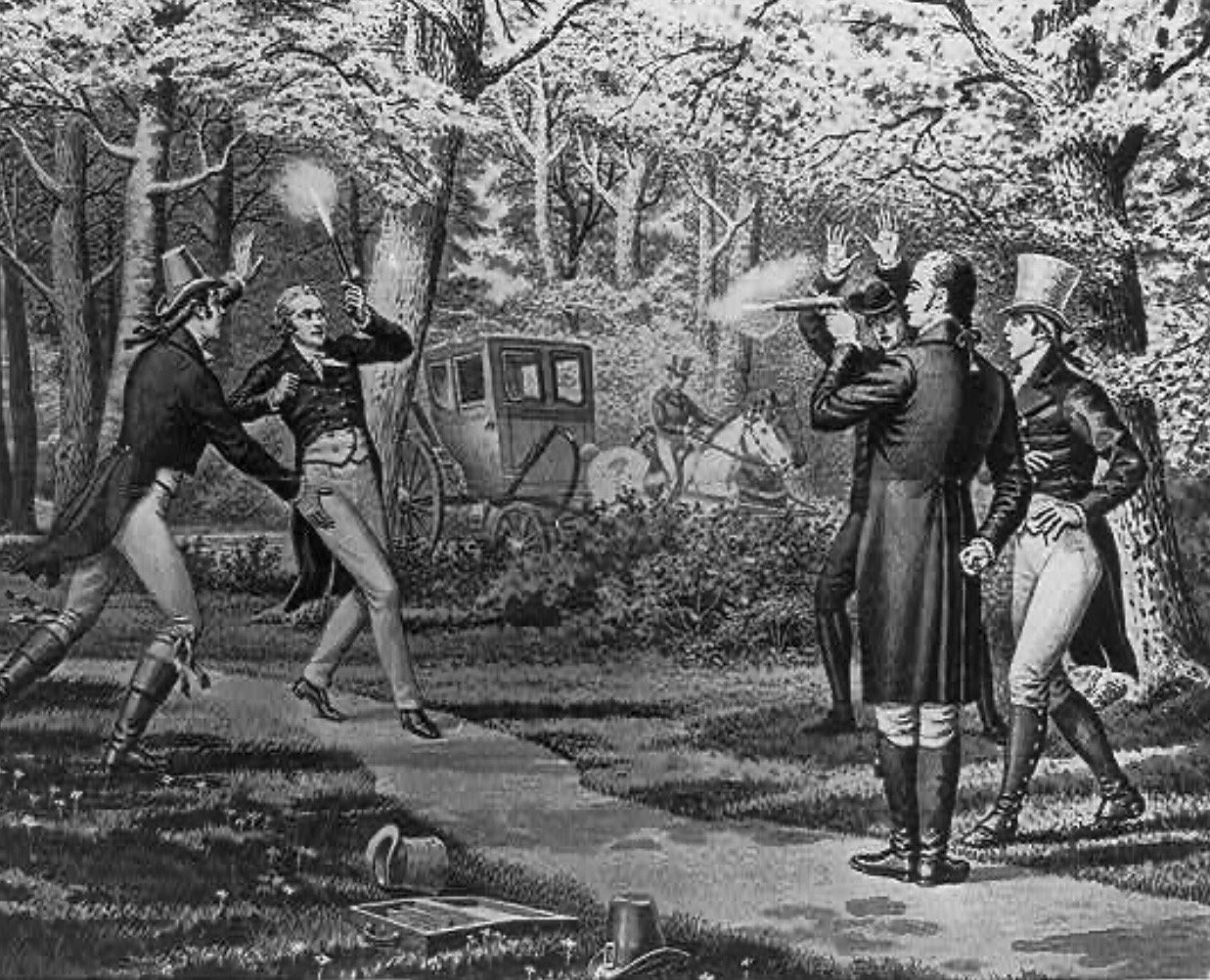
The most famous duel in American history, of course, occurred in 1804 when Vice President Aaron Burr shot and killed Alexander Hamilton, the nation’s first treasury secretary; Hamilton had said Burr was “a dangerous man, and one that ought not to be trusted.”
Few people, however, can name another famous duel, even though multiple public figures exchanged gunshots in the first half of the 1800s. Many of them were for relatively trivial reasons.
In 1806, President Andrew Jackson killed Charles Dickenson in one of the various duels he fought. President Abraham Lincoln narrowly averted a duel in 1842. In 1838, U.S. Rep. William Graves of Kentucky killed U.S. Rep. Jonathan Cilley of Maine; six witnesses were also congressmen.
Henderson County’s first brush with dueling, in 1810, received only a brief mention in E.L. Starling’s 1887 history of the county. Here is all Starling wrote: “William Allen enjoyed the distinction of being the first person indicted for sending a challenge to fight a duel.”
Court records reveal not only the indictment but also dueling lawsuits alleging slander. Allen’s antagonist was Lazarus W. Powell Sr., father of the man who was governor 1851-55. He had publicly accused Allen of having sex with one of his slaves.
Allen’s slander suit alleged Powell “openly and loudly” issued the following words, “Gentlemen, I will tell you that William Allen … was catched upon my negro woman.”
The court file contains depositions of two men from Robertson County, Tennessee, who corroborated Powell’s allegation of fornication and adultery in 1806-07.
Allen argued that he was a “good, true, faithful and honest subject of the commonwealth.” But on July 10, 1810, Allen asked the circuit court clerk to dismiss his slander suit against Powell.
The other slander lawsuit, filed by Powell, alleged Allen uttered “false, scandalous, malicious, and defamatory words” in that he accused him of rustling hogs and steers.
Powell won that slander suit in the October term of 1810 and Allen was required to pay him $465 – a respectable amount at the time.
The slander lawsuits apparently failed to resolve the men’s differences.
The commonwealth’s indictment against Allen for sending a challenge to duel came in October 1810, about the same time Powell won his slander lawsuit. It was quickly dismissed, however, and a charge of assault was filed against him. Prosecuting duelists for assault instead of for dueling was a common way to sidestep anti-dueling statutes.
The assault indictment was dismissed in the July 1811 term of court at the request of the commonwealth attorney, who “wholly refuses to prosecute” Allen.
Dueling incidents are often missing from the historical record because they were illegal. An article by David Strange that appeared in the Louisville Courier-Journal of Jan. 25, 2012, says, “In Kentucky alone, between 1790 and 1867, there were 41 recorded duels and probably many more unrecorded.”
None of those involved duels in the Henderson vicinity, Strange told me recently. My research, however, found two other local duels.
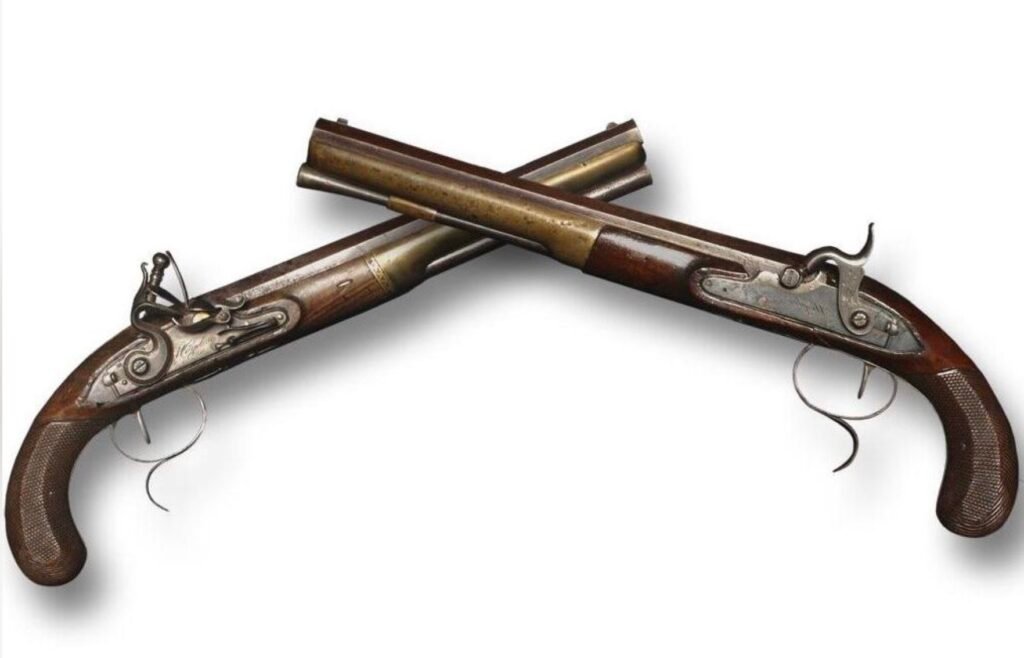
Henderson County’s second dueling incident took place on Diamond Island and it’s been written about extensively; many accounts say it involved the same pistols used in the Hamilton-Burr duel. But that’s easily disproved.
Neither Hamilton nor Burr owned the pistols used in that duel; they were owned by John Barker Church (Hamilton’s brother-in-law) and stayed in that family until 1930, when they were sold to Manhattan Bank — originally founded by Burr. They are currently owned by JPMorgan Chase & Co. and are seldom on public display.
But it seems clear the pistols used locally were once owned by Burr. All accounts say Capt. Samuel Goode Hopkins – eldest son of Gen. Samuel Hopkins, the county’s founder — bought them from Burr in the winter of 1813-14 for $500 in gold, carried them in the War of 1812, and later used one to kill a Spanish nobleman near New Madrid, Missouri.
They were made by H.W. Mortimore of London, the royal gunmaker, and have gold-lined priming pans and touch holes. “They are a bone-breaking brace of the first calibre,” according to multiple newspaper accounts. Most of those accounts say they were used by Hamilton and Burr, “which is a positive mistake,” according to the 1884 book “Field of Honor” by Benjamin Cummings Truman.
“The guns surely have a blood-stained history,” Truman wrote. “They have been used with fatal effect in 11 duels,” including a famous 1831 duel on “Bloody Island” near St. Louis in which U.S. Rep. Spencer Pettis of Missouri exchanged shots with Major Thomas Biddle because Biddle had called him “a bowl of skimmed milk.” Both men died.
The pistols were also used for the only duel in Daviess County, which occurred in February 1829. “Robert Triplett of Owensboro shot the old lawyer, Phil Thompson of that city, through and through with one of them but, strange to say, Thompson recovered and grew fat as a bear,” according to the Louisville Courier-Journal of April 14, 1883.
According to Truman, Hugh P. Brent of Henderson used one of Hopkins’ pistols to kill a man from Georgia named McCall in a duel on Diamond Island — but details are sparse.
Brent was a minor when his father died in 1816 and didn’t take over administration of the estate until 1821. That was probably when he turned 21. He died in early 1825, so the local duel probably occurred sometime between 1821 and 1825.
Brent was a gentleman. On Feb. 23, 1823, he bought two pairs of white silk gloves from a local merchant who later sued him. Also, the first administrator of his father’s estate had to post $10,000 bond – indicating considerable family wealth.
The only documentation for the last duel hereabouts I could find was a reprint from the Louisville Journal with a Henderson County dateline of March 31, 1848:
“Another ‘affair of honor’ took place nearly opposite of here on the Indiana side of the river. The parties were Dr. Griffing, of this state, and Mr. Ghilton of Louisiana.
“There were two rounds. In the first Ghilton wounded Griffing slightly on the front of the thigh, Griffing’s pistol not firing at all. In the second, Griffing’s ball took effect in Ghilton’s shoulder.
“Both being satisfied, they separated and soon left the state. The cause is said to be something Ghilton said against a lady, which Griffing resented.”
I suspect Henderson County saw other duels that have been lost in the mists of history. The Gleaner of Nov. 3, 1893, publicized an upcoming exhibit put together by Susan Starling Towles at the Henderson Female Seminary:
“The bravery of our grandsires will be attested by a number of weapons used in Indian, Revolutionary and latter-day warfare, to say nothing of … derringers, dirks, Bowies, and dueling pistols.”
Dueling was an effort to avoid feuds and was highly ritualized. Duelists had to mind their manners. The American version was based on the Irish Code Duello, which contained 25 rigid rules. Instead of just whipping out a sword or pistol, gentlemen were expected to follow an elaborate system that defined the insult, an exchange of letters either apologizing or explaining, the challenge to duel, acceptance, and arrangement of the duel.
Kentucky’s highest court, in 1909, clarified that not every fight was a duel. A duel, the court ruled, was “a combat with deadly weapons, fought according to the terms of precedent agreement and under certain or prescribed rules, prescribing the utmost formality and decorum.” Anything else was an “affray.”
Such as the combat involving Raymond Martin and Robert Rice, which appeared in the Evansville Journal of Oct. 8, 1894. The two Hebbardsville men agreed to use axes to settle their differences about a woman.
“They fought until Rice had both arms severed from his body and he fell dead. Martin received horrible gashes about the head and breast and is in a dying condition.”