












(This article first appeared in the January print edition of the Hendersonian.)
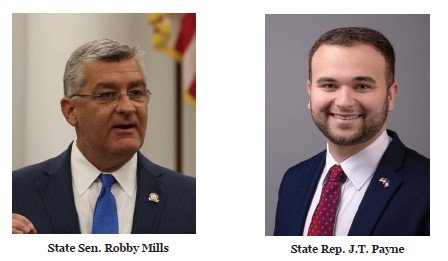
The priority for this year’s long session is to set a budget for state government spending the next two years. Local legislators, state Sen. Robby Mills and state Rep. J.T. Payne, both spoke to the Hendersonian in December about some of the initiatives they’ll be pursuing during the current General Assembly session which runs to April 15.
Mills said his number one goal to help Henderson County in the session is securing enough funding for the I-69 bridge which has “huge implications for northwest Kentucky for years to come.”
Right now, Mills said, the legislature has $452 million set aside to fund the construction of the bridge, termed section 2 of the Ohio River Crossing project. Estimates put the completion of section 2 at about $1 billion.

Both Indiana and Kentucky are contributing to the project, and currently Kentucky has more money set aside to get it done. The federal government could also give funding to the project, but currently that amount—if it is approved—is unknown.
Mills said a grant application is being evaluated at the federal level currently, and he’s hopeful that an announcement is made soon.
The state senator also wants the Watson Lane/U.S. 41 intersection project to begin this year. He said the project is currently being held up by some right-of-way concerns by residents along Watson Lane. It’s a $13 million project that will add lanes to Watson Lane intersection that should ease some of the turning problems there. He said he was told utility work on the project should start this spring.
Mills said because this project was approved in the 2023 budget session and construction has yet to begin, the price tag may go up. He said a priority this session is to watch the estimated costs and be sure that state money gets budgeted to cover additional costs, if they come.
“I want to be prepared for it so we’re not caught off guard,” he said.
The most recent cost estimate was $17.5 million
Mills said he’s also going to try to find funding for renovations at Henderson Community College’s library. He said the project is currently on the Kentucky Community and Technical College System’s list of priorities. It, however, is a bit down the list, which might make getting state funding difficult in this session. Mills said he’s going to try to get the project bumped up on the list. He said there hasn’t been any new construction on HCC’s campus for decades.
“I would say they’re due to have something new on their campus,” he said.
Mills also said he’ll try to get more funding for the Harbor House Men’s Christian Center’s expansion project.
Also on his to-do list is to increase the daily stipend per resident of personal care homes from $50 to $100. He said that might be done incrementally, up to $75 in the first year of the budget before $100 in the second year. This came about, in part, after the Hendersonian wrote several articles in 2025 about the poor conditions at Henderson Manor, which is a personal care home.
Mills also mentioned securing funding to complete construction of the Western Kentucky Police Training Center in Madisonville.
He will also ensure coal severance money is returned to counties. He said Henderson County could get $2 million in coal severance this year.
Mills, the co-chair of the state Housing Task Force, is also supporting legislation that would give local governments the ability to partner with developers to build housing more quickly.
Like Mills, Payne said he’ll be keeping his eyes on the Audubon conference center, the HCC library and funding for the I-69 bridge.
In general, he said that he’ll take a look at the state road plan and work to get as many Henderson County projects funded as possible.
Payne said he’s also looking at spinoff projects from I-69, including those that will be safety projects connected to the interstate. He said there will have to be new roads built because of I-69 in the future.
Payne, also the principal for Henderson County High School’s Career and Technical Education unit, said legislators will look at bills related to an expansion of Pre-Kindergarten education programs. Payne said the expansion might be a move to include children of families that fall in the salary range of 200-250% of the federal poverty rate, whereas the current cutoff for is at 160% of the federal poverty rate, Payne said.
He said there will also be some discussion about childcare, and regulating these centers. There could be some proposals to incentivize employers to provide childcare facilities at places of work, he said.
Payne said he’s personally working on a K-12 school accountability system, and he’s interested in exploring laws related to farmland protection.


