


















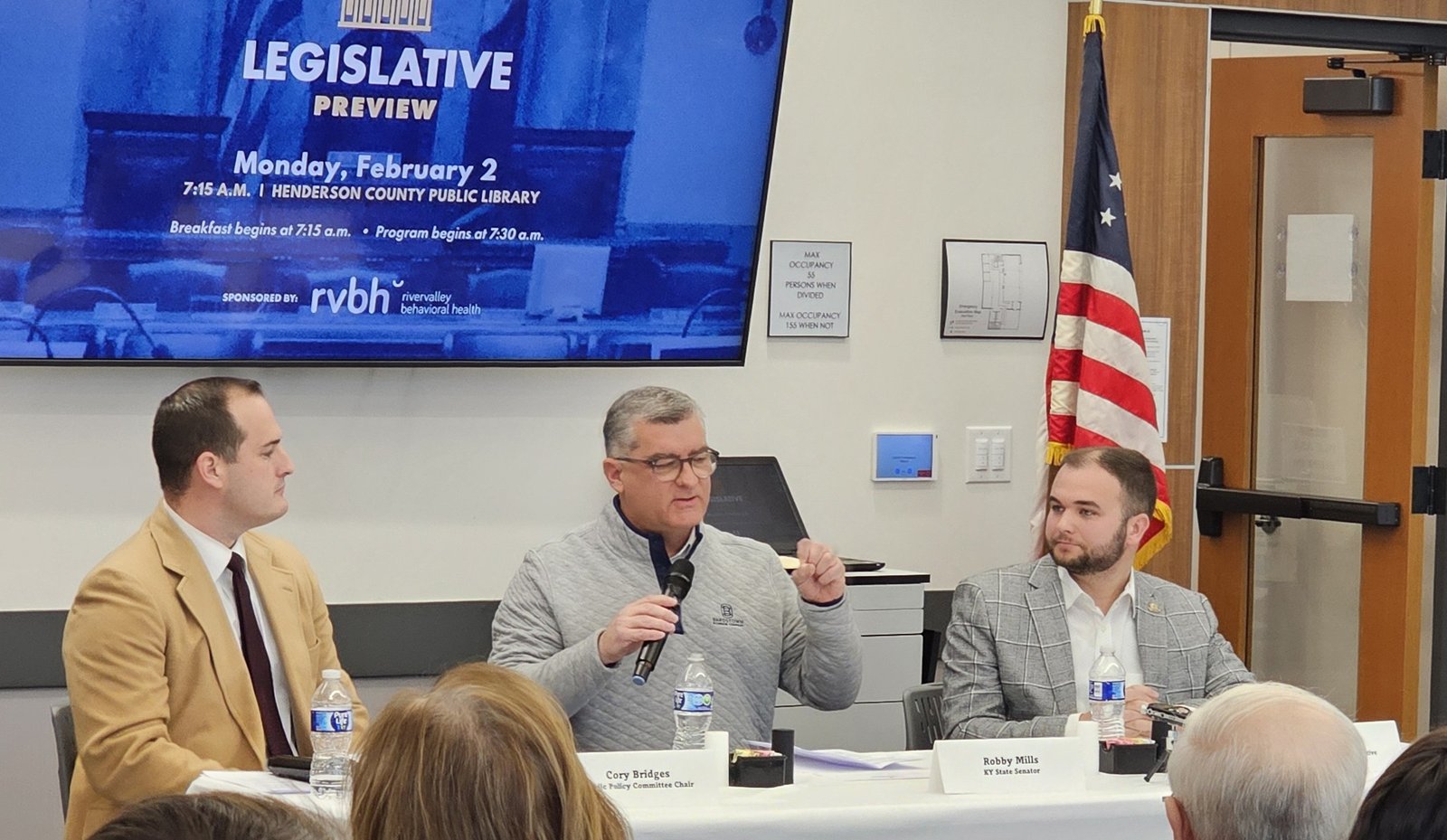
Henderson’s state legislators provided an overview of some of the work they’re doing in the current state General Assembly at the Chamber of Commerce’s Legislative Preview Monday morning, answering questions about affordable housing, energy, childcare and Pre-K for all, I-69 bridge funding, and Healthcare, particularly how the state will fund future cuts to Medicaid.
Medicaid
State Rep. J.T. Payne said the legislature’s priority in funding Medicaid is first improving the efficiency and transparency of the program at the state level. He said a recent audit revealed that there was some $800 million of abuse in the system.
State Sen. Robby Mills agreed that this year the General Assembly will need to improve the efficiency and transparency of the system. He said in year two and year three—when cuts start to come down from the federal government—the General Assembly will need to fill in the gaps.
Mills told the Hendersonian after the preview that there’s not a firm amount—he’s hearing high and low ranges—and legislators are attempting to conserve money in the budget surplus to prepare for what’s coming down next year.
Payne said Medicaid is the second-largest state budget item with 1/3 of all Kentuckians enrolled in the program.
Affordable housing
Mills, a co-chair of the committee Kentucky Housing Task Force, has been working on housing throughout the year leading up to this year’s General Assembly. On Monday morning, he was preparing to file Senate Bill 9 later that afternoon in Frankfort and hold a press conference about it after.
Mills said he hopes the bill can get developers off the sidelines and back into the game by providing incentives to build, Mills said.
According to a release from Mills later in the day, the legislation allows cities and counties to create Residential Infrastructure Development Districts and Housing Development Districts.
Residential Infrastructure Development Districts would allow infrastructure costs to be financed over time rather than forcing those costs upfront, said the release. That infrastructure includes roads, curbs and gutters, and electrical, gas and water lines. The release said these districts “can significantly lower the price of housing and accelerate construction.”
Housing Development Districts allow local governments to partner with developers on qualifying residential projects of at least 15 units up to 1,000 acres. Mills said these districts allow local governments to offer a percentage—or all—of property taxes of a development to the builder or contractor for up to seven years. The release also said that incentive payments can be awarded for up to 15 years for projects focused on revitalizing existing structures.
He said the optional program allows local governments to set an agreeable percentage—up to 100%—with builders or contractors.
Area development districts would administer the program at a local government’s request, according to the release.
Mills said the state currently needs 206,000 housing units and that number could increase to 300,000 in the next several years if something isn’t done.
Energy
Mills said one of the biggest policy issues in this year’s General Assembly relates to energy, and much of the debate focuses on Artificial Intelligence and a need for a large amount of energy so that it can operate. That need is often handled by data centers, and Mills believes that the state can handle three, four or five large-scale data centers—if they are implemented right.
Payne said that the state has received building requests that need 8.5 gigawatts of energy. Of that, he said, 2/3 are for AI data centers. Payne said that for the first time in the state’s history, less than half of the land is used for food production, and added that Kentucky has lost 1.4 million acres of farmland in the past 20 years.
When looking to add energy production, Payne said, “I think it’s important that we don’t trade one crisis for another.”
Mills is an advocate of using fossil fuels to provide for a utility’s baseload capacity.
I-69 bridge funding
Both Mills and Payne are in favor of keeping both the U.S. 41 Twin Bridges open once the I-69 bridge is complete, Payne said.
Mills said that Kentucky still needs $40-$50 million for the state to have in place its half to build the I-69 bridge. He said Indiana hasn’t secured its half of the almost $1 billion project yet. Indiana has submitted an application for funding to the Federal Highway Administration, he said.
Mills called the I-69 bridge, which has a completion date of 2030 or 2031, a “generational project.”
“I do think it’s going to be a boon” not only for the Henderson area but western Kentucky, Mills said.
Childcare and Pre-K for all
Payne said Pre-Kindergarten for all of Kentucky’s children—a universal Pre-K—is not something either party is considering currently. But he what he termed “Pre-K for some more” is on the table.
He said he’s had meetings with the governor’s office staff and said an increase of the threshold of what allows a child to take part in Pre-K is being discussed. Currently, the level of a family’s income to be eligible for Pre-K is set at 160% of the federal poverty rate, which Payne said equates to about $52,000 per family. He said there have been discussions of upping that to 200% of the federal poverty rate, which is around $65,000 per family and would allow more children to be eligible.
Payne said it’s important that an expanded program can first be paid for by the state and that it is also high-quality. He said that high-quality Pre-K programs improve the academic performance of students, but at least one study details how students who participated in a poor-quality Pre-K program ended up doing worse than those who did not have any Pre-K.
Tax reform
Both said they favor a methodical approach to lowering the income tax rate in the state. It currently sits at 3 ½%, down from 6% when the tax reform law was initiated. Payne said it doesn’t appear that the triggers were met this past fiscal year for another half-percentage point reduction to occur. Mills, though, said indicators show that next year another half-percentage point decrease in income tax will occur.
Special projects
Payne said he’s been working on House Bill 257, which is an education piece of legislation that addresses schools’ assessment and accountability. Among other pieces of the bill, it improves community input in education and includes an attendance component, Payne said.
“It’s the biggest (bill) I’m personally working on,” Payne said.
Mills said he’s working on housing bills that will come from the work of the state housing task force. He’s also keeping an eye on funding for local projects, which include the conference center at Audubon State Park and the road and intersection project along Watson Lane and at its intersection with U.S. 41.
The budget
This year’s General Assembly is focused on the state’s budget for the next two years. The budget always starts in the House of Representatives, and Payne said the session’s budget bills include a 4% reduction in baseline spending as a starting point. He said it’s a call for the executive branch to look at the bills and find spending that was added years ago and is not needed now. He also said HB 500 includes a 2% salary increase for all state employees and fully funds the state pension system.
Mills, the Senate majority caucus chair, said Republican leaders will get the baseline budget in two to three weeks and most likely hold off on a vote till late March. He said the last week of the session will involve legislative power plays as lawmakers look to get their priorities included in the budget.

