














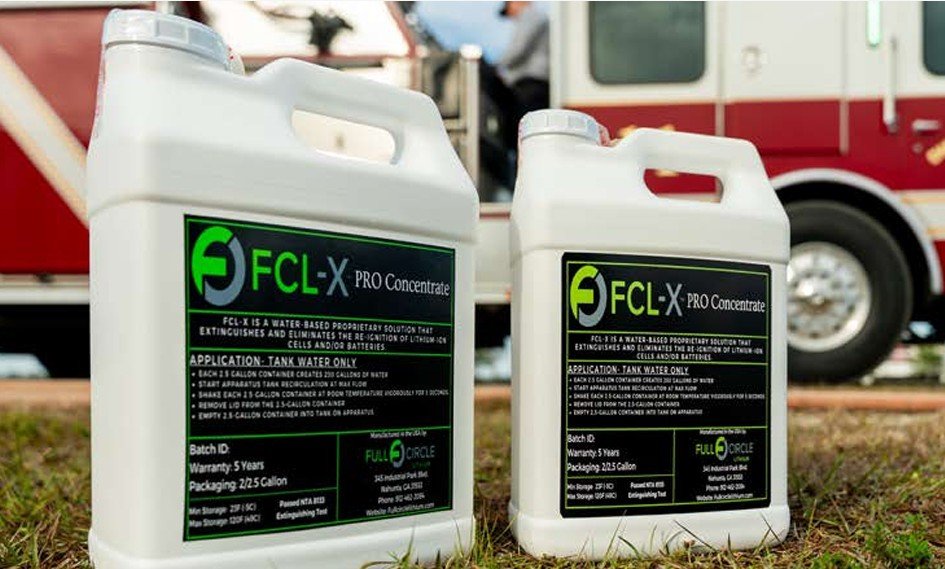
Officials say a new solution delivered recently to the Robards Volunteer Fire Department will be a “game-changer” when dealing with electrical fires that could occur at the fields of solar panels that surround the community, and it could end up being a part of changes to the county’s ordinance regarding battery energy storage systems.
The compound, called FCL-X, is a product from Georgia company Full Circle Lithium and sold by local supplier Howell Rescue Systems, and according to officials at the Dec. 23 Henderson County Fiscal Court meeting, it can—very quickly—extinguish an electrical, or a lithium-ion battery, fire.
Magistrate Taylor Tompkins said at the meeting and also during a recent brief interview that he watched a video of a fire that was burning at 1,300 degrees and after the solution, which is mixed with water on tanker trucks, was sprayed, the temperature fell to 87 degrees in 90 seconds.

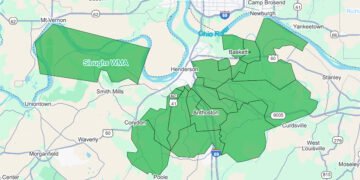
That’s particularly important for the Robards area where thousands of acres of solar panels stretch across the landscape.
Tompkins, the district 2 magistrate, of which Robards belongs, called the solution a “game-changer.”
The Robards Fire Department already used the solution at an inverter fire in September, which Chief David Denton said knocked down that fire.
Now Denton said a large shipment of the compound arrived in Robards on Friday. The department received ten cases each containing two jugs. He said one jug treats 250 gallons of water.
Tompkins said the supply was paid for by Moss Contracting, a construction group that is a subcontractor of NextEra Energy, one of two solar companies in the area.
FCL-X is also important as local government officials begin the process of working on text amendments to a battery energy storage system ordinance. The fiscal court at the Dec. 23 meeting approved starting the process of putting in place a one-year moratorium on any new applications for BESS, with one reason given that it will give officials—and residents—time to work on text amendments to the BESS ordinance.
“This (FCL-X) will definitely be a part of the discussion,” Tompkins said. “Now we are able to handle a thermal event safely, should it occur.”
That was echoed by both Denton and Niagara Fire Department Chief Glenn Powell, who were at the Dec. 23 fiscal court meeting to discuss FCL-X. Powell said that when discussions about BESS in the county first started about two years ago, he didn’t think local fire departments could handle a fire at a BESS.
Numerous past examples throughout the United States and the world show some fires at BESS that—because of their chemical make-up—cannot be extinguished with water. Some, called thermal runaway events, burn for extended periods—days or weeks.
But now with this product, “I am convinced we can handle a BESS fire,” Glenn Powell said.
Airline Road resident Deirdre McConathy has been pushing for a more thorough BESS ordinance with better protections since the county’s ordinance was put in place in 2024. The family farm on which she lives abuts a parcel of land that until mid-December had been the site of a proposed BESS. (The proposal was withdrawn then.)
When the fiscal court approved beginning the process of a one-year BESS moratorium in December–which McConathy also pushed for–she commented that it would give her time to do research to make suggestions for changes to the current BESS ordinance.
McConathy last week said she will look into FCL-X as it relates to the safety and suggestions she proposes in the BESS ordinance amendments.
“It requires investigation to see how it could be applied to the ordinance,” she said.
Mitch Powell, a regional sales manager for Howell Rescue Systems, said FCL-X works because it causes a chemical chain reaction that leads to heat absorption and dispersion. The compound works because of the “rapid amount of cooling” that takes place once it’s sprayed on a fire. Basically, he said, once sprayed, it removes heat so fast that the fire can’t keep up.
And it’s not just for lithium-ion or electrical fires, he said; FCL-X can be used—and works—for any type of fire.
For “any kind of fire, it’s going to be beneficial,” Mitch Powell said.
Additionally, Mitch Powell said that the compound has undergone LC50 tests, which are used to determine the toxicity of a chemical and are used to determine the harm to living organisms. He said the tests, conducted by universities in Georgia, North Carolina and South Carolina, revealed that “there are no negative effects.”
Update: The shipment that came to Robards Fire Department involved ten cases and each contained two jugs of FCL-X, said Denton. The Hendersonian previously reported that a case contained 20 jugs.


