












Henderson Water Utility hosted local, state and national politicians Thursday for an announcement of $2 million funding for a project that will install pipeline and an intake structure to pump water from the Green River to HWU’s South Water Treatment Plant.
Thursday’s $2 million announcement was buoyed by the politicians who helped secure them.
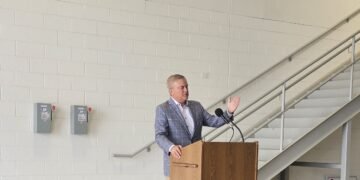
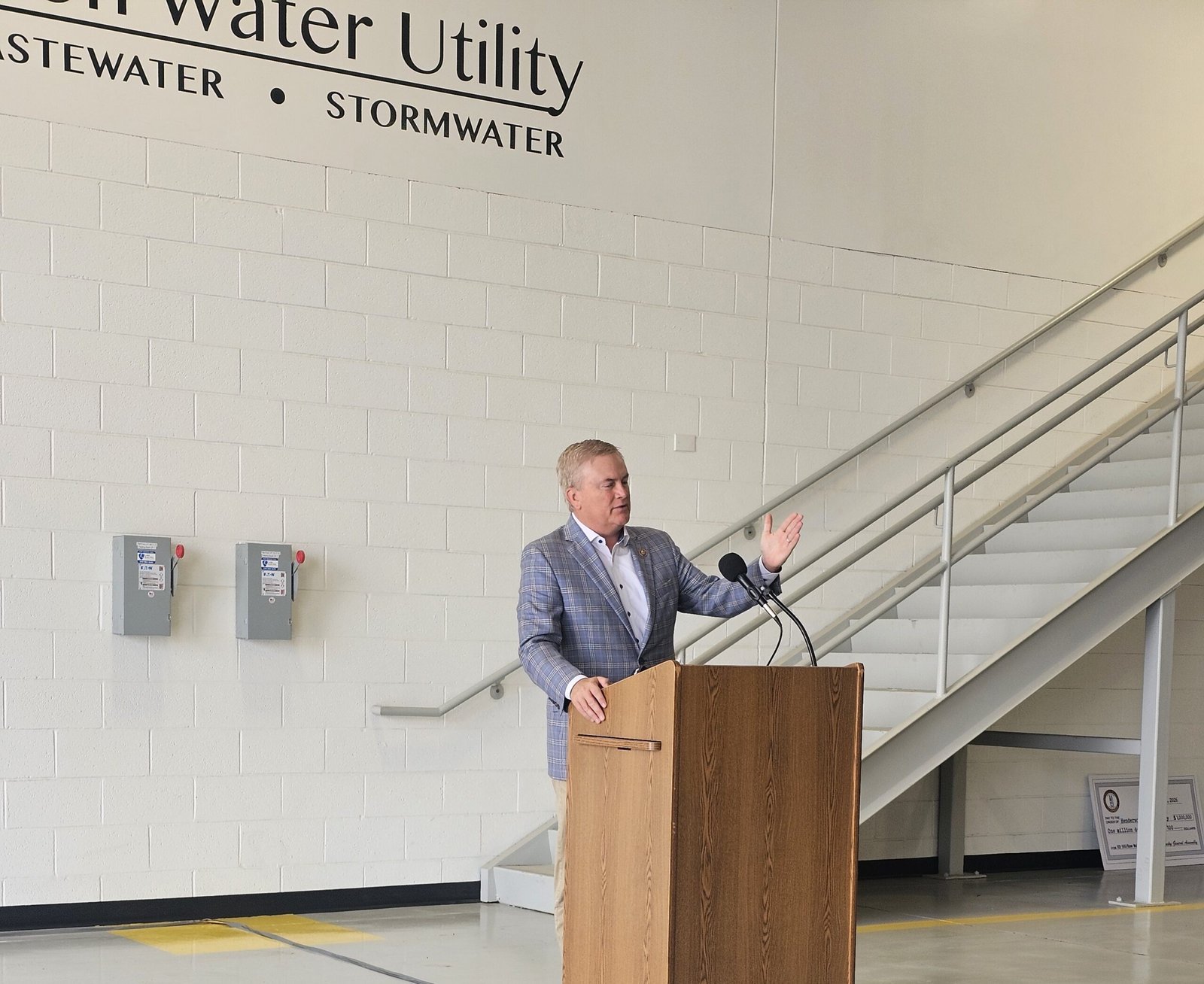
U.S. Rep. Jamie Comer was the featured speaker of the announcement Thursday morning at the Commonwealth Drive HWU office. Comer spoke about the $1 million in federal funding for the project, saying he chose this project for one of about 12 community funding projects each year in his district.
Henderson state Rep. J.T. Payne worked to get the $1 million state funding included in House Bill 900, which entails all the one-time funding projects that the General Assembly approved in last spring’s budget session.

Comer applauded Henderson and called this community one that is attracting attention and investment. He also mentioned pro-business and pro-growth policies that he hopes can help grow Kentucky.
“I think we’ve got the ability in the future to really move Kentucky forward, and Henderson is a big part of this,” he said.
Though Comer is running for another term as Kentucky’s district 1 representative, both Payne and state Sen. Robby Mills hinted they’d like him to be Kentucky’s next governor. That election is in 2027. Comer made no mention of a gubernatorial run on Thursday.
He did speak of other local economic issues, including securing funding to finish the I-69 bridge. He said he recently spent 30 minutes with President Donald Trump in the Oval Office, and informed the president that I-69 was his top priority infrastructure project in the state.
“He was very receptive to that,” Comer said.

Speaking on the HWU South Water Treatment Plant project, Comer said one of his interests in it involved the water that the plant will continue to supply to Tyson Foods in Robards. Comer said that young people interested in farming, who weren’t raised on a farm or inherited land, have difficulties getting into the profession. But one of the ways young farmers without land have been able to start a career in agriculture is via poultry.
“It’s been a huge success for young farmers,” he said.
Payne said the project may not be as “flashy” as some higher profile projects, but it’s necessary for industry already in the county and for attracting more. He said industries locate in communities with stable water resources and utilities.
An upgraded plant may also be one key in bringing new industry to the 4 Star Industrial Park, said Henderson County Judge-Executive Brad Schneider.
Developing the industrial park has been a push by local leaders, including Schneider and Henderson Economic Development, the past couple years, especially in light of the one million square foot build-ready pad located in the park.
Henderson Mayor Brad Staton acknowledged the city’s strong relationship with the state and federal legislators and the collaboration that has occurred on I-69 and the possibility of continued cooperation on the Loop Road, a proposed street that could start behind Walmart, before moving to I-69 where it would parallel the interstate for 1 ½ miles and then loop back to U.S. 60 at Wathen Lane.
In addition to the $2 million announced Thursday, Boles said the 4 Star Industrial Park board has approved a $1 million grant for the project. That money needs to be approved by the state Department of Local Government, Boles said. Those monies will be used for phase 1, Boles said.
He said he hopes to start on the first phase in 12-18 months and have the entire project completed in 4-5 years.
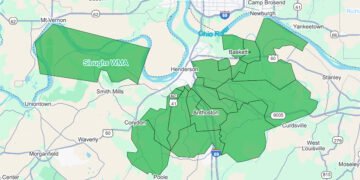
The first phase includes installing about 3,000 feet of pipeline from the Green River to the South Water Treatment plant, said a release from the City of Henderson.
The second phase, according to Boles, will be to build the structure that pumps the source water from the Green River to the plant. The cost associated with that is $5 million.
Currently, HWU is working with the Green River Area Development District to write state and federal grants for this second phase of the project. The final phase will be to install a power line—built by Kenergy—to provide energy to the structure. Boles said that will cost about $500,000.

