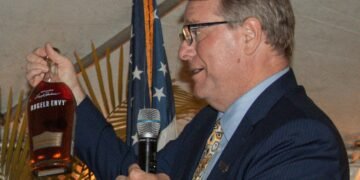

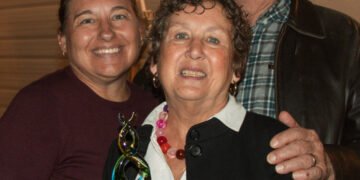













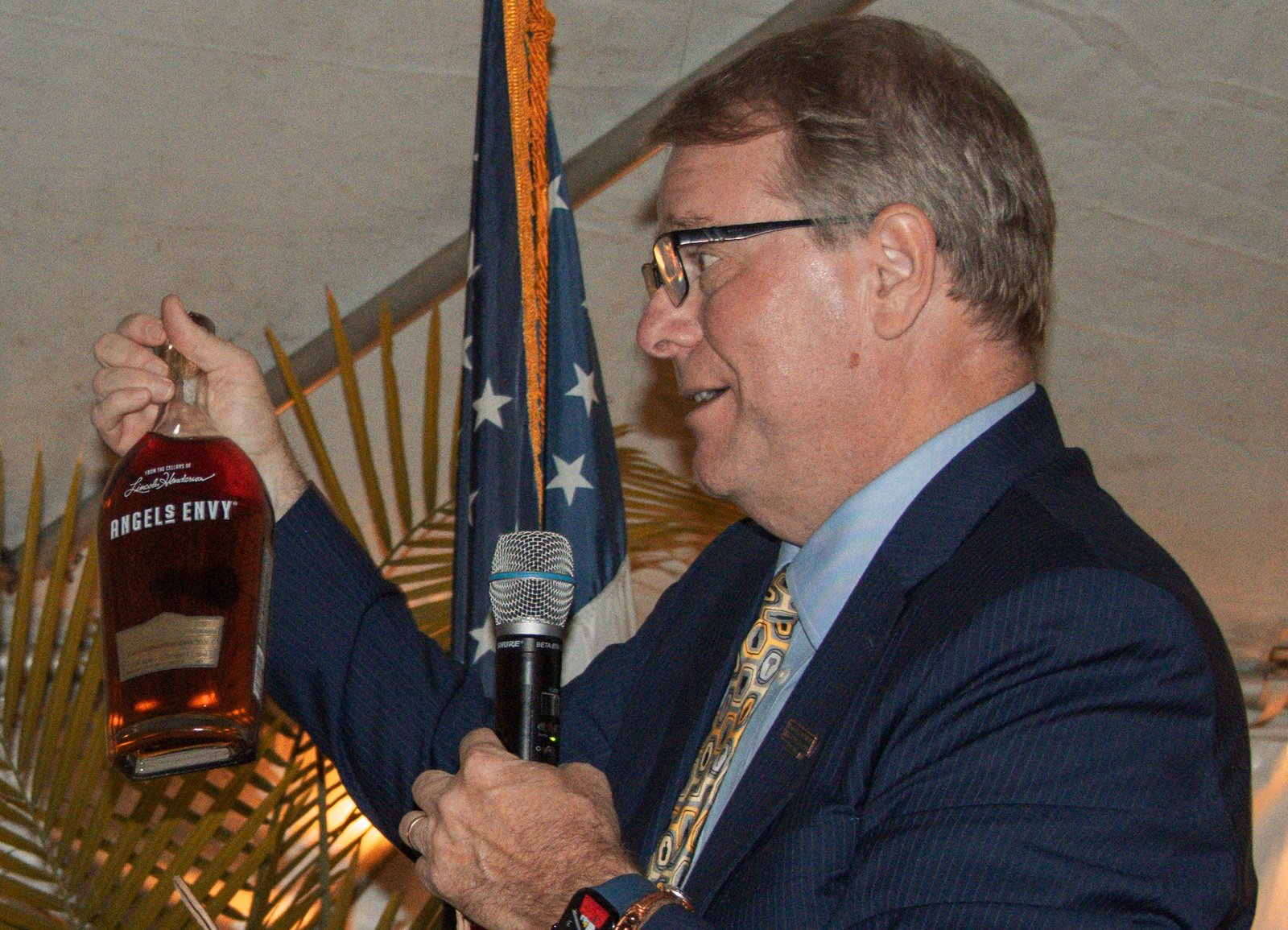
At the Henderson Chamber of Commerce Annual Dinner on Monday night held at the soon-to-open Rhythm River distillery on North Main Street, outgoing board chair Kelsey Hargis noted “the revival of bourbon in Henderson after more than a century.”
Indeed, not only will Rhythm River conduct its grand opening on the morning of Saturday, Nov. 14, but the Hargis family rebooted Henderson’s former Silk Velvet brand two years ago to considerable acclaim beyond this city.
On Monday, the man who lit the fuse on the rocket that is the Kentucky Bourbon Trail said Henderson will benefit from them both.
“Bourbon is going to help build your community, not only through tourism” — Rhythm River will be a member of the Kentucky Bourbon Trail, a marketing tool that will funnel visitors into Henderson — “but economic development,” Henderson native Eric Gregory, longtime president of the Kentucky Distillers’ Association, said in his keynote remarks at the annual dinner.
Statewide, he said, distilling is a $10.6 billion industry supporting 24,000 jobs at 139 licensed distilleries, with salaries and benefits totaling some $2 billion.
The opening of Rhythm River and the relaunch of Silk Velvet resumes a distilling tradition here.
“Henderson was a much bigger whiskey town than most people realize,” largely because most of its distilling tradition took place well before Prohibition, Gregory said.
Distilling here began in the early 1800s with Melton’s Kettle producing small amounts of apple and peach brandy each year.
Later, D.R. Burbank became the first large distiller, producing 627 gallons (about 10 to 12 barrels) of whiskey a day.
Others followed, culminating with the former Kentucky Peerless Distillery and the former Hill & Winstead Distillery, which produced nationally recognized Kentucky Peerless and Silk Velvet whiskey in the late 19th and early 20th century.
Today, former Hendersonians produce bourbon and rye at distilleries, including Corky Taylor’s reborn Kentucky Peerless Distillery in Louisville and Walter Zausch’s Whiskey Thief distillery outside Frankfort.
Gregory recited whiskey distilling’s broad impact, from the $372 million distilleries pay in state and local taxes annually to their $2 billion in federal excise taxes to their purchase of 10% of all corn produced in Kentucky.
He acknowledged that spirits are facing some headwinds these days.
Sales of whiskey have declined in recent years from factors ranging from young adults drinking less alcohol to President Trump’s tariffs having a chilling effect on vital exports.
“Canada was the No. 1 export country” for Kentucky bourbon before tariffs, Gregory said. “It’s basically fallen off to zero.”
“We do not like tariffs,” he said.
Tariffs have even hurt sales of used Kentucky bourbon barrels, which by law can be used only once for aging bourbon but are purchased by distillers of Scotch, Irish whiskey and other spirits overseas for aging their own products. Sales of used bourbon barrels once amounted to $400 million per year, but are now down 31%, Gregory said.
Spirits also compete with other recreational pursuits—such as video streaming, sports betting and online gaming—for consumer dollars.
Despite the challenges, Gregory is bullish on bourbon, long term.
“We’ve been through everything you can throw at us, including Prohibition,” he said. “No matter the challenges, no matter the tariffs … we’ve survived everything and come out stronger on the other side.”
There is also good news for Rhythm River and other distilleries that host visitors.
“We have not seen any impacts on the Kentucky Bourbon Trail,” Gregory said.
That’s great for distilling communities because he said bourbon trail tourists rival those in Napa Valley’s wine country, with the majority reporting incomes of $100,000 or more per year—making them ideal visitors for local hotels and restaurants.
And he said 80% of bourbon trail visitors come from outside Kentucky, effectively importing wealth.
Meanwhile, Gregory shared fond memories of growing up in Henderson (“There’s no place like home,” he remarked) and working with his two older sisters at their family’s Dixie Mart grocery on outer Clay Street.
He spoke warmly of their parents, Wayne and “Tootsie” Gregory, and recalled how his grandmother Sarah Gregory would produce 70 pies and cakes a day for the grocery.
After an award-winning career as a newspaper reporter in Lexington and Honolulu, Gregory went on to stints in public relations and governmental affairs before landing his current position with the Kentucky Distillers’ Association 19 years ago.
Under his leadership, the KDA’s Kentucky Bourbon Trail has grown from a handful of distilleries drawing thousands of visitors per year to 46 destinations that attracted 2.7 million visitors last year.
In September, he was inducted into the Kentucky Bourbon Hall of Fame, receiving the first Parker Beam Lifetime Achievement Award presented to someone who isn’t a distiller.
Gregory credits what he calls his “idyllic” years growing up here.
“Henderson made me the person I am today,” he said.