



















It was the second of seven scheduled public hearings to gather information to write a WECS ordinance
There was much to take in and digest at Wednesday’s Henderson City-County Planning Commission public hearing, the second of seven public hearings scheduled for the purpose of gathering data and hearing public comment with the intent to eventually writing an ordinance for wind energy conversion systems which will be sent to the Henderson Fiscal Court.
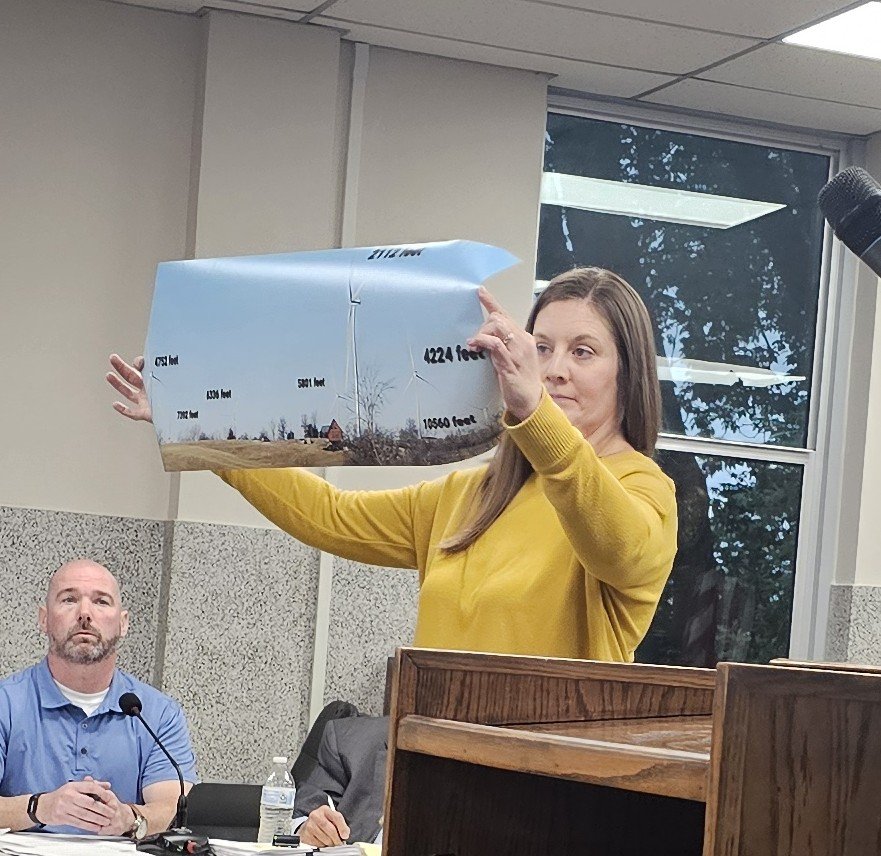
In between the loads of data, the planning commission heard personal stories of living in the middle of a wind farm, and both of the women who drove from Missouri offered bleak pictures of a homeowner’s quality of life with wind turbines nearby.
Additionally, planning commission staff gave its recommendation to the planning commission. In a summary of a report created by the staff and read by Executive Director Brian Bishop, it was recommended that sound levels measured at nonparticipating structures—those whose owners didn’t sign a lease to locate a wind turbine on their land—not to exceed 35 decibels.
And the staff recommended a setback of at least one mile or ten times the diameter of rotor diameter between a wind turbine and a nonparticipating occupied structure. This recommendation pertained to shadow flicker, which is a sort of pulsing, or flicker, of a shadow that can occur when the blade of a wind turbine cuts between the light from the sun and a structure.

The staff report stated that the recommendations are “more protective than some jurisdictions but not extreme outliers.”
Nakila Blessing, one of two who traveled from Missouri, agreed with the 35-decibel level recorded at a house but said the distance from a nonparticipating structure should be at least 1 ½ miles.
She said these are regulations that will work for the community but not for the developer.
Both Blessing and Carrie March came from the Schuyler County, Missouri, area, where High Prairie Wind Farm has been in operation since December 2020.
Blessing said she lives 3,400 feet from a wind turbine.
“The project has been life altering,” she said.
She said the 499-foot-tall turbines produce at times an 80 decibels noise level that she has measured from her back deck. Inside her house, her family can hear the turbines, especially nights and mornings, and vibrations shake her walls, she said.
March said the closest turbine to what used to be her home was 2,120 feet away and said the decibel levels were in the 70s. The noise “controlled what we did and when we did it,” she said. She and her family have moved to a different nearby county to get away from the wind turbines.
Industry experts also testified about the noise, vibration and shadow flicker. These experts were hired by the planning commission staff under direction from the Henderson Fiscal Court, and the attempt was made by planning commission staff to find experts who would provide unbiased information.
Kevin Lasher, with Morley & Associates, spoke about shadow flicker and vibration and made some similar recommendations as other presenters, such as not allowing an occupied structure within ten times of the rotor diameter. If that occurs, the effects of shadow flicker “negligible,” he said.
He also said it’s widely accepted that there are no negative health effects for people who live within that distance, a claim that was disputed by other speakers.
Another study Lasher cited said that vibration effects are generally not perceptible to humans. Again, attendees of Wednesday’s meeting disputed that, including Blessing’s account of her home’s walls shaking.
Acoustic engineer Mike Hankard, of Hankard Environmental, recommended the decibel limit to be 45. He also said that low frequency noise does not shake windows when the setback is 1,500-2,000 feet or more. For perspective, Hankard described what some decibel readings would sound like—a 50 decibel reading is akin to a road nearby, the wind blowing, or a neighbor mowing grass; 60 decibel reading is bad; and 80 decibel reading is hearing loss material.
For most of the second part of the meeting, representatives of The Henderson KY Responsible Land Use Coalition, presented their findings, which included research primarily done by Robards resident Melody Thompson, she said. Thompson said that there is a potential disconnect between modeling sound and what is actually experienced by people inside their homes.
The group also spoke about low frequency sound. Presenter Rick Thompson said low frequency sound from wind turbines can travel long distances and then penetrate residences. And human response varies, with those with more sensitive hearing perhaps having more problems, he said. Rick Thompson also said that compliance with set standards does not guarantee that individuals will not be impacted.
Presenter Kelly England said that shadow flicker can cause headaches, nausea, difficulty concentrating and neurological response, and modeling does not take into account resident occupancy, window placement and the way the resident uses a home.
Low frequency sound, or infrasound, according to information presented by Dr. James England, can interact with the structures of a human’s inner ear and cause sleep disturbance, headaches and dizziness. He also said that standard measurements may not capture low frequency sound.
Melody Thompson, in a final statement, reiterated that modeled compliance does not equal “real world conditions.”
Pattern Energy recently merged with Cordelio Power, a company that had been pursuing a wind farm in eastern Henderson County called Rock Bluff Energy Park. Pattern officials were not present at Wednesday’s meeting but submitted a report to be entered into the public record.
The nearly three-hour public hearing was the second of seven scheduled meetings used to gather information and hear public testimony before the planning commission writes an ordinance regarding wind energy conversion systems. That ordinance will then be sent to the Henderson Fiscal Court, which can approve it, decline it or send it back to the planning commission for further work.
Holding the meetings, gathering the information and then writing an ordinance comes to the planning commission as a directive from the fiscal court.
The next WECS public hearing will be 6 p.m. Wednesday, July 15, in the Fiscal Court courtroom. The topic of that hearing will be environmental and ecological impacts.

