

















Meanwhile, those opposed to a wind farm project locating here want more answers
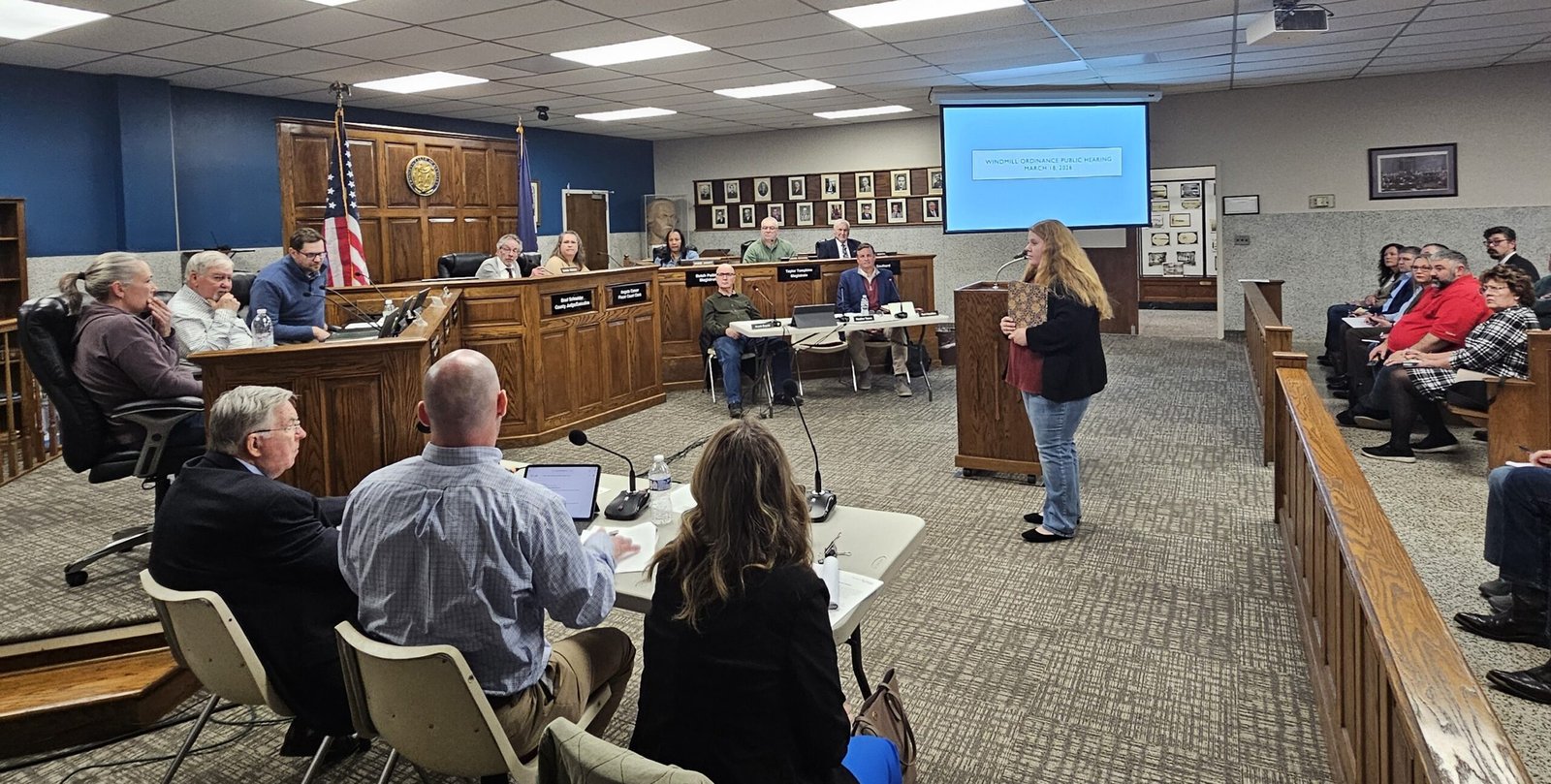
Wednesday night’s first public hearing in what is scheduled to be a series of meetings used to collect data to form a county ordinance for wind energy conversion systems offered some surprises, none more interesting than recommendations the Henderson City-County Planning Commission staff made for the ordinance.
It also offered a bit of contention, as both the planning commission’s attorney and members of the public asked questions of representatives of the Rock Bluff Energy Project that that they said can’t be answered yet.
At the start of what turned out to be a more-than three-hour public hearing, planning commission Executive Director Brian Bishop presented the staff recommendations, which began with the suggestion of a maximum height of 200 feet with the possibility of a variance to go higher than that in limited circumstances.
This recommendation, according to the staff’s executive summary, is in line with the current county ordinance that doesn’t allow a structure higher than 200 feet.
The recommendations also include:
- Only allowing commercial WECS on land zoned heavy industrial
- A minimum one-mile setback from occupied structures, rivers, wildlife refuges, publicly-owned nature reserves, dedicated natural areas, similar protected conservation lands and possibly others identified during the public hearing process
- A setback of 1,640 feet of 1 ½ times the turbine height or the ice throw distance plus 250 feet (whichever is greater) from property lines, public roads, above-ground-utilities, transmission facilities private access easements or driveways serving non-participant properties and occupied structures that have entered into waiver agreements waiving the one-mile setback.
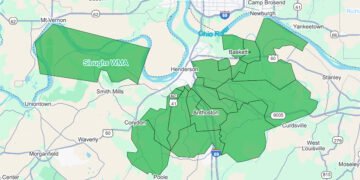
Another piece of the recommendation stated that lands in the current Surface Mining District—12,000,-13,000 acres of Penn Virginia land are planned as part of the project—“cannot be amended to accommodate WECS.”
These are main recommendations contained in the nine-page document, which also lists justifications from the county’s current ordinances and other sources, including ordinances from other jurisdictions. Read it here.
The recommendations caught representatives of Cordelio Energy off guard. They said they had not had a chance to review these recommendations before the meeting and so their responses were limited.
Greg Dutton, a Louisville attorney representing Cordelio and the planned Rock Bluff Energy Park, first responded to the staff recommendations, saying it was difficult to form a response because he hadn’t seen these before the meeting and rebutted the statement that surface mining land can’t be used for WECS.
“That kind of area is perfect for that kind of development,” he said.
(On a side note, Cordelio is currently being acquired by San Francisco-based Pattern Energy.)
Additionally, Tim Vought, Cordelio’s vice president for development, said he couldn’t think of any wind turbine developments that have been built with a one-mile setback regulation in place. He also said the project would request to be approved for construction in land zoned agricultural.
Later in the meeting, Dutton said project representatives had done some quick research during the meeting and found that there were no wind farms in the United States that had the height and setback restrictions placed on them that the local planning commission staff recommend.
“We’re looking for a process to bring a viable project before you,” Dutton said. He added that with the staff-recommended height and setback requirements, “There’s no roadmap in the United States for a project that can financially be constructed with those parameters.”
Vought said that project representatives are looking for an ordinance very with clear expectations and standards so that they can verify “set-by-step, line item-by-line item” every piece of it, and if that is done, an approval will be granted.
This, however, was a point of disagreement coming from Planning Commission Attorney Tommy Joe Fridy, who likened that request to a “chicken or the egg” situation. During a discussion of the total land area that the project will encompass, Fridy asked if Vought can provide a map of the planned project.
Vought said he couldn’t do that yet because without specific regulations to follow, project representatives have no way to know where exactly turbines can be located. Dutton said that having an ordinance in place would allow project representatives to choose locations and conduct required testing at those locations, but without an ordinance to do that, it’s “effectively a guess.”
Fridy said that response frustrates both the planning commission and the public, saying it would be “difficult if not impossible” for the planning commission to make a recommendation to Henderson County Fiscal Court without that information.
“You want us to give you an ordinance without giving us any information,” Fridy said.
There were other instances throughout the meeting when project representatives said they wouldn’t have answers until an ordinance could be created, which would allow them to accurately do the work to provide those answers.
There were also other instances when new and more precise information was released. For example, Vought said that the current plan is to build a 200 MW wind farm comprised of 43 wind turbines each with a production capacity of 4.5 MW.
That’s different from what many opponents have commonly sited as the total number of planned wind turbines—93. That number came from information from the project that must be submitted to the Federal Aviation Administration for a study very early in the process, and Vought repeated previous comments that the land area and wind turbines typically submitted for these FAA studies are much greater than what a project ends up being.
Another point Vought made was that the wind turbines planned for Henderson County would be 697 feet tall. And he said that approximately 35 leases have been secured to locate wind turbines on land. Planning Commissioner Dickie Johnson said one of those was the big one—Penn Virginia.
The meeting also featured 17 different Henderson County residents speaking against the project, and one speaking in favor.
Robards resident Kelly England compared the proposed height (she cited the 720-foot height) with the Gateway Arch in St. Louis, which is 660 feet. She added that there’s not yet been a peer-reviewed study that show effects of wind turbines that tall on property values.
Melody Thompson, another Robards resident, said that the local economy is dependent on both tourism and agriculture, and wind turbines would affect both.
Regarding agricultural land, different numbers were used throughout the night. In one instance, resident Steve Roehm said that the project would encompass 21,000 acres, and Vought agreed that 21,000 acres are under agreement currently. Roehm said that’s 15% of the county’s tillable land.
Vought, however, said that the 43 wind turbines when built would only take up one acre each, and during construction, about 8-10 acres would be needed for each.
There was also not a clear answer as to what project parameters will allow for on the leased land on which a turbine is located, as in can solar panels be placed there, can farming be done underneath the turbine or does the landowner lose the ability to do anything on the land by signing a lease.
However, Bluff City Road resident Shannon Hill pointed out that a solar panel cap that has been proposed by the Henderson Fiscal Court will most likely limit the number of acres that can be under solar panels to 6,050, which would keep Cordelio from adding solar panels under wind turbines. The fiscal court has sent the solar cap proposal to the planning commission to hold a public hearing, and that should occur within the next few months, Bishop said.
Vought said in the meeting that the Rock Bluff plan includes wind turbines, solar panels and battery energy storage system—each with a total of 200 MW of power. Later, after Hill spoke, he said that the company would abide by regulations limiting the number of acres that can be used for solar panels. (Bishop said currently 6,013 acres in the county have solar panels on them.)
Hill along with Airline Road resident Deirdre McConathy pointed out several WECS ordinances from counties in the country that include restrictions as stringent or more stringent than what local planning commission staff have proposed. Hill mentioned counties in Nebraska that included either a five-mile setback, a three-mile setback or a prohibition.
McConathy referenced the length of two county ordinances in Indiana—Posey County at 21 pages and Kosciusko County at 17 pages—and pushed for something like that here, instead of the five-page ordinance that project representatives have submitted.
Speaking on behalf of the project, Robards resident Holly Vincent said that multiple states have policies that regulate wind energy, and people need energy to do many day-to-day tasks these days.
And many industries looking to locate in the county want to use renewable energy, and a lack of renewables can keep them from locating in Henderson County, said Vincent, who’s now working as local representative for Rock Bluff Energy taking over the spot that former Henderson Mayor Steve Austin had been in until the beginning of the year. She said the rest of Kentucky is looking at Henderson County, which will set a precedence with its WECS ordinance.
Resident Chuck Tucker said he and his wife have lived in their Spottsville home for 27 years, the wind turbines would dominate the skyline and “once installed, there’s no going back.” He said rural families that have spent “life savings” on homes should not have to “bear the burden of depreciating values due to a project they did not ask for.”
Thompson, who has in past meetings discussed bias in research occurring on both sides, again cautioned people and decision makers to be careful of that in what they read regarding WECS. Because big money can fund research, she said in a message to the Hendersonian that it’s important “to approach the available information with caution and to recognize that not all perspectives are equally represented in the data.”
She also said that Wednesday night’s meeting sets the stage for the scheduled future public hearings because land use is the “umbrella” under which all the other topics regarding the creation of the WECS ordinance falls.
“Land use impacts everything we will discuss over the next few months,” she said.
The next meeting, the second of seven scheduled, will be 6 p.m. Wednesday, May 20. Here’s the current schedule:
- Noise, vibration and shadow flicker: 6 p.m., Wednesday, May 20, 2026
- Environmental and ecological impacts: 6 p.m., Wednesday, July 15, 2026
- Health and annoyance impact review: 6 p.m., Wednesday, Sept. 16, 2026
- Safety, engineering and infrastructure: 6 p.m., Wednesday, Nov. 18, 2026
- Regulatory and administrative framework: 6 p.m., Wednesday, Jan. 20, 2027
- Post draft ordinance public engagement and transparency: 6 p.m., March 17, 2027


