















Keynote speaker Coleman exhilarates crowd
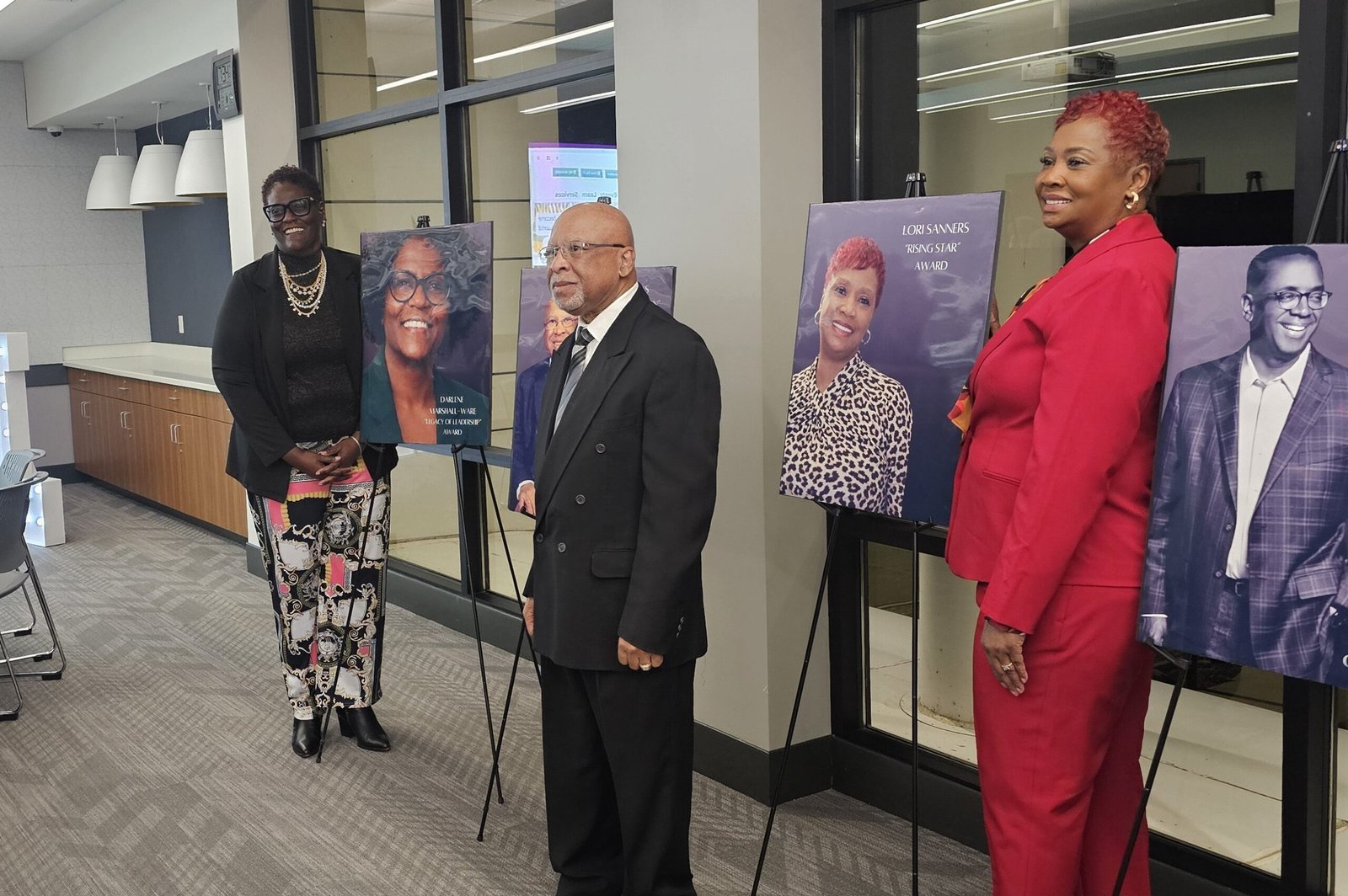
Five Hendersonians were honored Friday night at the Henderson County Public Library’s “A Night of Excellence.”
The evening, now in its third year, is a night when African American community members gather to celebrate successful people and the contributions they’ve made.
This year, two women were honored posthumously for their work and dedication and love of community.
Susan Morgan first worked at the Volunteer and Information Center before a 17-year career with the University of Kentucky Extension service. She was a member of the Henderson Leadership Initiative’s 2010 class, and the project that came from her group was the “Brain Bus,”
“Her work and community service reflected her deep love for helping others and strengthening her community,” according to her introduction. Morgan died in December.
Rose Mary Taylor was described as busy, busy, busy at Friday’s event. She spent three decades working with special needs students in the Henderson County school system. She also worked at Colonial Assisted Living and the John F. Kennedy Center, and she volunteered at 4 Good Community, not to mention the help she gave friends and babysitting she did, according to several at Friday’s event.
“Rose’s generosity, work ethic and spirit of service left a lasting impact on everyone she touched,” according to her introduction. She died in June.
Darlene Marshall-Ware was honored with the Legacy of Leadership award. A Henderson County High School and University of Southern Indiana graduate with both a bachelor’s and master’s degree, Marshall-Ware has been a social services clinician with the state Cabinet for Health and Family Services since 2000. She’s a community leader, and after the loss of her husband, David Ware, she founded the faith-based nonprofit Bishop’s Table. She’s also been awarded the 2021 Femina Fortis Henderson Woman of the Year and was a Henderson County School Board member, according to her introduction.
Marshall-Ware told the crowd her faith is important to her, and during her remarks, she said this award “reflects God’s provision and his guidance.”
“When we invest in people, we invest in the kingdom of God,” she said.
Lori Sanners was honored with the Rising Star award. Sanners is an HCHS and Madisonville Community College graduate. She played basketball for the Lady Colonels. For the past 14 years, she’s worked as a Bio/Med Healthcare Technologist at Deaconess Midtown in Evansville. Additionally, for the past decade she’s served as the president of the Henderson County Black History Committee, which gives out scholarships to local high school graduates and hosts the Dust Bowl at the JFK Center each summer, according to her introduction.
“It really means a great deal to me,” Sanners said. “This award is not something I did by myself.”
She gave a nod to the Rev. Dr. Anthony Brooks and Thomas Platt, who started the Black History Committee.
“I know we’ve got a lot of work to do,” she said.
Donald Banks was honored with the Hometown Champion award. Banks is a U.S. Army veteran who served in the Vietnam War. He also worked as an electrician for 40 years and is currently a deacon at First Missionary Baptist Church.
Banks is also a member of St. John’s Lodge, serving as Honorary Past Potentate, and holding leadership roles with the Honor Guard Team of the American Legion Post #40.
Banks’ passion is history, particularly African American history in Henderson. He’s a co-author of two books and has written extensively on his family history and the history of Black residents in Henderson. Banks has also contributed to the Hendersonian and has helped this newspaper with research.
***
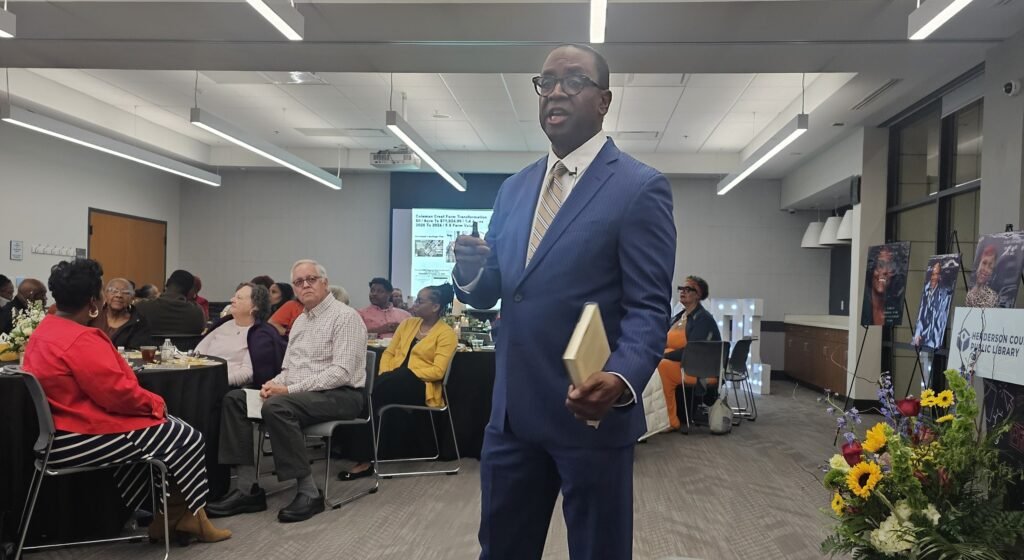
Keynote speaker, Jim Coleman, ended his “sermon”—Marshall-Ware joked—and a talk that had many in the crowd joining in with lessons he’s learned from Coleman Crest Farm, the family farm in Lexington where he moved after his wife died in 2020.
- Seize the moment and focus on the controllables
- It’s always darkest before the dawn
- Only until you’ve been in the deepest valley, can you ever know how magnificent it is to be on the highest mountain
- Be grateful, life is a nanosecond
To lead up to those points, Coleman told of his family’s history, starting with his great grandfather’s purchase of the farm in 1888 after having been a slave on that same land. Throughout the generations, his family suffered setbacks but didn’t make excuses and pushed through them, he said.
His great-grandfather, James Coleman, joined the Union Army’s Fifth Colored Regiment in 1863 and fought till the end of the war, when he returned to the farm where he was born and had previously worked the land as a slave.
He said there were three options to his grandfather then—complain that he’s locked out from things he wanted; retreat and move away; or seize the moment and focus on the controllables.
He chose the third. James Coleman was able to take out a $1,200 loan from the Union Benevolent Society to purchase what would become Coleman Crest Farm. The farm has been with the family for generations.
Coleman on Friday night also told some anecdotes with famous connections. One was about his uncle Stanford, who as a freshman at Lincoln University in Pennsylvania had a roommate who only wanted to go out and party at night and didn’t want to study. Coleman said his uncle worked on him and worked on him to get up and get to class. Finally, he turned his roommate around, and he got motivated, a motivation that led him to Howard University Law School and years later, the United States Supreme Court. He was Thurgood Marshall.
Another anecdote was when Coleman was running for an student office when he was Howard University. During one of his speeches that he presented to a group of ladies (because he was trying to recruit some to help him pass out campaign materials), one giggly student from San Francisco came up to him after he spoke and asked to help. Later on in life, she said she got interested in politics from working on a campaign in college. It was Coleman’s campaign, he said, and her name was Kamala Harris.
Coleman also spoke about a mother’s resilience and mentioned a moment when his own mother wouldn’t give up. After applying to Howard, Coleman was sent a rejection letter. But his mother wouldn’t accept it, writing to the president of Howard the very next day. Weeks later, another letter came in the mail—this one a letter from the president saying he was admitted to the university.
At Howard, Coleman met his future wife, Cathy. They were married for 37 years before she died from breast cancer in 2020. At that time, Coleman returned to the family farm after a corporate career that had taken him all over the country.
He said he could have given up, but his family legacy wouldn’t let him.
“My great grandfather didn’t give up,” he said.
He cleaned up the property that had become overgrown, built a new house and started an organic farm, which in 2022 became the only African American certified organic farm in Kentucky.
Coleman is also an author, podcaster, and philanthropist, including the founder of a $3 million scholarship endowment supporting minority students.