

















(This article first appeared in the March print edition of the Hendersonian.)
What do you do when life changes in a split-second?
If you’re Stu O’Nan, you fight.
The 37-year-old Henderson resident and veteran of the city police department is undergoing a second round of treatment for a rare form of cancer.
A health and fitness enthusiast, O’Nan said it was in August of 2024 that he first spotted something abnormal on his arm.
“I was at work and noticed a bump near my elbow. It was equivalent to half of a golf ball,” he said. “I didn’t have any pain so I assumed I had either hit it on something or it was a minor weight lifting injury. I wasn’t too concerned with it.”
When the bump didn’t heal, O’Nan decided to contact his doctor.
Following an ultrasound, he said, the initial conclusion was that the bump was a hematoma, and would disappear on its own.
It didn’t.
In fact, O’Nan said, it grew bigger and became painful.
“I contacted the doctor again, and I was sent for a biopsy.”
Within a few weeks, the bump had a name—Sarcoma—and he was connected with doctors at Vanderbilt University who specialize in this type of cancer.
“When I was told I had cancer, I really wasn’t too concerned,” O’Nan said. “I was ready to fight it and get back to my normal life. If I knew then what I know now, I would have been pretty upset.”
“My type of cancer is very rare; Less than 1% of adult cancers. Unfortunately, there isn’t a lot known about it and how to treat it.”
The realization of the battle ahead began setting in when he, his mom, and then girlfriend Macey went to an appointment with an orthopedic oncologist.
“He explained the complexity of the tumor due to it being wrapped around the lower bicep muscle, arteries, veins, and nerves. He explained this type of cancer, ‘myxofibro sarcoma’ forms in the extremities, but ultimately could end up in the lungs.
“Every doctor always explains the possibilities of surgery outcomes when they speak with you,” he said. “The most eye opening realization of the severity of my cancer was when he explained that a lot of decisions can’t be determined until he gets inside my arm to remove the tumor.
“He explained there was a possibility I could lose my arm due to the amount of veins and arteries that may have to be cut out,” O’Nan said. “I think that was the hardest information I had heard up until that point. That conversation still sticks with me today. “
The next few months were filled with appointments with radiation oncologists, plastic surgeons, MRI’s, CT scans and follow-up consultations.
Just six days into 2025, O’Nan withstood a 10-hour surgery to remove the cancer. During the process, a bicep muscle was removed. Surgeons then harvested from his leg a muscle flap to put in his arm as a covering for veins, arteries and nerves. The muscle flap, however, does not have the ability to perform as a bicep muscle, he said.
“My arm was left completely open with my muscle exposed for four days,” O’Nan said. “During this time, nurses would perform hourly checks on the muscle to ensure the muscle was receiving blood and would survive. Four days later, on Jan. 10, a skin graft was removed from his leg and placed on his arm.
Slowly, but surely, life resumed a normal pace.
A cancer-free O’Nan returned to his role as HPD investigations lieutenant, and within a month of surgery was back in the gym.
In July, he and then fiance’, Macey, announced their wedding date for November. “I didn’t want cancer to dictate my life, and how I wanted to live it,” he said.
And then on Oct. 11, O’Nan said he noticed a lump on his bicep.
“Immediately after feeling it, I already knew what it was,” he said. “I began contacting my doctor. After several appointments and a biopsy, a surgery was scheduled for Dec. 1.”
The surgery didn’t go as planned.
Arriving in time for the scheduled procedure, O’Nan said there was a significant delay with staff not giving reasons as to why.
“I sat in a full waiting room as people kept getting called out (for their procedures). A doctor walked through the waiting room, which was something I had not seen before. Soon after, I was called to a small room to speak with that doctor,” he said.
During that conversation, O’Nan learned cancer appeared to be in the lymph nodes in his arm. Instead of removing the tumor, the lymph nodes would be taken that day and tested.
They tested positive for cancer, and the plan of attack was altered to radiation on the arm and lymph nodes while undergoing immunotherapy.
“Currently, the tumor in my arm is about the size of a coconut,” he said.
Unlike the first cancer fight, this round has had a greater impact on his daily routine.
“This tumor is under my arm about half way up my bicep. I have been in extreme pain, and am severely limited in what I am able to do. My everyday life has completely changed,” O’Nan said. “I’m still stubborn and try to push through the pain and do what I can, but most of the time, I struggle.”
With surgery scheduled for March 16, he said, “My treatment process this time has been different. I have been staying in Nashville Monday through Friday for radiation. I have seven more treatments left. Unfortunately, doctors don’t believe I will have any pain relief until the tumor is removed. I don’t feel like I can start to live a normal life until about a month after the surgery. It has been a long process.”
Co-parenting with cancer
Once a parent, always a parent—even when fighting cancer.
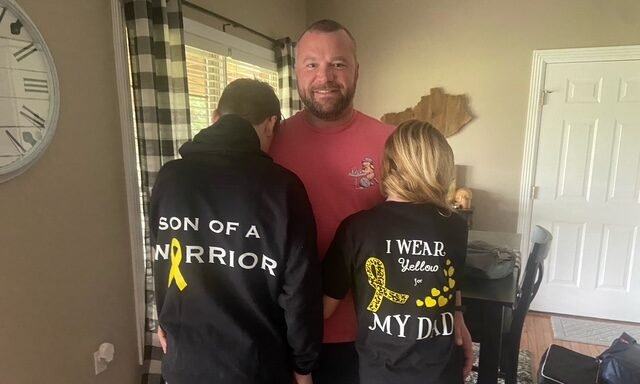
O’Nan and ex-wife Courtney Greene, also a Henderson County resident, said they’re working together to help steer their children through this time of uncertainty.
“In both journeys with cancer, I have been trying to make sure my kids don’t see any difference in their lives. I have tried to stay positive and not show pain or fear because I know if they see me worried, they would be even more worried,” O’Nan said.
“I think they try to ask Courtney most of the questions they have because they don’t want to make me scared or more worried by bringing up their concerns,” he said. “Courtney does a good job of telling them the truth without causing fear.”
Greene said it’s her faith in God that guides her when supporting their children through their dad’s fight with cancer.
“We pray a lot,” she said. “Mason, 14, and Addy, 13, asked for transparency about their dad’s illness, and that openness has shaped how the family approaches this journey. Rather than shielding them completely, honest conversations and frequent prayer have become the foundation.
“They feel better knowing what’s going on instead of guessing or hearing whispers,” Greene said. “We tried to sugarcoat things the first time, and I think that created more anxiety. This time, we’re doing it differently.”
What’s her advice for families facing similar situations?
“There is no instruction manual for guiding children through a parent’s cancer,” Greene said. “We lean heavily on faith, extended family, and friends, while striving to maintain as much normalcy as possible.
“Co-parenting through a crisis has also revealed something powerful—broken homes do not have to stay broken,” she said. “We are blessed to be able to co-parent so well. We both have spouses who love our children deeply, and support our co-parenting relationship… Children should never have to suffer because their parents divorced.
“That unity has created meaningful moments like spending Christmas morning together so the kids wouldn’t have to choose between parents. It’s a tradition that’s continued for several years, and supported wholeheartedly by both spouses,” Greene said.
“My daughter once said, ‘Mom, I’m so happy I have so many people that love us.’ That sentiment captures the heart of this journey: a family, extended by grace, surrounded by community, choosing compassion over division, and faith over fear.”
For those starting out
For anyone just receiving a cancer diagnosis, O’Nan offered this advice.
“Stay positive,” he said. “I’m a firm believer that when people give up, their body gives up. Don’t ever give up!”
Also, “Take someone with you to appointments. A lot of times you are overwhelmed with information; you don’t catch it all. Have someone go with you, ask questions, and take notes.”
For family and friends, “Be a good support system. Check on them when they need it, but don’t overwhelm them. You know them. So, during their cancer journey—do they need help financially, with travel, with cleaning the house, etc.? Try to do things to make their life easier.”
Finally, O’Nan said, “Don’t let cancer dictate your life. Always strive to live everyday life as normal as possible or get back to normal as quickly as you can.”


