




















Culture drives Henderson County’s success
How does a high school basketball team graduate seven seniors and lose 77 percent of its scoring, only to return the following season with an even better record?
That’s a question Henderson County High School basketball coach Tyler Smithart could have been asked during the Colonels’ recently completed season, a campaign that saw the Colonels finish with 26 wins against five losses—all with only one starter returning from the year before.
The answer is multi-pronged: You could point to the emergence of junior point guard Xavion Johnson as one of the region’s most complete players, the rise of Amare Stewart into a consistent scoring threat and the development of sophomore Malaikye Taylor, who jumped from the freshman level into a varsity starting role.
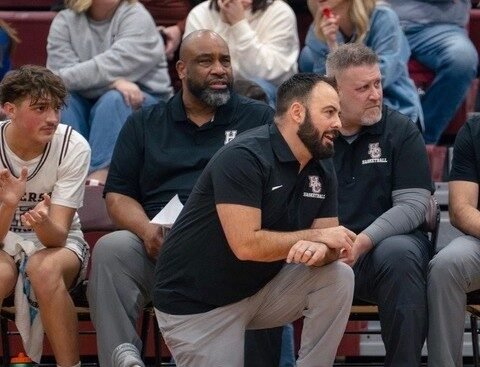
But none of those things happen without the leadership guiding the program. Now in his 15th season as a head coach, Smithhart has seen nearly every stage of a coaching career. There was the early success, the painful postseason losses (one of which occurred Tuesday night in a thrilling double-overtime loss to Lyon County), the seasons spent learning and adjusting, and now a stretch of sustained winning. Henderson County has gone 99-28 in the past four seasons.
For Smithhart, the road to this point has been shaped as much by growth as by victories.
Returning to Henderson County was always something he hoped might happen one day. A graduate of the program himself, Smithhart watched and played for coaches who helped build the Colonels’ basketball tradition, and he saw the impact they had on the community.
“This was always a dream job for me,” Smithhart said. “Watching coaches like Curtis Turley, Phil Gibson and Tom Fisher, those guys helped raise me in a lot of ways. Henderson has always been a place where basketball really means something, not just to those coaches but to the community and the players and parents.”
Smithhart began his coaching career at Christian County, where he served as an assistant on the Colonels’ 2011 KHSAA state championship team before taking over as head coach there for the 2011–12 season. When Henderson County’s job opened shortly afterward, the opportunity arrived earlier than he ever expected.
“When the opportunity presented itself, it presented itself much earlier in my life than I thought that it would,” Smithhart said. “My wife and I were ready to be back closer to home, and it was one that we felt like we couldn’t pass up.”
More than a decade later, the moment still carries meaning for him.
“Sometimes I have to pinch myself and remind myself that I get to do this,” he said.
Smithhart’s early years at Henderson County brought immediate success. The Colonels went a combined 74–18 in his first three seasons and were regularly among the region’s best teams. Still, they did not end up advancing to Rupp Arena.
Henderson reached the regional championship game twice during Smithhart’s first two seasons, only to fall to powerful Hopkinsville teams that would go on to represent the region in the state tournament. Another promising season ended in 2015 when a Henderson team that entered the postseason with a 25–3 record again came up short of a state tournament berth.
Looking back now as the Colonels winningest coach in program history, Smithhart says those disappointments became some of the most important learning moments of his career.
“There was a lot of humility,” he said. “We definitely didn’t get it right every time as a staff.”
Over time, Smithhart’s perspective on leadership began to change. One of the biggest influences came not from basketball but from life itself. Becoming a parent reshaped how he approached coaching and the relationships he builds with his players.
“It’s hard to look at a player as a son until you have a son of your own,” Smithhart said. “You start to understand family a little bit differently.”
That shift helped reshape how he thought about leadership within the program. Earlier in his career, Smithhart admits he sometimes focused too heavily on talent and making sure players felt comfortable in their roles. Experience gradually pushed him toward a different approach.
“One of the things that the most talented individuals really crave is discipline and accountability,” Smithhart said.
That emphasis on accountability gradually became the backbone of Henderson County’s culture. Smithhart believes that holding players to a high standard is one of the clearest ways a coach can show trust and belief in them.
“If you really love somebody enough, that’s what you do,” he said. “You hold people accountable to what they could be and not just leave them where they are.”
Over the past several seasons, that culture has translated into results. Henderson County captured the Second Region championship last year and returned to Rupp Arena for the first time in 26 years, a breakthrough that followed years of near misses.
The challenge that followed was significant.
The Colonels graduated a senior class responsible for more than three-quarters of the team’s scoring and rebounding. For many programs, that type of turnover would signal the start of a rebuilding year. Instead, this year Henderson County won … a lot.
Smithhart credits the example set by the players who came before.
“I don’t think it was really anything that we did as coaches,” he said. “I think it was them seeing the group before them do it.”
That mentality has helped the program maintain its standard despite the roster changes. Johnson and Stewart this past season stepped into larger roles, while younger players embraced new responsibilities. Early in the season, Smithhart said the team endured some difficult moments as expectations shifted and players adjusted to increased pressure.
“They took some really hard coaching early,” he said. “But they kept their head up, they embraced the accountability, and they kept showing up and working to get better.”
That response convinced the coaching staff that the group had the potential to grow into something special. The Colonels’ season ended Tuesday night with a heartbreaking 64-61 loss to Lyon County in the Second Region championship.
While the wins have piled up—nearly 100 over the last four seasons—Smithhart remains quick to credit the people around him. He points to the players, families and previous teams that helped establish the culture the program now relies on.
“We’ve been really fortunate to have awesome players and families,” he said. “Without players like that, it’s impossible to be successful.”


