




(This history column first appeared in the September print edition of the Hendersonian.)
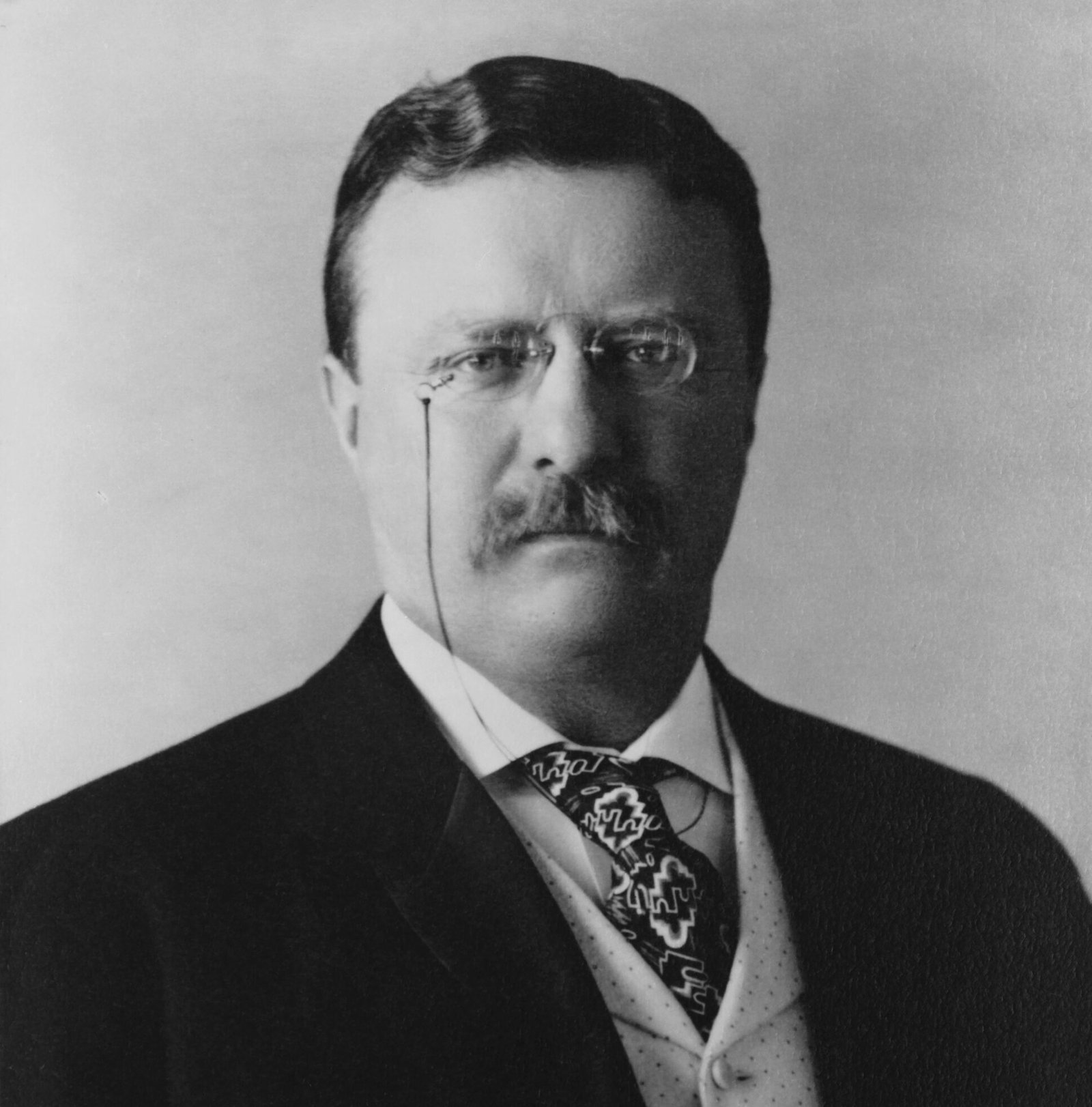
No stones were thrown at vice-presidential candidate Teddy Roosevelt Oct. 13, 1900, when he came to Henderson to open his Kentucky tour.
Spalding Trafton’s local history column in The Gleaner of March 23, 1924, said, “He was the ‘nearest’ president that the city of Henderson has ever had within its borders.” I don’t believe that’s correct; Zachary Taylor lived here for most of 1828 while working in a store.
Y’all might wonder why I would call attention to something that didn’t happen. There’s a reason, which is illustrated in the El Paso Daily Herald of Oct. 13, 1900:
“NO DISORDER When Roosevelt’s train reached Old Kentucky,” the headline read. The story noted Roosevelt’s special train arrived at 8 a.m. at Fourth and Green streets, where the railroad station was then located.
The final paragraph read, “A crowd of a thousand gave him good attention, and there were no signs of the promised disorder.”
There had been an incident in Fort Wayne, Indiana, on Oct. 11, shortly before Roosevelt entered Kentucky.
After leaving Fort Wayne, “the stone-throwing incident in the streets of that city was the chief topic of conversation” on the train, according to the Evansville Journal, that city’s Republican paper. A man standing near Roosevelt had been struck in the face but was not badly hurt.
“I was not injured at all,” said Roosevelt. “There is danger that this matter may be magnified. It amounted to nothing.”
Indiana Gov. James A. Mount, who was riding the train, expressed “deep regret” at the incident. “Nothing has happened in years that gives me so much sorrow as that attack,” he said. “It was the work of rowdies only and should not be permitted to reflect upon the Democrats of the town, for they would not countenance such an outrage.”
Right after saying that, the governor went to Roosevelt and apologized on behalf of all Hoosiers.
Earlier in the campaign swing, on Sept. 26, 1900, Roosevelt had been chased out of Victor, Colorado, by angry miners, who vehemently disagreed with the Republican Party sticking to the gold standard. The miners wanted currency to be backed by a mixture of gold and silver, which would loosen the money supply and ease pressure on working people.
Kentucky also had been in political turmoil because of the disputed election of 1899, which led to the assassination of Democrat William Goebel, an event Roosevelt apparently alluded to during his remarks here as well as in Madisonville and Hopkinsville.
An excellent account of the Goebel affair by Marianne Walker appeared in the July/August 2013 issue of Humanities, the magazine of the National Endowment for the Humanities. In brief, the initial count showed Goebel losing the governor’s seat.
His supporters convinced him to seek a recount, which threw out more than 2,000 votes. A committee was set up to resolve the dispute. Which brings us up to about 11 a.m. Jan. 30, 1900. Goebel was walking across the capitol grounds with two friends when a shot rang out. It struck him in the chest.
The next day the all-Democrat contest committee determined Goebel had won the election. Goebel was quickly sworn in.
“For the time being, Kentucky had two governors, two lieutenant governors, two adjutant generals, two militias, and two legislatures, each conducting its own business as if the other side did not exist,” Walker wrote. “With his lungs filled with blood, Goebel died at 6:44 on the evening of February 3, 1900.” (He is the only sitting U.S. governor to be assassinated, although several territorial and former governors have met that fate.)
A Democratic majority in the General Assembly named John C.W. Beckham, Goebel’s running mate, as acting governor while the dispute made its way through the court system. The U.S. Supreme Court declined to hear the case on May 21, 1900, which left the Democrats in charge.
The killer of Goebel was never brought to justice. Kentucky Republicans, however, no doubt still felt considerable resentment about the aftermath of the 1899 election.
Roosevelt had led the famous Rough Rider charge up San Juan Hill in Cuba during the Spanish-American War, and that gave him a national reputation, but his political career had been mostly confined to New York state.
He cleaned up the notoriously corrupt New York City police department and built on that to become governor of New York. The only reason he was the vice-presidential candidate paired with William McKinley is that the Republican bosses in New York essentially kicked him upstairs into a position with little real power—neutering his progressive instincts. He reluctantly accepted the job.
McKinley adopted the traditional strategy of staying on his front porch, giving occasional speeches, leaving Roosevelt to the work of campaigning. Roosevelt traveled more than 21,000 miles across 26 states; he gave more than 670 speeches.
In many of those speeches Roosevelt said he wanted to provide a “square deal” to the working man. That became a hallmark of his later political career. While in Indiana, he also made remarks likely to land favorably with Black voters.
According to the Evansville Journal, he called for “equal rights for all men, whether white or black. I fought with the dusky veterans of the Ninth and Tenth cavalry at San Juan and I asked for equal justice for white and black in the march to victory.”
He did not repeat those remarks in Kentucky.
Almost exactly a year after his Henderson visit, by which time he had become president in September 1901 after the assassination of McKinley, he invited the most famous Black man in America, Booker T. Washington, to dine with him at the Executive Mansion. (By the way, Roosevelt was the first to begin calling it the White House.)
Black and white eating together caused a tremendous furor across the southern states, where people saw it as an assault on white supremacy; no Black person ate with a president for another three decades.
But let’s return to Roosevelt’s appearance here, where a speaker’s stand had been erected near the railroad tracks.
The local committee that received him included F.J. “Boss” Pentecost (who was beginning his career as a stalwart Republican leader here), W.H. Overby, A.J. Worsham, Sam H. Cromwell “and a number of other leading Republicans,” according to The Gleaner of Jan. 8, 1919. That story appeared two days after Roosevelt died in his sleep from an embolism.
The local committee “all wore Rough Rider (slouch) hats out of compliment to their candidate for vice-president.” Republican politicians from across the state also rode on the Roosevelt special during its trip through Kentucky.
And Roosevelt wasn’t the only bona fide Rough Rider to make an appearance here. Also on the train was Henry B. Hersey, who was a major in the 1st U.S. Volunteer Cavalry, which was the official name of the Rough Riders. He was also a pioneering balloonist and meteorologist.
Roosevelt didn’t speak long here, and was even more brief in Madisonville, because he had caught a cold in Evansville.
According to the Evansville Journal, he said: “I believe emphatically in sound currency, expansion, and in the honor of the flag, and, most of all, in orderly liberty under the law, which lies at the foundation of our institutions.
“I believe emphatically in a square deal for every man and that he be allowed to have his vote counted as it was cast. I believe it in New York and believe it in Kentucky. (That apparently was an allusion to the contested 1899 election; a voice cried out from the crowd, ‘So do we.’)
“I believe this is less a party contest than a crusade for freedom. I have stood on the platform with northern men and southern men and with men who have worn the blue and men who have worn the gray and all agree that liberty stands as the basis of American citizenship. If the people are wise, they will pursue the course which has brought material prosperity, but greater than material prosperity is freedom.”
In Madisonville Roosevelt was so hoarse he was barely able to speak above a whisper, but he once again alluded to the 1899 election:
“We may differ as to policies and the nation will still go ahead,” he said. “But when once a considerable body of our people cease to understand that it is the right of any man to cast his vote as he wishes and to have that vote counted as cast, self-government itself is in danger. We cannot, my countrymen, go on long as a republic if that right is denied.”
He made similar remarks in Hopkinsville: “I appeal not only to Republicans, but to all good Democrats against the suppression of votes understandingly cast and the seating of men who are not elected,” a statement that met with hearty applause.
Roosevelt easily won re-election in 1904 but in 1908 he backed his longtime friend William Howard Taft. He later considered that a mistake, prompting his run in 1912 as the third-party candidate of the Bull Moose Party after Republican bosses denied him the nomination.
Splitting the party like that handed the presidency to Democrat Woodrow Wilson; Taft came in third.
During that campaign, however, he was shot Oct. 14, 1912, in Milwaukee, Wisconsin. His steel eyeglass case and the folded 50-page speech slowed the bullet; it did not pierce any vital organs.
He refused medical attention and spoke for about 90 minutes, beginning, “I don’t know if you fully understand I have just been shot, but it takes more than that to kill a bull moose.”