
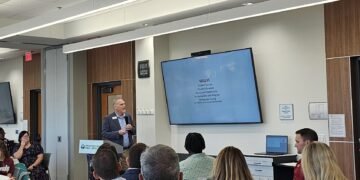
















The scope of work that will be undertaken by the Henderson City-County Planning Commission and its staff to write an ordinance regulating wind energy conversion systems started to come into focus Tuesday night, and it appears to be a daunting task.
The planning commission’s objective regarding WECS during Tuesday’s meeting was to take in documents and research from the community, Cordelio Power and others so that that information could be entered into the public record, compiled and then disseminated to the planning commission for members to study.
Of the nine people who spoke, six of them brought documents to be entered into the public record. One of those was Cordelio Power Vice President for Development Tim Vought, who submitted a binder with 5-page summary up front followed by 31 tabs, most with several pages or less but some with more than twenty and one with more than 50 pages of supporting material. The binder totaled close to 230 pages.
Middle Delaware Road resident Steve Roehm brought a summary of 56 journal articles, and Robards resident Melody Thompson submitted an analysis citing 11 sources. Another brought an ordinance from a county in Oklahoma, another a case study article and another questions submitted for the planning commission to consider.

This is just the beginning of the process.
Tuesday’s meeting was the first public hearing in which documents could be submitted and was described by planning commission officials at a previous meeting as a way for all the information that has been shared on social media and other methods thus far to be entered into the public record.
There will be seven more such meetings when the planning commission will invite the public, Cordelio and experts to speak and submit documents. (See the proposed schedule at the bottom of this article.) Those future public hearings will be broken into specific categories that planning commission staff have determined to be important for gathering information and hearing public comment so that an ordinance for wind energy systems can be written.
Needless to say, planning commission members will end up reading and digesting possibly thousands of pages by the time the text amendment to the county’s zoning ordinance is written, which will occur in early 2027.
Another complication for the planning commission revolves around which articles and sources to believe, which are credible and which are junk science. When asked that after a previous planning commission meeting, chair David Dixon said, “All we can do is use our best judgment.”

Airline Road resident Deirdre McConathy addressed the “best judgment” Tuesday, bringing a paper to be entered into the record that discusses how to best investigate documents to find useable data. For instance, she mentioned a writing that said that the ratio of people who had a favorable view of wind turbines to those with unfavorable views was 7 to 1. But a part of the article, she pointed out, said the people who responded and were used as data in the study were asked about 350-foot-tall wind turbines, which is about half of what is proposed in Henderson County.
She also said that planning commissioners will study many conflicting opinions within the submitted documents while trying to form their own opinion—a task she likened to what PhD’s, medical doctors and engineers must do in their line of work.
Already Tuesday night documents with conflicting opinions were submitted. The summary submitted by Roehm, who is the owner of Stability Counseling and Associates, LLC, details the harmful health effects of wind turbines, much of it adverse mental health effects. The summary introduction says that green energy systems “constitute a significant and preventable public health risk by acting as a chronic environmental stressor.”
On the other hand, Cordelio’s submission contains three tabs that basically adhere to the theme that wind turbines have no adverse effect on health, though those documents seem to focus on physical health while also being written by two entities that advocate for green energy (Environmental Business Council of New England, Inc. and American Clean Power) and one from the Ohio Department of Health.
That last point is something Thompson addressed in the document she submitted. She said the planning commission needs to rely on independent research because renewable energy studies published since 2015 often “reflect selective framing, funding influence, or optimistic press releases rather than full, balanced evidence.” She urged decisions be made from “clear, unbiased information.”
All this on the first night and with much more to come, planning commission Executive Director Brian Bishop said the whole process is brand new territory for the planning commission.
Even before Bishop said this, and then again one time after, Spottsville resident Ben Johnston—knowing that the time and energy to sort through all the information that will come to the planning commission—suggested that a third-party consultant is hired to guide them through the process.
Another suggestion by Curt Hamilton, a member of the planning commission board, was that summaries of documents or reports be submitted before scheduled public hearings so that planning commissioners could read the argument before hearing it in the public hearing.
Toy-Anthoston Road resident James Franks had concerns with that because many of those everyday citizens who want to speak don’t have the training to submit briefs effectively. Hamilton responded that it wouldn’t be a requirement to submit a brief to speak.
Nearing its end, the meeting took a contentious turn when Roehm and Shannon Hill asked that any document that has been sent to individual planning commissioners be turned over to planning commission staff so that it could then be given to all the commission. Roehm asked for each individual member to vote yes or no to do that.
Planning commission member Stacey Denton said members already know to do that and by asking for another vote suggests “a lack of trust.”
“We’re supposed to report it and we will,” she said.
Roehm said he was not trying to create a perception of mistrust but “advocate for the utmost level of transparency.”
Tommy Joe Fridy, the attorney for the planning commission, ended the discussion by taking up for the planning commissioners.
“I have never see the level of transparency that’s happening right now for your benefit,” he said.
He said some of the comments made during the meeting are “personally insulting to these people.”
Hill said she would like to publicly apologize to the planning commission “because that is not my intent.”
The tentative schedule of WECS meetings, including the area of concern for each meeting, is as follows:
- Noise, vibration and shadow flicker: 6 p.m., Wednesday, March 18, 2026
- Health and annoyance impact review: 6 p.m., Wednesday, May 20, 2026
- Environmental and ecological impacts: 6 p.m., Wednesday, July 15, 2026
- Land use and siting criteria: 6 p.m., Wednesday, Sept. 16, 2026
- Safety, engineering and infrastructure: 6 p.m., Wednesday, Nov. 18, 2026
- Regulatory and administrative framework: 6 p.m., Wednesday, Jan. 20, 2027
- Post draft ordinance public engagement and transparency: 6 p.m., March 17, 2027
At the end of the process, the planning commission intends to develop a draft WECS ordinance with performance standards and siting criteria as well as a summary report that will go to the Henderson County Fiscal Court, according to a document from the planning commission staff.


