











(This article first appeared in the July print edition of the Hendersonian.)
When she was a little girl growing up in Henderson County, some of Karen Dempewolf Nix’s most cherished times took place when visiting the family farm with her grandfather Carl Dempewolf.
On those visits they would often visit a place so peaceful, so spiritual and restorative that years later Karen hasn’t forgotten the feeling she had while being in that space at the family cemetery.
“It was such a magical place,” she remembers, recalling the sound of the wind, the stillness, the birdsong.

Now, and in a circuitous way, that memory of the cemetery prompted her to reconnect with generations of ancestors on both sides of her family, just in time to make it a part of the celebration of America’s 250th birthday.
It started back in the winter when Karen visited the old cemetery and noticed that it needed a little clean-up. A little TLC.
It has dozens of graves, some of which have lost their markers, so with the blessing of other local family members she contacted someone who knows a lot about restoring and documenting such places. Local history researcher and enthusiast Sue Berry gave Karen some advice, and some refurbishing started to make it “an even more beautiful place.”
But soon it became not just only about the cemetery. It became about the people who found their resting place there and their personal stories. Karen was inspired to know more about them but also others on the branches of her family tree.
And that’s where Sue could offer her expertise through genealogy resources at the Henderson County Public Library, public records in Henderson and neighboring counties, newspapers.com archives and more as she explored not only the very active community life of the Dempewolf family in Henderson County, who settled here later than the Revolutionary War era, but also the Cooper, Lilly and Tuttall families (and other branches) that go way back in this area of Kentucky.

“Pretty soon, every time she would call me, she would say ‘You’re not going to believe this,’” Karen said. “It seems like it was just meant to be.”
With an eye on the 250th birthday of America’s independence and a renewed enthusiasm for documenting the connections, Sue suggested that she should work toward tracing Karen’s lineage on her mother’s side of the family at least to a generation of Patriots that would qualify her for seeking membership in the Daughters of the American Revolution.
Neither of them needn’t have been concerned about the possibility. Eventually 11 ancestors designated as American Patriots showed up on Karen’s family tree. One of them, a first cousin five times removed, is Patrick Henry, a Founding Father, the first and sixth post-colonial governor of Virginia, a planter and an orator who famously declared: “Give me liberty or give me death!”
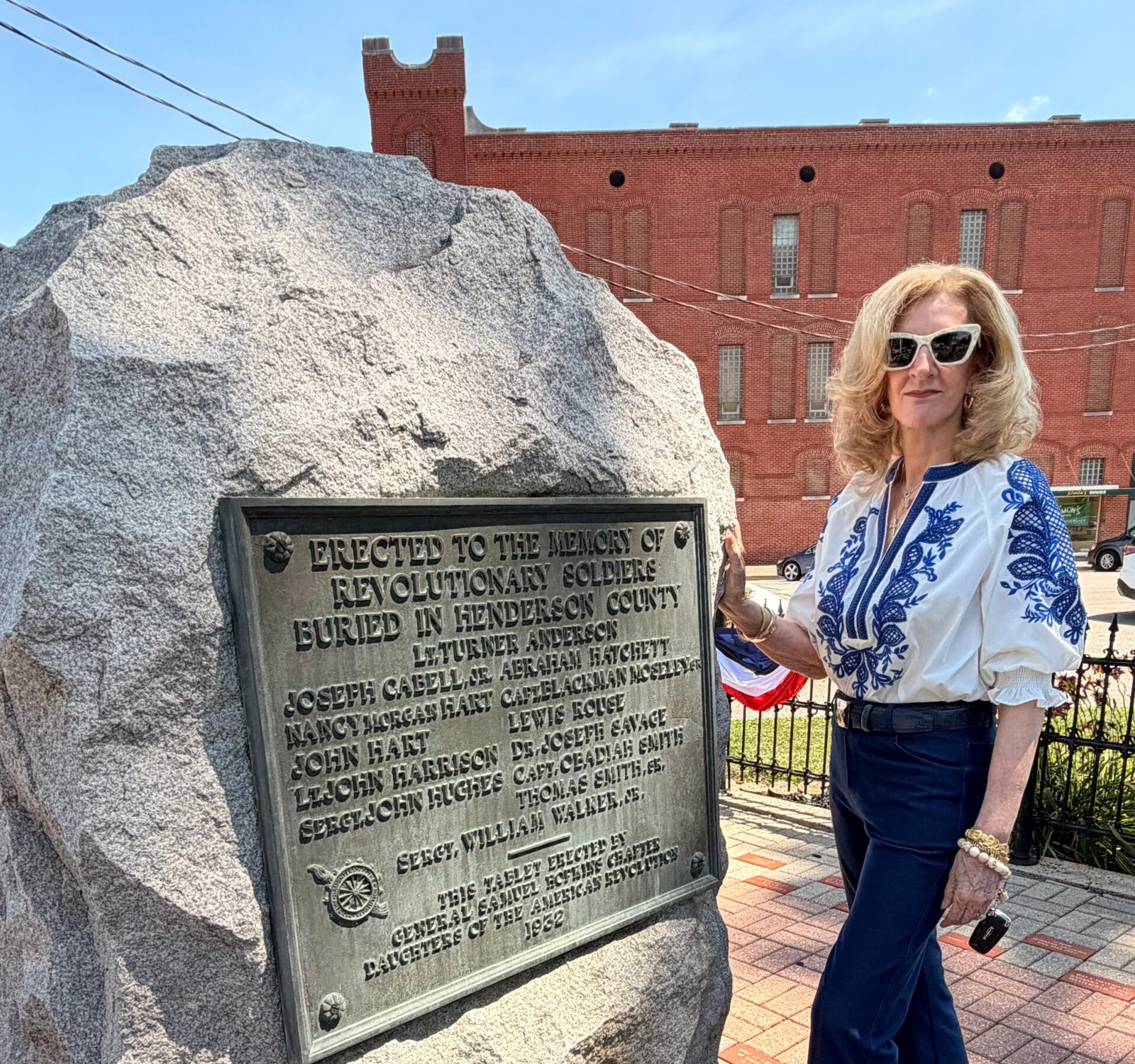
The names of three of her ancestors (Thomas Smith, John Martin and Joel Gibson) appear on the bronze plaques affixed to the stone DAR monument at the corner of First & Main streets on the Henderson County Courthouse grounds.
Another of the 11 is a woman, Mary Church Duncan, whose role was to pay a supply tax in support of the American Revolution in 1783.
“Sue was finding all of these Patriots,” Karen said. “(But) to have a lady (Patriot) in my line is really awesome.”
“It was the icing on the cake,” Sue added.
To be considered a Patriot, a person could have taken on many roles, including soldier, supporting the revolution monetarily, pledging an oath of allegiance to the Continental Army, serving as a ranger, offering supplies or delivering messages.
“Her ancestors did a variety of services in development of the new country,” Sue said.
The duo was coming along nicely with the DAR application when Karen heard that some cousins she hadn’t seen in a while were coming to visit Henderson in May. She and husband Ray Nix offered to host the clan for an impromptu reunion.
So, with just a couple of weeks to work with, Karen and Sue put together booklets for each ancestor that detailed each of their family lines. Their dining tables were decorated with patriotic colors, silhouettes of Colonial era people and lineages.
“When the cousins came in, they were blown away when they saw it,” Karen said. “It was all beyond my wildest dreams.”
It also started a movement. The family got excited about the work, and some were inspired to also join the DAR in the 250th year of our country.
Six will be going in at the same time, Karen said. Four are from the family and two are close family friends who also learned that they qualified after learning about Karen’s project.
“The enthusiasm was infectious,” she said.
“It started out with me trying to find a grave spot for me and blossomed into a family reunion and the DAR,” Karen added.
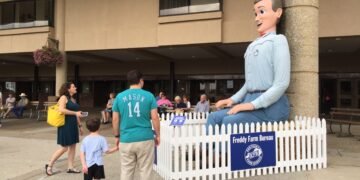
It has also inspires more detailed work about the Dempewolf family who ferried people and animals to safety during the 1937 flood, ran successful businesses, were leaders in local institutions like the Farm Bureau, collected milkweed pods for the World War II war effort and were generally very active in community life.
Many of the stories are about Karen’s grandfather who took her to visit the family cemetery. There are many stories to capture.
“He was really involved,” she said. “When you think of all he did and still made time for us, it’s amazing.”
Sue said she wasn’t really surprised that a simple visit to a cemetery led to so much. She’s learned as much in her long-time interest in history.
“Sometimes connections happen for a reason,” she said. “History is all around us. You have to sit back and let it find you.”


