




















In cases of a lost child or a lost adult, seconds and minutes could make the difference in finding them in a safe condition.
The Henderson County Office of Emergency Management on Tuesday revealed a new plan that it hopes will help authorities find missing persons more quickly.
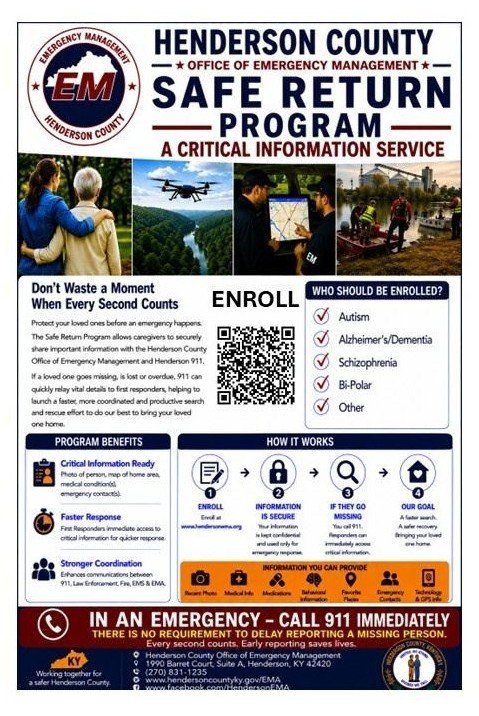
With what the OEM is calling the Safe Return Program, caregivers are asked to submit information about the person they are watching, and especially people who have been diagnosed with Alzheimer’s/dementia, schizophrenia, bi-polar or other disorders. The OEM is also asking that parents of autistic children fill out the form, which is located on the OEM webpage. Click here to access the form.
In addition to the conditions mentioned above, OEM also suggests that caretakers of those with special needs or anyone that has a medical condition that may cause disorientation to sign up, according to information on the website.

The information that caregivers submit to OEM is then given to 911 Dispatch and is attached to the CAD system, said OEM Director Kenny Garrett. When a person whose information is in the system is reported missing, his or her profile is sent out to authorities to help them find the person more quickly, Garrett told Henderson Fiscal Court at Tuesday’s meeting.
“That gets us a head start on information that’s critical in those first few minutes when we’re looking for someone,” Garrett said.
OEM Director’s Assistant Jill Ward said that the profile created will include basic information and a picture as well as other more detailed information, such as sensory concerns of a person that might help authorities in the search. Those could include such details as if a person prefers dark places, quiet places, or are they more likely to answer to a female’s voice, she said.
The profile will also contain a map with the outline of a one-mile area radius around the person’s home, Ward said.
Ward added that the submitted information will remain secure and that it will be collected by OEM and shared with 911 Dispatch and no one else, until needed for a search.

Ward said that when it takes some 10-15 minutes to get to a residence to conduct an interview and then more time to distribute a photo and information, that could lead to about a half hour before a search could begin.
But with the Safe Return program, the information could be disseminated after it is checked with family or the person who called 911—much more quickly, she said.
“We get more eyes out on the road a lot faster,” Ward said.

