

















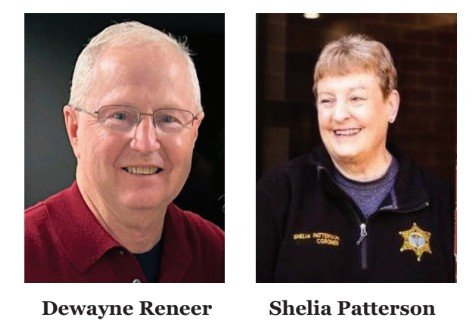
Dewayne Reneer and Shelia Patterson square off in the coroner’s race, with both emphasizing that their experience as the reason voters should turn out for them.
Reneer, who is both a deputy sheriff and a registered nurse, said the aspects of both jobs—crime scene and detective work as a deputy and his nurse’s medical training, including anatomy and physiology—will help him as coroner.
“I’ll be able to look at it two ways,” he said, adding the coroner’s office will allow him to tie both of his current careers together.
Meanwhile, Patterson said her opponent “does not have any experience in the coroner’s office,” which she said is a different skill set than in the sheriff’s office. Patterson has worked in the coroner’s office since 2007.

Patterson, who was appointed as coroner after Bruce Farmer resigned in January 2025, also cited her current position and 19 years in the coroner’s office as well as decades as a registered nurse at Methodist Hospital, where she was a house supervisor for 32 years.
Reneer is also a registered nurse and, in addition to his deputy work, has owned his own business and taught classes at Ivy Tech in Evansville.
One of the things, Reneer said, he’s noticed while working as a deputy is that the coroner’s office currently doesn’t have the equipment it needs. For instance, when a larger person dies and the body needs to be moved, the coroner’s office must call a volunteer fire department or the Henderson Fire Department to assist with lifting the body, Reneer said.
He said equipment such as this is needed, and the coroner must ask fiscal court to help fund that. Reneer said that equipment to handle this task, a hydraulic lift will be on his list of asks of the fiscal court.
Patterson said that Reneer is mistaken—the coroner’s office does, indeed, have hydraulic equipment to help move larger people. But she said there are some instances when the equipment can’t be used; for example, when the body is located on a second floor. That’s when the coroner’s office calls volunteer fire departments or the Henderson Fire Department, who Patterson said are always ready to help.
Reneer also believes, that like law enforcement, the coroner’s office must be prepared with personal protection equipment to “gear up” to go inside scenes that may be hazardous or contaminated. Having that PPE is another initiative for the coroner’s office, he said.
Patterson said that one of her focuses will be to more easily get to the final destination for deceased who are indigent. To accomplish the task, it often takes lots of time to find a next of kin, and many of them haven’t seen the deceased in 30 or 40 years, she said.
One idea is for a monthly fee to be kept back from older residents’ Medicaid to go towards a cremation or burial fee, she said.
Reneer also wants to help those who have been left behind after a loved one dies. He said many aren’t prepared to handle tasks that must be completed after a spouse dies. A couple examples include handling Medicare and navigating the court system. Getting this education to the community is part of the coroner’s job, he said.
Another piece of education he wants to work on is prevention. That includes drug and suicide prevention, he said.
Reneer has also in the past been the owner of a medical company, Infusa-Care, for about 6 ½ years, so he said dealing with the financial side, especially setting a budget, is another strength.
Patterson also said she wants to implement sessions where staff train each other. Each year deputies are required to get 18 hours of training and that can come from trainings around the state that offer many different topics related to the work. She said she’d like to see deputies return from their training and then teach their colleagues.
Regarding staff, Reneer wants to implement mental health initiatives for the coroner’s office staff. He wants it to be a requirement for staff to go to counseling twice each year to help them deal with the traumatic events they witness in the job, he said.
Patterson wants to recognize deputy coroners Don Farris and Bill Schwartz, who’ve been at the office longer than she has. To get a Master Coroner designation, a person needs to have worked more than 300 cases. She’s sure they have.
Finally, Reneer said he’s been working towards his own education to prepare himself for the coroner’s job. He has completed a practitioner certification for dementia and a Centers for Disease Control infectious disease certification.
Patterson said the caseload at the coroner’s office has gone up from 60-70 cases in 2007 to about 150-160 cases per year now. She said the six deputies on staff now are a good, cohesive group. They lean on those whose expertise leans to crime scene when it’s needed, and lean on the former nurses when more medical knowledge is needed.


