














(This article first appeared in the November print edition of the Hendersonian.)
A family cemetery on Tillman Bethel Road holds the graves of Tilman Bethel’s ex-wife, a daughter and two grandsons.
Tilman was not welcome there.
This is not a happy story because it’s about the disintegration of a family. And it really should focus more on ex-wife Maria Talbott Bethel; in the late 1890s she was in the news quite a bit, both here and in Evansville, because someone tried to poison her. She was not happy about the publicity.
In many ways, she appears to have been a remarkable woman. She was a major landowner at a time when women were usually confined to the kitchen. More interesting, perhaps, she was a feme sole two years before the General Assembly granted those rights to all women.
What’s a feme sole, you ask? Don’t feel bad. I had to look it up myself. And I drew blank looks from several lawyers when I asked them about it. It’s a Norman French term from common law, meaning “single woman,” that dates to feudal times.
Back then, under the common law doctrine of “coverture,” a woman lost pretty much all her legal rights when she married. They were absorbed by her husband under the authority of multiple Biblical verses that talk about the two being made one flesh. She could not buy or sell property, write a will, enter into a contract, or keep the wages she earned without her husband’s permission.
Methods under which a married woman could keep those rights included a prenuptial agreement or a judicial decision. The Henderson County Clerk’s Office has at least 29 prenuptial agreements recorded from 1809 to 1888, although only four of them came after the Civil War.
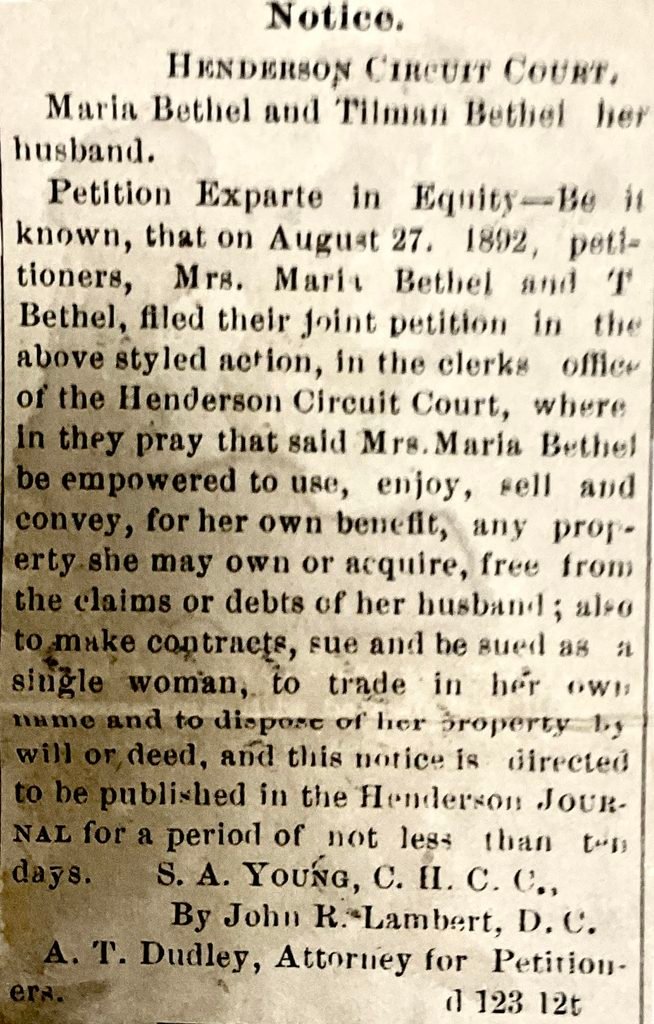
Maria Bethel did not have a prenup. She did, however, have an 1892 order from Henderson Circuit Court, made with her husband’s consent, clarifying she had all the legal rights of a single woman, free from any debts incurred by her husband. (The Kentucky General Assembly did not fully abolish coverture until March 15, 1894.)
The wills of both her father, Benjamin Talbott, and her grandfather, John E. McCallister, gave her control or outright ownership of about 2,050 acres of land around the mouth of the Green River. A codicil to Talbott’s will, however, gave Tilman a half-interest in most of that property. That would later be the source of much conflict with Maria.
He was born in 1828 and she was born at the end of 1842; they married Jan. 15, 1863, in St. Louis. They had eight children between 1864 and 1878, although only five made it to adulthood.
After nearly three decades of marriage, Maria apparently decided she wanted a bit more independence. Tilman purportedly went along. Together they jointly filed an action to declare Maria a feme sole, which was finalized Oct. 5, 1892. Master Commissioner R. Scroggin Eastin testified, “She is very intelligent and … has the capacity to manage and control her business matters with prudence.”
Seven months later, on May 11, 1893, Tilman filed suit against his wife, claiming that the feme sole court action was “null and void” because it had been done without his knowledge or consent. Furthermore, he claimed that her lands couldn’t “by the reasonable exertion of a female be safely or successfully managed.”
That suit was quickly withdrawn.
Maria unsuccessfully tried to divorce Tilman in 1894, which was part of a chain of lawsuits: Tilman suing her, Maria suing him, and various children suing Tilman and one another. All told there were nearly a dozen lawsuits by the time the couple died.
They separated on Sept. 11, 1893, at which time the various farms were divided between Maria and Tilman. Throughout their marriage the family had lived part of the year in the “Old Home Place” of Ben Talbott, and part of the year at 200 Oak St. in Evansville, which Talbott had also owned.
Tilman never again lived in the Evansville house after September 1893 and moved to a house on one of the other farms.
In the spring of 1898 Tilman again sued Maria and one of the questions raised was ownership of the Evansville house, which was “in a fashionable part of the city,” according to the Evansville Courier.
Ora Bethel Williams (later Polhuis) had just moved into the house. But she said she hadn’t asked her father for permission.
“I didn’t mean to ask it; my brother just spoke up and said, ‘She has got a right to live in your part of the house, has she not Papa?’ And he said, ‘Yes, she is welcome to, if she can stand it.’”
What did that mean? “I don’t know,” she replied. “I just remember the words, that’s all.”
Later in the same deposition she was asked about her attitude toward her father: “Well, I used to be a little indifferent towards him, but now I feel that he has treated (his wife and children) all so badly, I don’t only feel indifferent towards him.”
An iceman came to the Evansville house and insisted on dropping off a block of ice, according to the Courier of Aug. 25, 1898. Which was a little strange, because Maria had bought a block of ice earlier that day. She then went shopping with Sarah Hill, daughter of her friend and neighbor Bonaparte Hill.
That evening they went to a park and, when they returned, they were thirsty. So, they drank some water in which the ice had melted. Very quickly, both women complained of their throats burning. They then began vomiting and afterward fell into drugged sleep. They had a miserable night and awoke the next morning with difficulty.
A follow-up story the next day provided more details. Maria said an attempt to poison her had been made four years earlier; someone had put poison in her coffee pot.
Asked if she had any enemies, she replied, “I could not make the charge because I might have a hard time proving it. Nevertheless, I know pretty well who the person is.” She then went on to implicate her husband.
“I have a life estate in property in Henderson and own several farms. If I should die, my husband would have the benefit of all my property during his life. But I do not intend to soon release it.”
(In a 1907 deposition, Tilman called those words crazy. He asked that the Aug. 26, 1898, Courier article be entered into the legal record as evidence “as to the sanity and qualifications for truth and veracity” of Maria.)
The Courier ran a third story Aug. 27, 1898: “There can be but one conclusion. If the ice was poisoned, the accomplice of the poisoner was an employee of one of the ice factories,” because all of them used distilled water for their product.
She again filed for divorce Sept. 19, which the Courier publicized Sept. 21. Tilman claimed she was an Indiana resident, and there were multiple depositions about that. Bonaparte Hill and Virginia D. Posey both testified she maintained her legal residence in a room of the “Old Home Place” and lived in Evansville only part time.
“I think she occupies the room she used to occupy as a girl and which was afterward used as a parlor,” Posey said.
The second divorce attempt was granted May 25, 1900.
Maria was again in the news the first week of October 1898. The Courier of Oct. 6 reported she was one of multiple heirs to a German fortune of $99 million and that a big gathering of heirs had just met.
“Colonel (Bonaparte) Hill has just returned to Henderson from this meeting and is highly delighted with the prospects.”
But it was a scam by shyster lawyers, according to various genealogical websites. Lawyers ran advertisements in major newspapers in the late 1800s and early 1900s attempting to bilk thousands of people across North America by asking for genealogical research fees and travel costs to Germany up front.
Neither Maria nor Tilman experienced a happy ending.
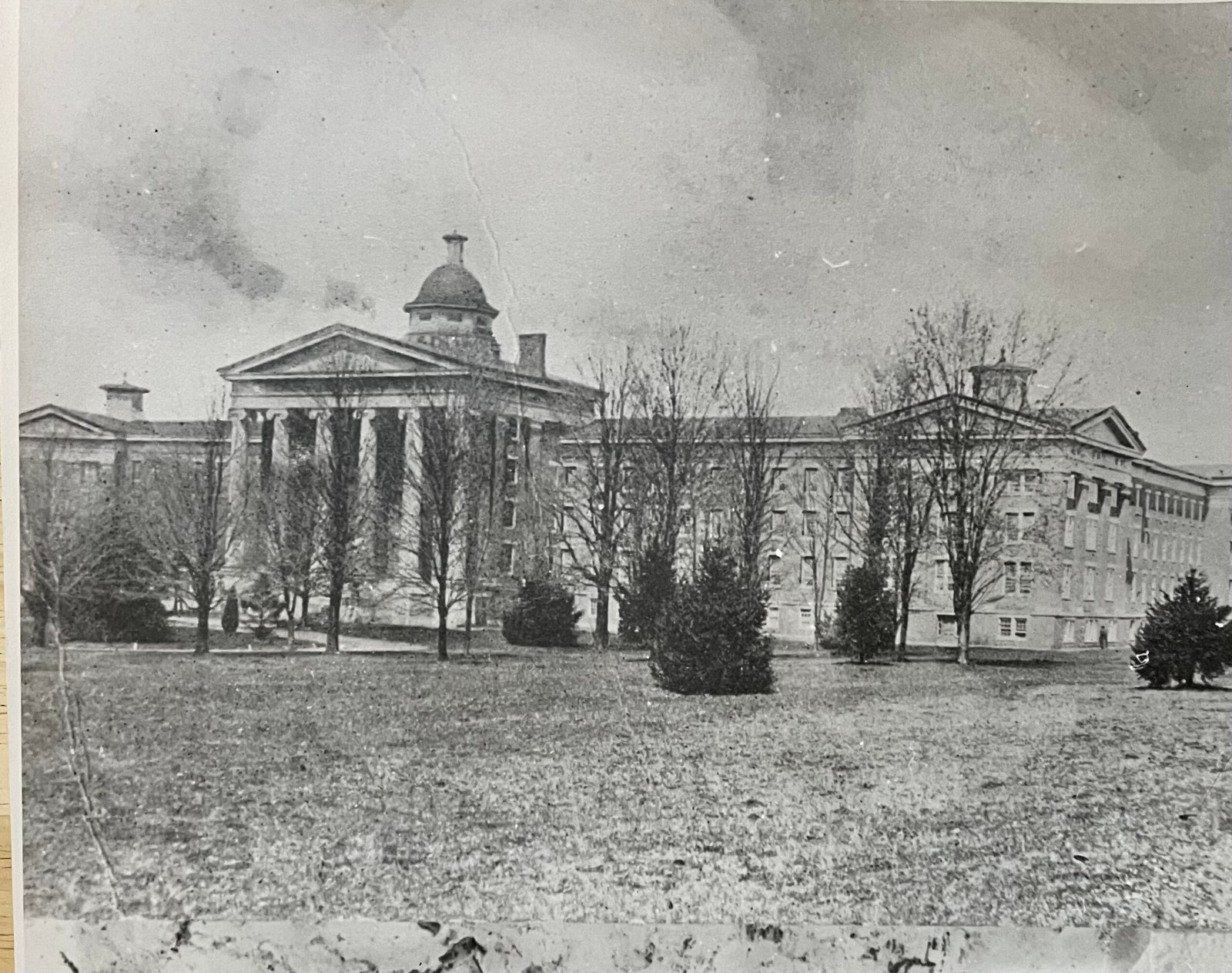
A jury in Henderson County Court determined Tilman was “of unsound mind and unable to attend to his business affairs” on July 6, 1908. He spent the rest of his life in the Western Kentucky Insane Asylum in Hopkinsville, where at age 83 he died Feb. 8, 1911, of senile dementia. That institution was renamed Western State Hospital in 1919.
He was buried in Rose Hill Cemetery in Newburgh among other members of his family of origin, all of whom spelled their last name with two Ls: “Bethell”.) He died deep in debt and Ohio Valley Bank & Trust, his administrator, had to sell his property to pay off his creditors.
Maria also ran up substantial debts between 1915 and 1920. And a large barn holding the tobacco of three sharecroppers mysteriously burned to the ground, according to The Gleaner of Oct. 24, 1920.
At age 78, she died of stomach cancer on Nov. 10, 1921, in the house she was born in. The Ohio Valley Bank, which administered her estate, maintained she owed it nearly $27,000. Her daughter Ora—the one buried in the family graveyard—received only about $51 worth of teaspoons, brooches and bracelets because the bank kept all other personal property.
“The deceased was widely known in the city and the county and for a number of years managed her vast farming lands bordering on the Ohio and Green rivers,” The Gleaner reported Nov. 11. “She personally managed more acres of farming lands than any woman in Henderson County.”