
















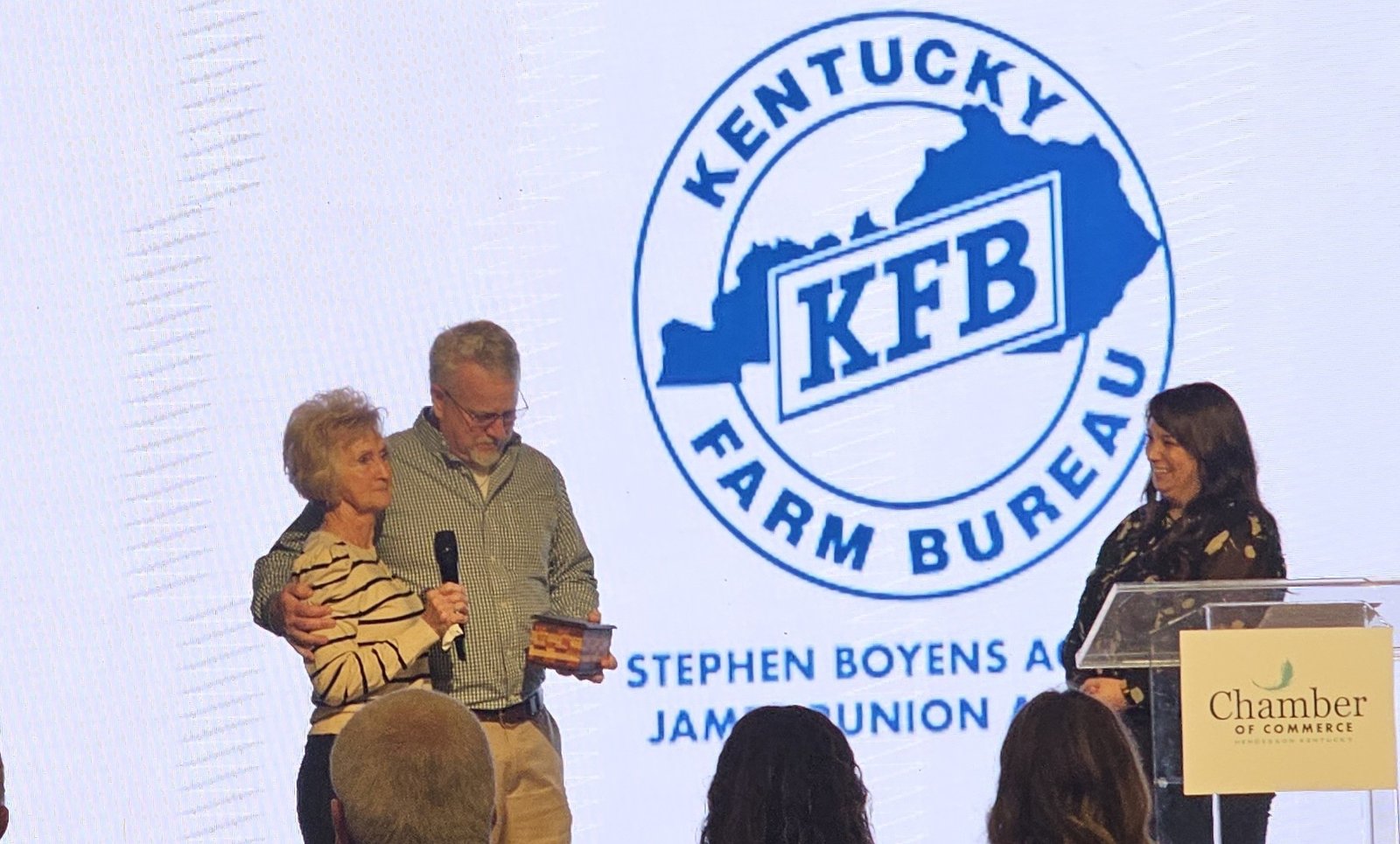
This year’s Agriculture Lifetime Achievement Award went to Mary Jenkins, who along with her husband, Horace, ran their family farm for decades.
Announced at Tuesday morning’s Chamber of Commerce Agriculture Appreciation Breakfast, Jenkins is the second woman to win the award, and she and her husband are the only couple to win the award. (Horace won in 2003).
She also inspired countless young people during her 32 years as a school bus driver for Henderson County Schools. In fact, she was nominated by Jodie James, who as a young girl rode the buses that Jenkins drove.
According to Jenkins on Tuesday, a big part of her work on the farm was keeping the help fed. She said she fixed meals for the two breaks of the day—breakfast and dinner—for many, many years and on most of those days, she didn’t know how many she was cooking for because her husband always wanted to feed whoever showed up at the farm, which could be temporary help, salesmen or others.

“I never knew how many was going to be fed,” she said. Consequently, all these years later, “I really don’t like cooking,” Jenkins said.
After driving the morning bus route, cooking two meals and driving the afternoon bus route, Jenkins came home and went out into the fields, she said.
She said the first farm she and Horace bought early in their marriage was 25 acres. Now, the family has about 1,700 acres, she said. Horace died in 2014.
Mary said she grew up on a farm one of 15 children, and her own father was a tenant farmer who never owned land. She said she was always impressed with him to have been able to feed all those mouths.
According to her son, Tommy, who introduced her Tuesday morning, his mother mentored and encouraged many young people, “always leading by example, especially for young women who want to make a difference.”
She spent her whole life in agriculture, she said. And according to Tommy, Mary’s children and grandchildren work in agriculture, and her great-grandchildren are learning.
“I never dreamed of this,” Mary said when she accepted the award on the stage of One Life Church, where the breakfast was held.
***
Keynote speaker, Aleta Botts, who is the project coordinator for the Kentucky Farmland Transition Initiative, spoke not only about her work in keeping farmland in active farming but also the values connected with farming and agriculture.
Botts told a story about when she was ten trying to finish the feeding a calf a bottle of milk after she’d been run off by the calf’s mother. When finished, her young self had the “look of having done something that meant something.”
Farming teaches values that include showing up for work, working hard, admitting mistakes and fixing them, not lying, and the most important value, she said, is knowing a farmer doesn’t have final control and puts faith in something else.
She said she strives to pass those values on to the next generation of farmers.
Botts also spoke about her current work, mentioning some of the challenges that Kentucky and Henderson County is facing. Kentucky’s farmland acreage is now less than 50% of its total land for the first time in history, she said. Locally, she said Henderson County has lost 11,000 acres of farmland in the last 20 years.
Nationwide, she said the amount of farmland owned by investors has doubled in five years. And in one example, one in five acres of farmland in Iowa is owned by someone who has never been a farmer and does not live in Iowa, Botts said.
One goal of her work is to keep land on a farmer’s balance sheet and keep growing equity in it, she said.
***
Speaking of saving farmland, local State Rep. J.T. Payne talked briefly with the Hendersonian Tuesday before his emcee role for the breakfast began. He spoked HB 785, a bill he introduced on Friday.
In it, solar companies that place solar panels on more than five acres of land would be subject to an annual tax of $200 per acre.
The money collected would go into the Kentucky Rural Agriculture Development Fund to help fund low-interest agriculture loans and other initiatives, Payne said.
He said the reason is that many are choosing to turn rural land over to solar companies because “they get more money.”
He said he wants keeping land in agriculture as or more appealing than contracting with solar companies.
The bill was just introduced, and Payne is not yet sure how much traction it will get in the House. But, he said, “my main goal is to get the conversation at the state level started.”


