


















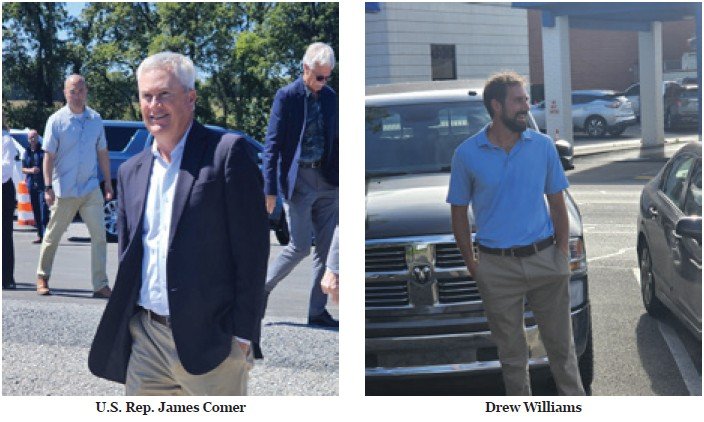
Since May 2025, when he began his campaign for U.S. Representative, Drew Williams has attended 178 events, put 145,000 miles on his Nissan Maxima and gone to all 35 counties in Kentucky’s District 1 at least three times–at least that was the total when the Hendersonian spoke to him at an event last month at Rookie’s.
A Democrat, he says he’s the definition of blue collar, working a $30,000 a year job building boat docks in the Lakes Region of Western Kentucky.
While his work ethic might be impressive, he’s also never won an election, something James Comer, his incumbent opponent in Kentucky’s District 1 Congressional race, noted in a recent phone interview.
“I don’t consider him credible,” Comer said in response to a jibe by Williams that the Congressman is already running for governor and doesn’t have his sights set on the U.S. representative race.

Williams, meanwhile, told the Hendersonian he only knows of two stops in District 1 that Comer has made in which he was speaking with everyday folks and not invited guests at ribbon cuttings or paid fundraisers.
The race for Kentucky’s district 1 congressional seat may be seen as a true David vs. Goliath matchup, what with Comer’s longevity and name recognition as well as the district’s ranking as one of the most highly Republican in the country.
Williams is hoping that he’s able to make some gains simply because he’s traveled all over the district and talked to more people out on the road than Comer has in his Capitol office, he said.
“I would hope I’ve met more people,” Williams said.
Comer said Williams attacks him every day on Facebook but he doesn’t respond to it.
Still, there is some legitimacy in Williams’ claims that Comer is already running to be the next governor of Kentucky. Republicans at the Henderson Lincoln Day dinner in September said Comer would be the next governor. Comer, meanwhile, told the Hendersonian he would decide in November.
Comer said that his top goal as a congressman has always been to represent his constituents and to help make their lives better. He said many of the requests from them are for help with Social Security, Veterans Affairs needs or Medicare. He said his office works to cut through the bureaucracy.
His assistance also goes to businesses in the district, many of which have needed help in dealing with tariffs in importing and exporting their products, Comer said. That means working through the concern with government agencies to make sure the businesses are doing things right, he said.
Another priority is to continue work on cutting waste, fraud and abuse of federal programs. Comer mentioned Medicare fraud and said it represents the biggest increase in government spending, adding there are a lot of phony Medicare providers that are duping states. He said more than 200 people have been arrested thus far as well as three dozen providers.
Comer also believes federal funding to complete the bridge portion of the I-69 Ohio River Crossing project—Section 2—will be coming at some point. He said he’s spoken to President Donald Trump about it, and last year, he attended the Section 1 (the Kentucky side) dedication, when transportation Secretary Sean Duffy was also there–a good indicator of funding coming down at some point.
Comer said “none of us are happy about what’s happening in Iran” and he “wished it had never happened.” He said he wants the U.S. out of the war as quickly as possible and that “it’s already been too long.”
A couple more issues Comer discussed were AI and data centers. On data centers, he said, “It’s a local decision.” He said he wants to pass legislation that data centers that do come to communities must pay for their own energy. A bill like that has passed out of the U.S. House but not yet the Senate, he said.
On AI, Comer said it’s going to happen. “I would rather is happen in the U.S. instead of China,” he said. He said there needs to be guardrails to protect people, and a kill switch. “If there’s such a thing as a kill switch, I’m for a kill switch,” Comer said. AI, he said, will be taken up again in the next congressional session.
Williams counters with what he said he’s heard on the trail that many mistrust the government, and some of the blame can be put on career politicians, which is how he described Comer who has been in some office since 2001.
“A lot of people haven’t felt like their lives have gotten better,” Williams said.
Williams said he’s pursuing the revitalization of the American Dream, which should be attainable—and not a goal that is reached by working two or three jobs.
To make that dream attainable, Williams would like a tax exemption on income tax for everyone who makes less than $100,000 per year. That would eliminate federal income tax for 75% of Americans, he said.
Williams also wants to restructure the Small Business Administration, which he said is focused on either businesses on the large end of being considered a small business–those with 400-500 employees–or micro-businesses, those with 10 or fewer. Businesses that have a number of employees somewhere in the middle, like restaurants, suffer because some of the different incentives or regulations don’t apply to them.
Regarding data centers, Williams said, “We need a moratorium immediately.” He said a community’s health and environmental health as well as community-based dividends need to be considered.
On AI, Williams said that human rights, civil rights, workers rights and creator ethics need to be considered. For example, workers need to have a seat at the table regarding the use of AI, and if their jobs are cut, they need to be re-trained or be given other options. He also said there needs to be dividend structures in place.
He said we are in a period before AI really begins to speed up. “We have a time period before it really starts having a huge impact,” he said.
Williams also said the U.S. military budget needs to be handled in a way in which money is not wasted just so that the next year’s budget can be increased. He said a goal would be to reduce waste and use the savings on that which military leaders, not politicians, deem is important for the armed forces.
Williams said only 2% of Congress historically has come from the working class, a strata that he identifies with.
“I know what $40 (can buy) when you go to the Dollar General,” Williams said, adding residents in District 1 “can definitely tell that I’m going through it with them.”

