















Will love letter to wrestling notch win at home for author with overseas fan base?
(This article first appeared in the June 2026 print edition of the Hendersonian.)
Joey Goebel’s sixth novel, “Sunset Flip,” was published in German on May 20, and the local author, fresh off his school year teaching English and writing at Henderson County High School, flew to Europe soon after for a book tour.
Goebel has a strong following in the German-speaking world and continues to work with a publisher in Europe. For the past three novels—including “I Against Osborne” (or “Ich gegen Osborne” in German) and “I Know It’s Going to Happen For You Someday” (or “Irgendwann wird es gut” in German) and now his current novel, Goebel has written the books in English and then sent the manuscript to his publisher for a translation.
But finding an American publisher has been difficult for his past three novels. In his early 20s, Goebel published “The Anomalies” and then just a year later followed that with “Torture the Artist,” which German-speaking audiences went ga-ga for. Four years later, Goebel published “Commonwealth,” but for his next projects, he hasn’t been able to land an American publisher.

The last three books are only available in German, and Goebel said that is disappointing.
But, with “Sunset Flip,” he hopes that will change, saying this novel might be his best chance for the publication of an English version, or at the least, the best chance of his three most recent novels.
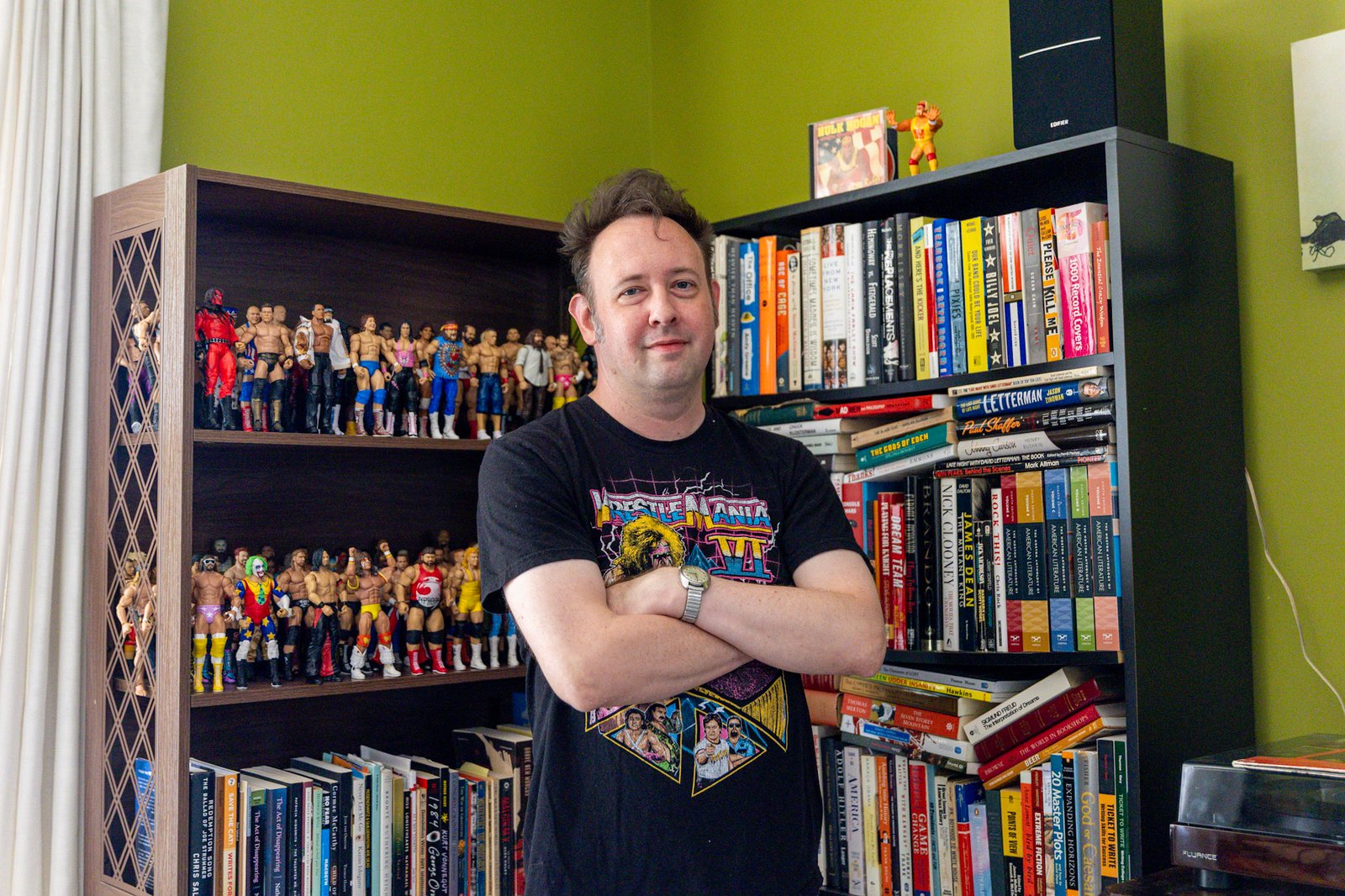
Why? Well, it’s a story wrapped in American pro wrestling—think 1980s and 1990s wrestlers Hulk Hogan, Andre the Giant and Macho Man Randy Savage—and according to Goebel, pro wrestling is “quintessential American culture.”
Though Goebel certainly knows that some turn their noses up at pro wrestling, he sees it differently, and he’s been a fan since he was a boy.
“There is just nothing else like it on the planet,” he said, adding that it’s a bit of escapism for him. “It’s something that allows me to turn my brain off and just be entertained.”
But then several moments later in the interview, Goebel re-thinks that statement and said that he doesn’t totally turn off his brain while trying to figure out the back story of wrestling matches—what are the backstage politics that allows one wrestler to win over the other, when is a wrestler going off script in his (or her) comments and truly speaking their mind about an opponent.
“How much of what I’m seeing is fictional and what role did reality play in bringing this fiction,” Goebel said.
That fiction is much of what the story of “Sunset Flip” is wrapped in, and more precisely the fiction inherent to pro wrestling as it relates to those athlete/actors who are wrestling’s stars.
Goebel describes his new novel as “my literary love letter to ’80s and ’90s professional wrestling but it’s also a character study of a troubled man.”
That man is Augie Schnuck, a pro wrestler who as his fame has grown starts to confuse his wrestling identity with his real identity. Schnuck starts to bring the character he plays on television into his home life, Goebel said.
Goebel said he did a lot of research for the novel, reading dozens of books about wrestling and psychology. He said when actors play a role on television or a movie, they might be filming for a couple months. But a pro wrestler can be on the road 300 days a year playing the character, and add to that, the wrestler might play a character for decades, blurring the lines for the wrestler between what’s real and what isn’t, he said.
Goebel also employed a different structure. In the odd-numbered chapters, told in present tense, the narrative focuses on Augie’s stardom and the unraveling of his personal life. The even-numbered chapters are told in the past tense and provide Augie’s life story but in reverse, starting from near the present and moving back through time all the way to his childhood, when Augie finally discovers trauma that he had repressed through his life.
At that time, Goebel hopes, it clicks with readers that “it was fated from the beginning.”
In addition to the research he’s done and being a lifelong pro wrestling fan, Goebel said there was another reason he decided to work on this novel: his son, Joe, a rising sophomore at Henderson County High School. Joe is also a fan of pro wrestling, and the elder Goebel bounced ideas off his son throughout the process, including taking walks with him that often led to discussions about the novel. Goebel said his son was basically a co-author and he dedicated the novel to him.
Goebel said writing “Sunset Flip” was the most fun he’s had on a writing project since he first started in his early 20s. As he composed his first novel, “The Anomolies,” he wrote with abandon, without care, simply the joy of creating and writing. But after that was published in 2003, there came pressure to write a better novel—and with that came the second-guessing of voices in a writer’s head.
With “Sunset Flip” though, it was a return to the “most joyful writing” since his first novel, and “it shows,” Goebel said.
Unsureway—a new musical project
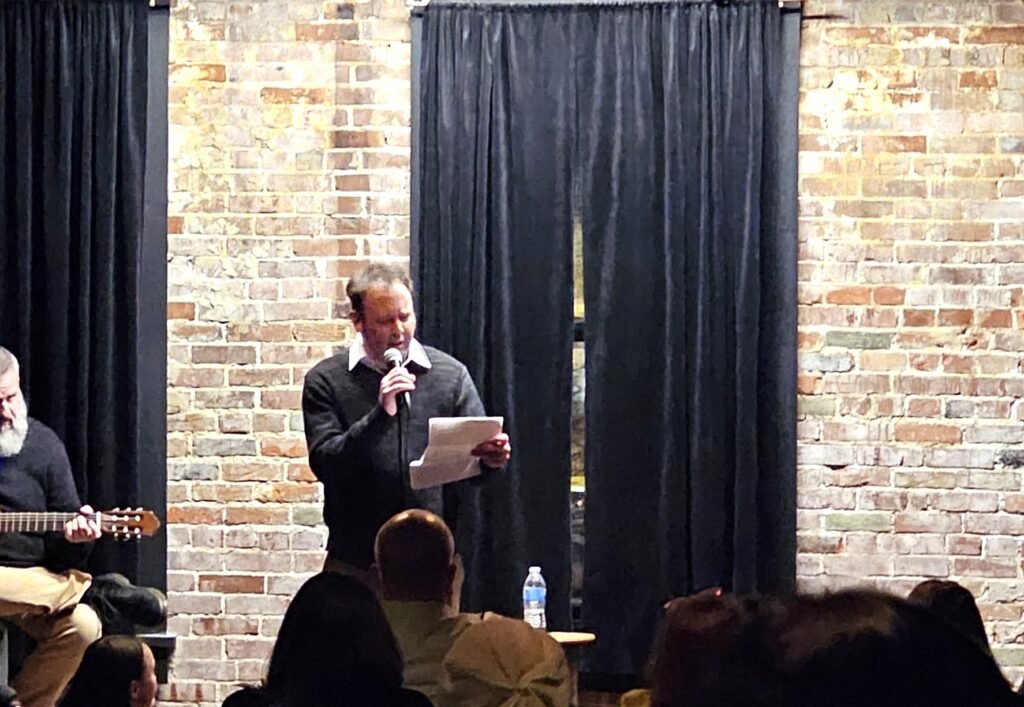
But Goebel is not only a novelist, he also has artistic roots seeped in music. If you are a Hendersonian of a certain age—say mid- to late-40s—then there’s a pretty good chance you remember Goebel’s first band, The Mullets, a punk band that mostly played local and regional venues—including in St. Louis and Indianapolis—in the late 1990s and early 2000s.
Goebel said there was a thriving punk scene in the area at that time, predominantly in Evansville, and the Mullets “gradually accumulated a rabid following,” Goebel said. The Mullets played exactly 100 shows, he said.
Goebel has always kept music close. “Every several years, I get the musical itch,” he said. “Something inside me that compels me to write songs.”
That itch several years back compelled him to write an 18-song rock ‘n roll musical called “Grand Romantic” during the COVID-19 pandemic.
After the pandemic, that itch pushed him to reunite with The Mullets—Jason Sheeley, Justin Hope and him—to record a new album. But it wasn’t as straightforward as that.
Here’s a recap of the unorthodox manner in which Goebel’s new album got made.
One evening, Hope came to his house to hang out, and they were listening to records. At the end of one record from a group they both admire, Goebel uncharacteristically said, “It’s good, but I can do better.”
According to Goebel, Hope told him that if he ever wrote any more songs, then he’d love to get the band back together and record. They left that night with a deal, and Goebel began writing songs—14 of them that took six months to finish.
Then The Mullets, all three of them, began trying to record the songs. But, simply, that became easier said than done because, according to Goebel, it’s a lot different being in a band as adults with careers and families than it is as a relatively carefree teenager.
“It was very difficult to get together at all,” Goebel said. “We would do well to get together once a month.”
That became frustrating, Goebel said, and so the project was shelved for a while—a year or so—and it was in this time that he wrote “Sunset Flip.”
After writing the novel, The Mullets tried again at recording, but “the stars were not aligning for us,” Goebel said.
It was with that backdrop that Goebel had “something similar to an epiphany” when he spied a pair of reading glasses that he’d recently began using. He realized he wasn’t getting any younger—it “signified my mortality.”
Goebel has chronic fatigue syndrome, he said, and seems to be getting worse. In that moment looking at the reading glasses, he asked himself what he wanted to do now as he still has health.
“I decided I needed to make this album at all costs,” he said.
Soon he bumped into a former student, Logan Rideout, at a music store in Evansville. Goebel said Logan and his brother, Landon, are virtuoso metal musicians and he’d seen them play years before.
So, he told Hope and Sheely, in a painful conversation that he was going to record the songs with the Rideouts. Goebel and the Rideouts got some of the tracks down.
Later though, Goebel felt remorse for quitting the recordings with Hope and Sheely. “It didn’t sit well with me,” he said.
When all was said and done, Goebel recorded some of the songs with the Rideouts and some of them he recorded with The Mullets. In addition, Matt Glick, who owns the record store The Elm on Main, played guitar on some of the songs.
The whole project is titled “Unsureway” and was recorded at Russian Recording in Bloomington, Ind.
The album will be released some time in July. According to Glick, Goebel’s Unsureway album, “Songs For The Worried,” will be released on vinyl, and available through pre-order starting June 5 at watchicecream.com, which is the online companion to his brick-and-mortar store on Main Street.
He said the release date is expected to be in late July. A listening party and signing event will take place upon the album’s release at The Elm On Main.
At the time of this article’s early June publication, Goebel was in Germany finishing up a book tour.
Now with the album complete, he told the Hendersonian he is unsure what role music will play in his life going forward.
“I want to say this was it,” he said of recording the album. “But it was so much fun…with the other musicians.”
And admittedly more fun than writing a novel, which for anyone who has written one or tried to write one is a long, hard slog. Yet he knows he’ll continue writing.
“I have to,” he said. “I have to keep writing.”