
















(This column first appeared in the May print edition of the Hendersonian.)
Henderson picked up the telephone about five years after its invention; on-line romance wasn’t far behind.
Alexander Graham Bell patented his invention March 7, 1876, and publicly demonstrated it June 25 at the Centennial Exposition in Philadelphia, thereby launching the telecommunications era.
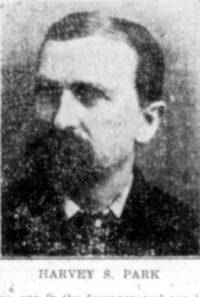
The first articles about local telephones I’ve seen are in the Sept. 27, 1880, edition of Henderson’s Twice-a-Week Reporter. They indicate the earliest Henderson phones probably appeared that summer and stemmed from the work of Postmaster Harvey S. Park and druggist William S. Johnson.

Reporter editor and publisher L.W. Coleman was pushing the new invention, and in one of the first stories he urged the Henderson City Council to install phones in the fire station and at the water works. “Many buildings in the city have been almost entirely consumed before the alarm could be sounded.” He also noted that the telephone company was planning on keeping an operator in the office both day and night.
The other story on Sept. 27, 1880, documents the first long-distance call made from Henderson. W.S. Johnson had approached W.A. Arnold, manager of the local telegraph office, and arranged for phones to be temporarily installed on both ends of the telegraph line between Henderson and Owensboro.
“A pleasant conversation with persons in the latter place” was held and “the success of the experiment was complete. The sound and articulation was quite equal of a low tone of voice in a room and as easily understood.
“Many instruments have already been put into their places, and the connection all over the city will soon be made.”
Park and Johnson set up an exchange on the second floor at the rear of the post office, which was then located at the southeast corner of Second and Main streets, and it was operational by Oct. 14, according to the Reporter:
“Telephone wires running out of the Central office are as thick as spiderwebs on a cool and dewy morning.”
That exchange required the operator to manually make connections between conversing parties.
No sooner had the switchboard been set up than prank calls and jokes began. The Reporter of Nov. 23 related a fanciful conversation initiated by personnel at the Hill & Winstead Distillery at the end of First Street to a liquor store owner downtown.
The distillery had just begun operations that year and a man there was bragging about how much Silk Velvet they had produced. The store owner asked how many shots the distillery man had taken.
“I have only tasted it,” was the reply.
“That won’t do; I know you have taken seven or eight.”
“Why do you think so?”
“Because I can tell by your breath; it nearly knocks me down.”
The distillery man couldn’t believe the smell of whiskey could be transmitted over the phone line, so he told one of the employees to “take a square drink and then came into town so see if he could detect the smell from this end of the wire.”
An early prank call occurred about the same time.
“Some boys in Hon. John C. Atkinson’s coal office amused themselves annoying Betsy Johnson at the coal yard, near the depot, over the telephone wire. Finally, Betsy got mad and yelled out, ‘Shut your mouths until I get through!’
“About this time Mr. Atkinson came in and having some business at the yard rang the bell and Betsy answered, ‘I am through now, go on with your doggoned foolishness.’ He was as much surprised at finding his mistake as Mr. A. was at receiving his message.”
By Dec. 10, 1881, the exchange had 49 telephones connected. A typewritten list of subscribers was made, and it was reprinted in The Gleaner of Nov. 17, 1929. Seven subscribers had two telephones—for both home and business—while W.J. Marshall had three. Seven of the subscribers were doctors.
Marshall, by the way, apparently was responsible for running the telephone line to Corydon, according to the Reporter of Oct. 8, 1881. “The line will save many a long ride and many a dollar to our people,” the Corydon correspondent wrote. “The enterprising firm of W.J. Marshall & Co. deserve great credit and should be liberally patronized.”
The 1929 article noted the bell in the Henderson telephone exchange was loud, according to one old-timer recalling events from the early 1890s. “The office was equipped with a regular alarm bell, which could be heard in the summertime when the windows were open.
“The night operator was a boy about 19 years old, and he would go to sleep, and the bell failed to awaken him. Men who stayed out until the early morning hours would throw rocks through the window and occasionally hit the boy to awaken him.”
The April 7, 1881, Reporter noted Joseph Johnson was running the exchange.
Lizzie Held, a daughter of former mayor Jacob Held, had been working as an operator, according to the Reporter of Sept. 19, 1882, because that story noted she had resigned to take a job with the phone company in Evansville. “Her friends wish her every success.”
By Nov. 17, 1882, Gus Slaughter was running the exchange and Robert L. Lewis was the night operator.
The Evansville office appeared to be very busy, according to the Semi-Weekly Reporter of Nov. 22, 1882, which noted it was enlarging its switchboard to connect 600 subscribers. Evansville had just connected to Nashville and had connections to about 70 other towns and communities throughout the Tri-State area and parts of Tennessee. That included Henderson.
The Semi-Weekly Reporter of Feb. 23, 1883, noted Lizzie, after less than six months in Evansville, apparently got homesick for Henderson. “Miss Lizzie Held has accepted a position in the telephone exchange and manipulates the wires during the day. Bob Lewis runs the machine during the dark, gloomy hours of the night.”
On Nov. 14, 1884, the Henderson Reporter published the following item: “We regret to learn that our accommodating telephone exchange operator, Miss Lizzie Held, has tendered her resignation to the company. It will be difficult for them to fill her place with one who will give such general satisfaction as she has.”
Exactly a week later the Reporter published an article that had originally appeared in the Owensboro Messenger, which explained why she had resigned:
“A pleasant little romance will culminate in a marriage in a neighboring city in a few weeks. The bride that is to be was, until she resigned to prepare her trousseau, operator in a telephone exchange. First attracted by her sweet voice and amiable manners, which he discovered in business conversations, a prominent young businessman in a village 50 miles away became interested in her.
“He sought an introduction over the wire, and finally visited her in her home, and found her in personal appearance as charming as her voice was musical. In a few weeks an interesting courtship sprang up, which was expedited through the telephone, (the precaution being taken, we presume, to cut all other connections off), and the result will soon be publicly announced.
“There’s many another man whose ear has been electrified by the sweet voice, and whose heart will ache when these lines are read.”
To all of which the Reporter added, “Wonder who it can be.” The Reporter had been closely following Lizzie’s career, so I suspect the editor knew exactly who she was.
A marriage license shows she married M. Stutzenberger on May 19, 1885. But they didn’t live happily ever after. Lizzie filed for divorce about July 1886, according to the case index for Henderson Circuit Court.
Any account of Henderson’s early telephone system would not be complete without mentioning a kind of marriage that took place in 1928—merging the two phone systems that had served Henderson for more than three decades.
The original founders of the first system, Park and Johnson, sold it to J.W. Porter of Owensboro in early 1881; in September 1883, it was incorporated as the Cumberland system which, in turn, was swallowed by the Bell system.
In 1893, according to Maralea Arnett’s “Annals and Scandals” book, it was joined by another phone company commonly known as the Home Telephone Co., but more accurately called the Henderson Telephone and Telegraph Co. Both that firm and the Cumberland company were granted franchises by the city on Sept. 24, 1898. The Cumberland firm paid $70, and the Home system paid $65.
For decades any well-connected Henderson citizen had to have two telephones and two different directories because there were no connections between the two systems.
In November 1927 the Henderson City Commission approved merger of the two systems, but it conditioned that approval on removal of the Home system’s telephone poles from the downtown area, which took place in June 1928.
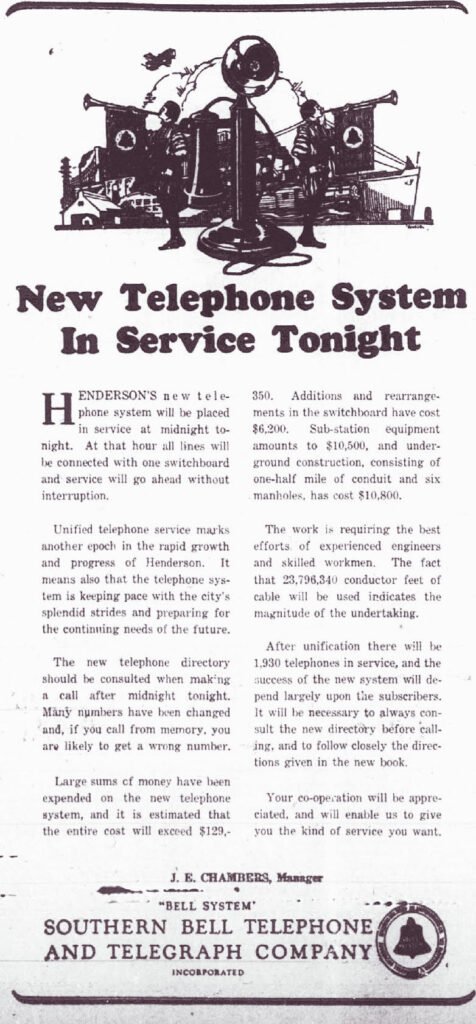
The merger took place at midnight on Sept. 29, 1928, according to an advertisement in that day’s Gleaner. At that point, the Home Telephone system had approximately 800 customers.
“The switching of the lines took but about eight minutes,” according to a brief article in the Sept. 30 edition.
The merger created a system that had 1,930 local telephones.
A lot of people hung up during the Great Depression because as of Oct. 1, 1935, there were 1,489 local phones. However, there was a boom in the late 1930s because by 1939 there were 2,025.
World War II created a backlog of phone orders—about 525—which weren’t filled until after the war. Henderson had 5,915 telephones as of December 1950.