












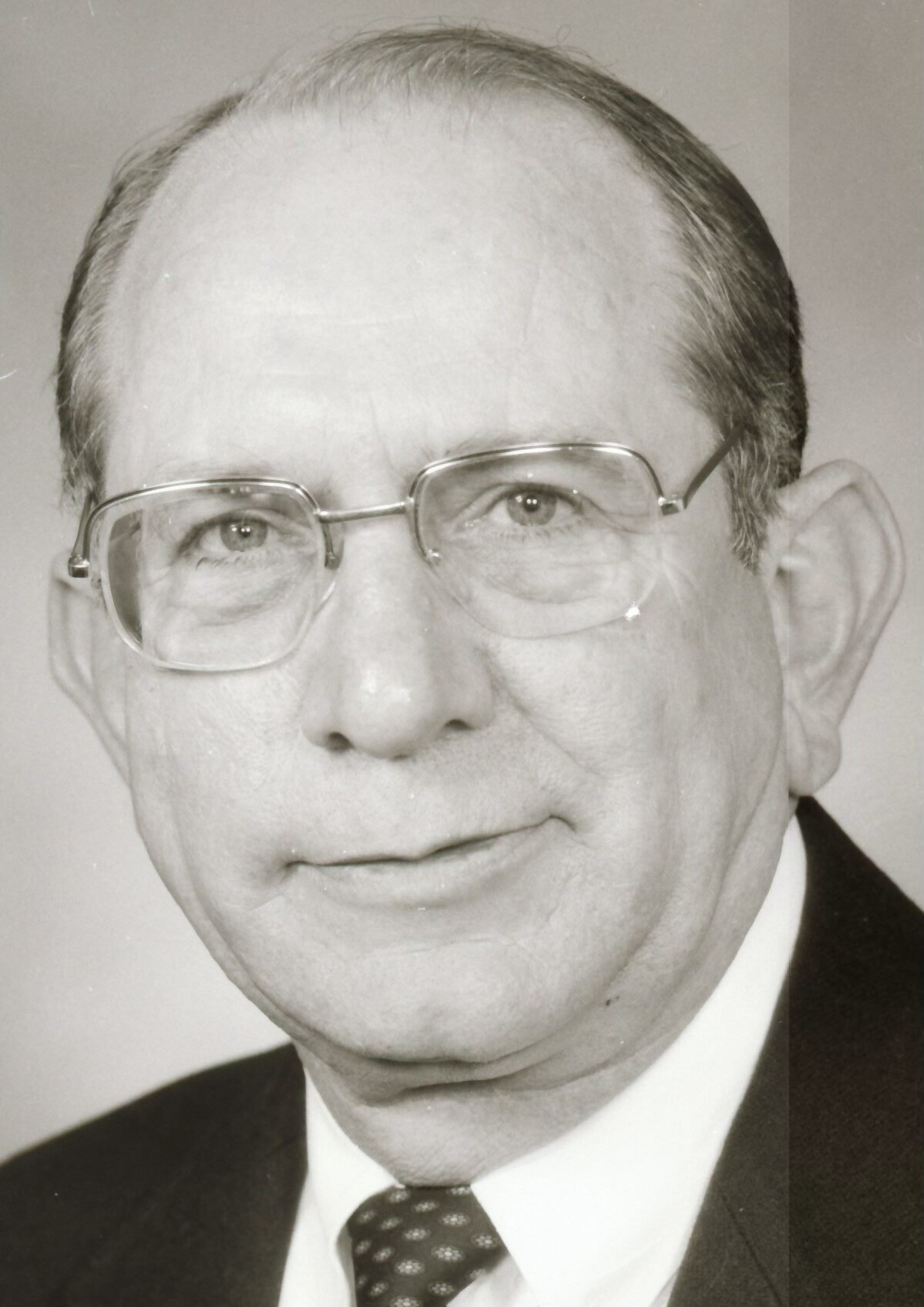
If Henderson had a Mount Rushmore, Dr. John A. Logan’s face would be chiseled into its granite.
If it were Cooperstown, his plaque would hang there.
If there were a phrase in the dictionary for “He was hard to say ‘no’ to,” his picture would appear beside it—along with the phrase, “unless you didn’t intend to fully follow through with it.”
After decades of steadfast work to better his adopted hometown, the longtime physician, local hospital advocate, community fundraiser and civic booster died Sunday at Ascension St. Vincent in Evansville. He was 88.

Friends, colleagues and admirers say he is irreplaceable.
“You don’t come in contact with many people like that in a lifetime,” Wayne Meriwether, former Methodist Hospital chief operating officer, said of Logan in a phone interview. “He was so special. I count it as one of my many blessings.”
“Every day he wakes up and works to make this community better,” Dr. Lee Newberry, a colleague at the hospital, said at a ceremony in 2017 when a plaque honoring Logan was unveiled at Vista View Plaza at Seventh Street and Merritt Drive along the Henderson RiverWalk.
Logan’s long, close friendship with U.S. Sen. Mitch McConnell was key to funding a key portion of the RiverWalk and other riverfront improvements.
In 2013, Logan recalled how McConnell secured funds a decade earlier for construction of The Depot, the replica of the historic but deteriorating former railroad passenger station that many at the time assumed was unsalvageable and would be lost forever.
McConnell came to Henderson to dedicate The Depot, then that night spoke at a Henderson Chamber of Commerce banquet. Later, the senator and Logan spent hours on Logan’s back porch, discussing the phenomenon of “cities rediscovering the rivers,” as Logan later recalled.
“He listened intently and never said a word,” Logan said. But weeks later, McConnell called to ask how much it would take to upgrade the Henderson riverfront, which at the time was largely just an asphalt parking lot with boat ramps.
What resulted in 2005 was a $10 million federal earmark that funded a redevelopment of the riverfront, the addition of restrooms and sidewalks in Sunset Park, the scenic extension of the RiverWalk between Sunset Park and 12th Street, new sidewalks along Water Street/Merritt Drive, development of Red Banks Park at a former rock yard, substantial improvements to the Doc Hosbach Tennis Complex and the stabilization of the riverbank in the vicinity of Riverview School and the tennis courts—in short, a reboot of Henderson’s priceless but long-ignored riverside venue.
Logan and others spent years raising funds for many other community improvements, including the Henderson County Family YMCA; the Preston Arts Center and the Sullivan Tech Center on the HCC campus; a fund drive to put computers in public schools; the $2.4 million Rotary Colonels to College scholarship endowment; the Hugh E. Sandefur Center (now called Elevate); the hospital’s neonatal intensive care unit; a collection of John James Audubon memorabilia for the Audubon Park Museum and the ongoing Interstate 69 work.
Logan was also an early and crucial supporter of the initiative that became St. Anthony’s Hospice.
And he was instrumental in the restoration of the long-neglected Spring Garden Cemetery off Zion Road that is the final resting place of Gen. Samuel Hopkins, arguably the founding father of Henderson, if not its namesake.
“Many of those things wouldn’t have happened if it hadn’t been for John,” attorney and former state legislator David Thomason said in 2017.
Thomason recalled how Logan years ago pushed for funding in the state budget for the fine arts center. In the closing hours of the Kentucky General Assembly came a catch: Henderson would have to contribute $200,000 to make the bonding a reality.
Asked in the middle of the night if the community could make that happen, Logan replied, “You’re damned right!”
“He never met a challenge he didn’t embrace,” Thomason said. “Once he’s on board, the ship doesn’t sink. In my opinion, he has done more than any other volunteer in the past 50 years.”
“Many of Henderson’s landmarks simply wouldn’t exist without John’s leadership,” McConnell said in a 2019 tribute he had entered into the Congressional Record.
Inevitably, endeavors like those required lots of money. Often as not, Logan chaired or co-chaired the fundraising campaigns.
“There will never be another person who could raise money like John Logan,” retired banker and travel ambassador Phyllis Crafton said.
“He is who taught me how to raise money for worthwhile causes,” financial advisor and former nonprofit executive Mark Chumbler, who has been a part of several campaigns, said. “I learned every ounce of that from him.”
Logan would enlist influential citizens to go out in the community and ask for money for important causes. “And if you didn’t, if you agreed to be on a committee and you didn’t fulfill your obligation, he would be quick to tell you, ‘I don’t think this is for you,’” Crafton said.
“He was a good friend and a person who loved this community, and quick to take on the task of raising money for whatever the cause was,” she said. “He didn’t do it for the recognition. He did it for the community.”
“I’ve leaned hard on a lot of people … for the benefit of the community. The list (of those he leaned on) is long,” Logan acknowledged in 1993.
During a community visioning process in the mid-2010s in which a host of community betterment ideas were being pursued, Logan at a Henderson Rotary Club meeting summed up his no-nonsense credo: “If you get on one of these projects, you need two things: You need the patience of Mother Teresa and the tenacity of a bulldog. If you don’t do that, you won’t get it done.”
So great was the impact of civic leaders such as Logan, newspaper publisher Walt Dear and businessman/philanthropist Ray Preston that the thought of them aging and someday retiring from community life inspired five younger community leaders to form the Henderson Leadership Initiative in 2006, which has groomed and graduated 328 Hendersonians, many of whom are now leaders in this community’s public, business, civic, nonprofit and educational lives, with more in training now.
A native of Edmonson County, Kentucky, Logan was just a sixth grader when the baseball coach at Brownsville High School recruited him to play catcher on his varsity team in 1951.
“I started without a mask and I still have the scar under my left eye to prove it,” Logan recalled in a 2019 Father’s Day guest newspaper column penned by a granddaughter, Ashton Brooks Logan.
Young John Logan went on to play for the American Legion team from Bowling Green and became acclaimed across Western Kentucky for his strong throwing arm, cutting down opponent after opponent who dared tried to steal second base.
So respected was his arm that in the 1955 American Legion Junior State Tournament, opposing baserunners dared not to try to steal second … not realizing that Logan was playing with a broken elbow and couldn’t throw hard.
When he was a teenager, a Brownsville physician became a mentor to Logan, allowing him to shadow his work. After high school, he flew through his undergraduate studies at Western Kentucky University, then enrolled in medical school at Vanderbilt University. He later would tell Jack Hogan, the director of facilities management at the hospital here for many years, about hitchhiking home to Brownsville from Nashville.
Logan attended medical school on a scholarship that required him to spend a year practicing in an underserved rural area for each year he was in medical school.
So, he opened a practice in Sebree, the hometown of his wife (and office nurse), Jackie Barnett Logan, doing the things that country doctors did then, as well as becoming associated with Community Methodist Hospital in 1962.
Hogan said Logan told him of making house call after house call across three counties, then returning to his office to find a waiting room full of patients.
“He said he missed a lot of his kids’ lives” working long hours, Hogan said.
Logan in 1967 opened a private family practice here with Dr. Kenneth Eblen and became enmeshed with the Henderson community, such as helping with the fund drive that built a modern YMCA facility that opened in 1973.
In 1986, Logan resigned from private practice to become medical director at what was then Community Methodist (now Deaconess Henderson Hospital), going on to also serve as president of the medical staff and chief of the medical staff.
“Probably the biggest thing that stood out to me about him was, he always had best interest of patients in his mind,” said Bruce Begley, who was the hospital’s CFO and assistant executive director when Logan was hired at the hospital, later becoming its CEO.
“When it came to the medical profession, he was a man of high integrity and wanted everybody associated with hospital to do their best, treat(ing) patients as family,” Begley said. “That to me made things very successful.”
“He was certainly an organizer, highly driven, result-oriented and had a great heart for people. And a great heart for doing what’s right,” David Park, the hospital’s former general counsel, said.
“He cared about all parts of a person—their physical health, their mental health, their family health. He just cared,” said Pam Moran, who served as the hospital’s vice president of strategic planning and marketing as well as working for the hospital foundation.
Working in an office suite at the hospital with Logan gave Moran special insights into him.
“What I remember best about him is that people sought his counsel,” coming to his office and meeting behind closed doors on all sorts of topics, she said.
“He was a good advisor,” Moran said. “You might not want to hear it sometimes, but he was a good advisor.”
Logan could present a seriousness, even gruffness, that might have intimidated some, and he could be plain-spoken.
“I wouldn’t say he ruled with an iron fist, but there was definitely a John Logan way. But he got things done,” said Scott Davis, former chairman and CEO of Ohio Valley Financial Group/Field & Main Bank, on whose board Logan once served. “If you couldn’t abide that, you shouldn’t stay around … John was not going to suffer anyone who wasn’t going to do the work.”
“He was not someone I wanted to disappoint or say no to,” said Davis, who served in many civic capacities with Logan. “If he asked me to be a part of some campaign, I wasn’t going to say no.”
Logan’s candor had its advantages. “I always knew where his heart was,” Begley said.
“To me, he was easy to work with,” said Lisa Hope, spent 37 years as a secretary at the hospital, most of it working directly with Logan. “He’s just up front. He’s honest. He’s direct. You don’t have to wonder. He tells you, and that’s it. I miss him.”
“I was a little intimidated at first,” Hope admitted. “He was a little fiery, quick when he speaks. No nonsense. I had to figure him out.”
She said she did.
“He was such a good guy,” Hope said. “He loved that hospital. He was the hospital. He had insight and vision. He always did what was best for the hospital. He never got down in the minutia; he saw the big picture.”
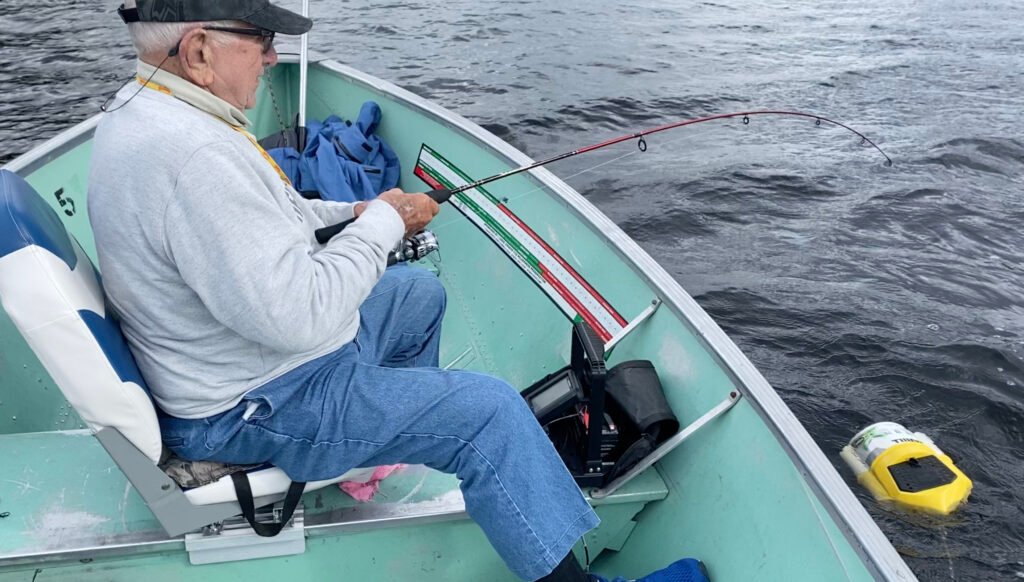
Others saw yet other sides of John Logan. Businessman Jim Crafton, along with first his father, then his son, went on fishing trips to Canada and elsewhere for more than 35 years with Logan and other friends.
“He was a wonderful storyteller and joke teller,” Crafton said. “Bruce Woodring (and Logan), the two of them, were just great at that. I really enjoyed that. After we had been going awhile and we knew some of the stories and jokes they would tell, if they hadn’t told them, we would start prompting them. Some of them were just as funny the 30th time as the first time.”
Sometimes the group staged contests to see who could catch the biggest fish. “He was a competitor,” Crafton said. “He liked to win the fishing contest”—or at least beat his friend Woodring.
“He was a lot of fun to be with,” he said.
“He had a really good sense of humor,” Moran said. “He was funny.”’
“If you got close to him, you could have fun with him,” insurance agent Chase Fulcher, who had known Logan since growing up near his home, said. “But when it was business, it was all business.”
Logan was also bright and informed.
“He was knowledgeable about everything,” Hogan said. “Any subject you could come up: Agriculture, fishing, hunting, anything.
“We both loved Kentucky history,” Hogan said. “I think I’m knowledgeable, but whatever I came up with, when we would be at lunch, he was more knowledgeable than me. He could quote people from the 1800s.”
Others credit Logan for guiding their career trajectories.
“Dr. Logan was a visionary,” said Angie Beck, a registered nurse who went on to become vice president of clinical quality at Methodist.
“He was a mentor to me when I was a brand-new nurse in a bedside role and as a nurse who went into more of an administrative role, with him as my mentor and leader,” Beck said. “… I feel blessed that I was able to work with him as long as I did and he gave me opportunities I wouldn’t have had had he not been there. … I am forever grateful.”
“He was Henderson,” she said. “He was the hospital. He gave so much of his life to both.”
“He did lot of things not just for hospital, but for whole town of Henderson,” Begley said. “He loved Henderson. Anytime he could pull some political strings to benefit Henderson, he would and he did everything he could to make it a better place.”
“He so much encouraged people to give, give their time, give their expertise” to better the community,” Moran said. “And he gave of his.”
“I feel strongly that professional people, too many times, in their own community use the excuse of not helping out in community organizations because they are too busy,” Logan himself said, according to his granddaughter Ashton’s guest column.
Logan was honored numerous times.
In 1993, when he was named the Henderson Chamber of Commerce Distinguished Citizen of the Year, Logan joked that after 30-plus years, he had finally gotten his “citizenship papers.”
“I hope over the next 30 years … we can leave this community a better place,” he said in accepting the award.
“This is a great place,” Logan said at the time. “It’s not a great place because we have buildings. It’s not a great place because we have technology. It’s a great place because we have good people.”
Obituary information for Dr. Logan was not available at the time this article was posted.

