


















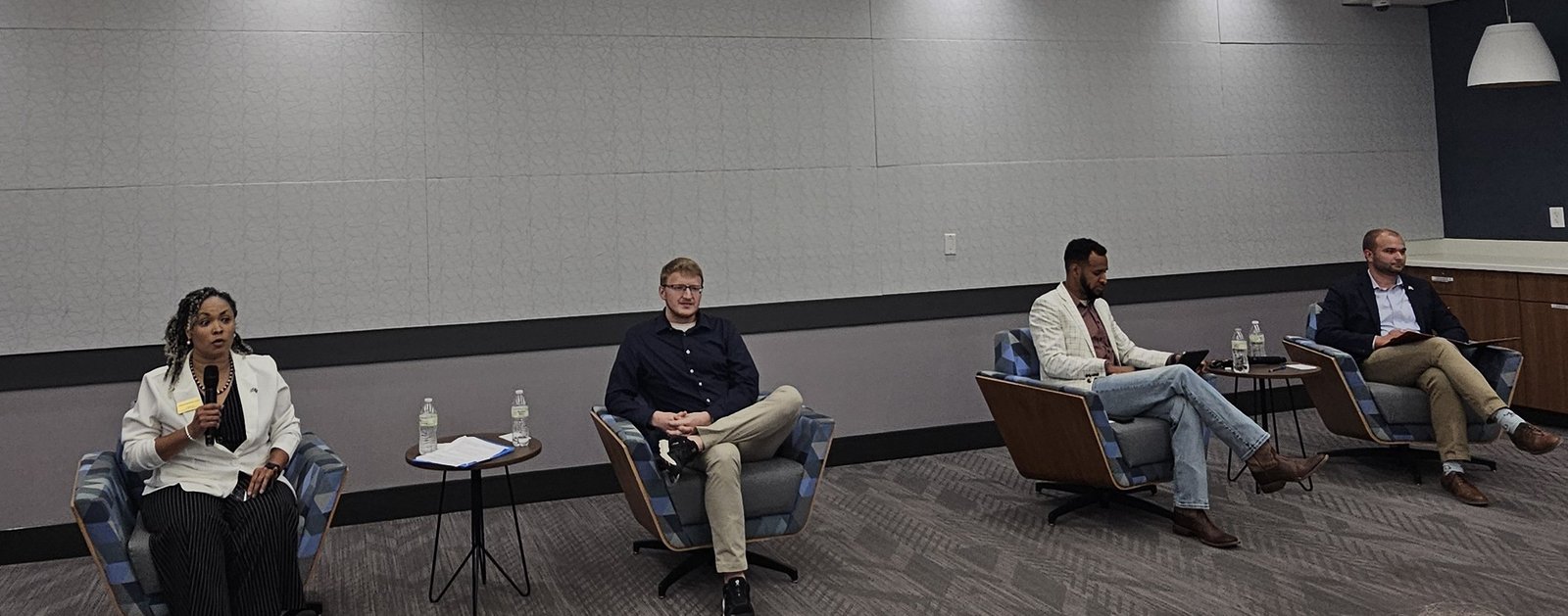
Four local candidates took part in the Henderson NAACP’s “Can We Talk?” forum, answering questions that included topics of data centers, business development and Flock cameras.
Those at the forum included Democrat Janelle Glass and incumbent Republican J.T. Payne, both vying for the Dist. 11 state representative seat, and Democrat Les Jenkins-Mackey and Republican Timmy Dunn for the Henderson County judge-executive post.
The forum was organized in a manner that started with questions coming from the NAACP followed by questions that came from the audience.
Data centers

Glass said she would follow what the people wanted, and didn’t want data centers to have more power than people.
“I don’t want anyone to feel as if data centers have more right to water that I do,” she said.
She later asked if governments will respect communities that say they don’t want a data center.
Jenkins-Mackey said there’s a chance that a data center could come to Henderson, and if that were the case, it would follow the normal planning and zoning process.
“I’m OK with them not coming here,” he said, but if a data center company did attempt to, he said he wants the community to have the discussions together.
Dunn said the rise of data centers being built is a recent hot-topic, hidden from most while people were concerned with other issues. Though there could be some pros to data centers, such as an expanded tax base, he’s not in favor.
“I’m against the data centers,” he said.
He added that it comes down to strong leadership, and if county leaders say no, there’s no problem after that.
“We just stand firm with what we want,” he said.
Payne, meanwhile, framed the issue as a national security concern, saying if the United States doesn’t keep moving forward with data centers and AI, then another country—China—will run with it and leave the U.S. a “third world country.”
Payne, however, also said that having a data center in a community is a community decision, and there are regulations that can be put in place to ensure data centers are safe.
Flock cameras
Jenkins-Mackey said that current Flock cameras within the city limits of Henderson were voted on by participants in the Inner City Improvement Plan. He expressed concerns with Flock, though, because of a history of disproportionate racial profiling and that systems of all sorts get hacked all the time, which would lead one to believe that Flock systems could, too.
Dunn agreed that Flock cameras have helped solve some crimes in Henderson, but he doesn’t see the necessity here.
“Personally, I don’t see a need for Flock cameras in Henderson County right now,” he said.
Though not in favor, he said, “I think the voter has the final say.”
Payne expressed concerns with where the personal information gathered by Flock cameras ends up years from now. And he’s not sure about involving a third-party company with the government and where a person’s information may end up.
“That’s not something I can get on board with right now,” he said.
Glass said she wants to protect the community but had concerns with what happens when a subscription with Flock ends.
Business and economic development
Dunn said that a key to new business is having new people in the mix.
“When I won the primary, we started to break up the ‘good ol’ boy’ system,” he said, adding when he wins in November, the playing field will be equal for all.
To that end, he said for the county to be more business friendly, he’ll work with the codes department to make going through that process smoother and will offer programs and incentives for small businesses.
He also spoke about bringing unique national businesses to the community, such as Bass Pro Shops.
Jenkins-Mackey spoke about bringing businesses that offer high-paying jobs so that kids here today will want to come back here to live in the future. He mentioned Henderson County High School’s Career and Technical Education unit as providing the training that will allow students to get good jobs here.
Payne listed four points that are key to developing economically. A community has to have good infrastructure; businesses want friendly tax rates; a community needs to have enough people in the workforce who are educated; and a community needs to offer good quality of life and adequate housing, he said.
Payne said he was given a 100% grade by the Kentucky Chamber of Commerce as a pro-business legislator based on his voting record.
He also mentioned the work state local state legislators are doing in the community to fulfill some of what he mentioned, such as funding a new conference center at Audubon State Park and funding the design work for a Loop Road that will start at a spot in the Bentley Point subdivision behind Walmart and then run beside I-69 before connecting with U.S. 60 at Wathen Lane. He said it will provide areas that can be developed.
“I-69 is no good to us if we can’t develop off it,” he said.
Glass spoke about finding ways to pay more to workers.
“We need to talk about how we are paying people in this community,” she said. She didn’t offer concrete approach on how a legislator can increase workers’ pay, but said increasing minimum wage doesn’t have to occur only at the federal level.
Mail-in ballots
The first question of the evening concerned mail-in ballots. All four agreed that mail-in ballots are a good thing, giving those with disabilities and mobility issues a chance to vote.
“Everybody has the right to hire us,” Glass said. “We want to make sure every voice is heard.”
Jenkins-Mackey said it affects people across the spectrum.
“I think it’s something we need to protect,” he said.
Dunn said mail-in ballots is not something a candidate for county judge-executive really needs to weigh in on. But he added, “I see no issue with the mail-in ballot.”
Payne said accessibility is important but “we also want to do (voting) securely.”
“Kentucky has one of the most secure election systems in the nation,” Payne said. “I would keep it the way it is.”
Nate Boyett, the Hendersonian’s advertising and grant specialist, live streamed the forum on Facebook. To watch it, click here.

