

















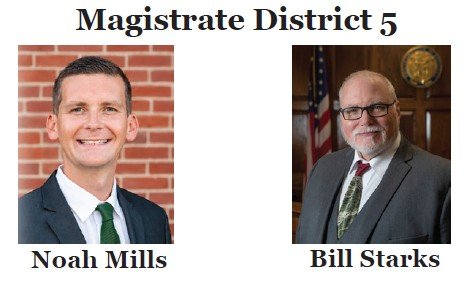
Candidates for the District 5 Magistrate seat are making similar appeals to voters with both incumbent Bill “Stephens” Starks and challenger Noah Mills talking about growth that will come from Interstate 69’s completion and working with City of Henderson leaders to best represent constituents in this area as development occurs.
In an interview with the Hendersonian, the three top items on Starks’ agenda are maintaining the county government’s strong financial position, working with local quasi-governmental partners to bring responsible growth and continuing to work with the City of Henderson on local projects.
Mills, in his interview, made the point that constituents he’s talked to during the campaign don’t feel like they’ve been heard, while also mentioning responsible growth and working to lower the cost of living.
Mills’ top goal is to communicate with his constituents of district 5 because he said over the previous few years, they’ve not been heard by county government. He said during his campaign, constituents have told him that they “just feel like they haven’t been heard” mostly about green energy issues prevalent in the news.

“They just want a say as to what’s going on,” Mills said.
Top on Starks’ list is to ensure that the county continues to spend taxpayers’ dollars wisely. He said that the Henderson Fiscal Court has not raised taxes for eight years (though other officials say it’s been longer). The challenge in continuing to do that be affording the rising price of fuel and diesel and just keeping up with inflation, Starks said.
“We’re (county government) not immune to those spikes in prices,” he said.
Though he said there are fewer grants now than in the past, the county will need to continue to go after grants and look for ways to collaborate with the Green River Area Development District and Delta Regional Authority and any other organizations, he said.
Coming up, Starks said, the county government needs to be prepared to replace emergency service radios, which will be very expensive—millions of dollars. The county also must always be ready to deal with the aftereffects of emergencies, such as the flooding Henderson County has had in recent years or other natural disasters, Starks said.
“I’m more for having a healthy surplus because we don’t know what tomorrow brings,” Starks said.
Mills mentioned that surplus in his interview. He said he’d like to take a look at the county’s reserve fund. Currently it’s sitting north of $40 million, and some might take that as a result of being taxed too much, he said. He said that the county still must keep a hefty rainy day fund because there are big expenditures that are going to come up over the next four years.
He believes the best use of money is on infrastructure, which will attract businesses and growth.
Connected to the hefty reserve fund is cost of living adjustments that could be made, something Mills said he wants to look into. Earlier this year, the Henderson County Fiscal Court cut the insurance premium tax for residents who live in the county. But for the residents of District 5, there was no cut because they live within Henderson city limits. He said he’d like to look at ways to make it more fair, which could be other cost of living adjustments for those who live within the city.
Both candidates have growth—and in their words, “responsible growth”—on their minds.
Starks credited Henderson Economic Development and the Henderson City-County Planning Commission as being important pieces in future economic development projects, and fiscal court should continue working with them to bring growth. He said growth must benefit the community.
“When we look at this, we don’t just have growth for growth’s sake,” he said.
Starks said the county government’s partnership with the city has had some recent impacts. Many of the projects will have benefits for city and county residents, he said. He included a recent Henderson Municipal Gas project in which the county is helping to fund a gas line extension that will reach Smith Mills. He also mentioned the county’s funding to the tune of $1 million of the lighting of the city’s SportsPlex and fiscal court’s $2.5 million funding that is going to the construction of the conference center in Audubon State Park.
There’s also going to be much development coming with I-69, he said.
“This is going to have an impact for many years,” Starks said.
His role in that development in District 5 is to be a go-between his constituents and the city and to advocate for them, Starks said.
For growth in the District 5 area, Mills mentioned the “Loop Road” more than once in his interview. He believes the Loop Road, a proposed road that will connect the Bentley Point subdivision with U.S. 60 at Wathen Lane and which part of will trace I-69 for about 1 ½-2 miles, is a key piece for growth in Henderson.
With responsible growth, Mills said improving infrastructure is key for allowing growth to occur.
District 5 is located within City of Henderson limits, and Mills also said that he wants to work on more partnerships between city and county government to bring projects and programs to his constituents. Mills said building relationships with city leaders as well as being a part of the City-County Coop and garnering more support from other magistrates for projects within city limits will help. Again, he spoke about the Loop Road, “which is our biggest area for growth.”
Growing from the opportunities of I-69 is key to Mills’ focus in the next few years.
“We need to try to take advantage of it as best as we can,” Mills said.
About data centers, Starks said, “I have a lot of concerns. Who wouldn’t?” Those concerns include its siting and impact on residents, not to mention the top reason for the proliferation of them, AI.
With the planning commission just starting to look at this issue, he expects it will fall where other high-octane issues in recent years have fallen—with a very restrictive ordinance that sides more with residents. Again, he pointed out that growth should have benefits for the community.
And he said a data center, if one were to locate in Henderson County, would need to be sited thoughtfully—somewhere like the Penn Virginia strip mine site in eastern Henderson County. Not on farmland, he said. “We need to protect our farmland,” Starks said. “That’s our heritage.”
On data centers, Mills said the current best path forward is to put in place a two- or three-year moratorium. This will allow for guidelines that state legislators put in place in upcoming sessions to become law and would allow for a better baseline to write a county ordinance, he said. And a moratorium “gives us time to listen to what the residents of Henderson County want,” he said.


