

















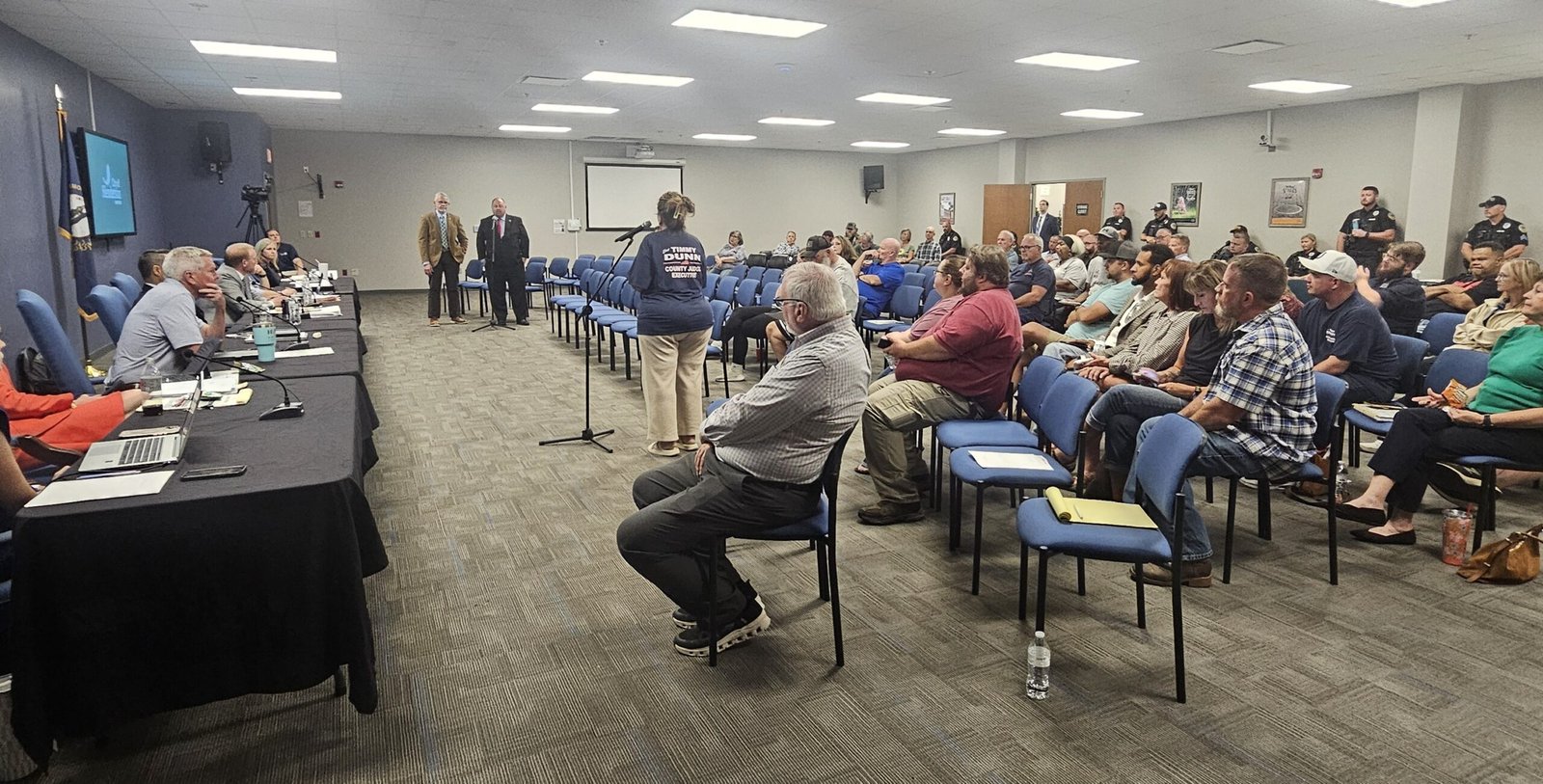
Most of the concerns brought up at a Henderson City Commission public forum on Flock cameras revolved around recent abuses of the technology throughout the nation and an overreach regarding its surveillance capabilities.
But the tenor was calm and the responses measured in what was expected to be a more charged audience, which didn’t fill half the allotted seats at the City of Henderson’s Municipal Service Center on Corporate Drive Tuesday evening.
At the end of the meeting, city commissioners—for the most part—said they’d hold their opinion about Flock cameras until they could learn more about the technology.
Commissioner Rodney Thomas said that before the meeting he was undecided on the issue, but afterward, he was leaning toward being in favor, though he still wanted to do more research.

Commissioner Austin Vowels said his mind was not made up on the issue, while Commissioner Robert Pruitt said he wouldn’t make any decision that night, though he did say if the 22 Flock cameras leased by the Henderson Police Department remain in use, they will not operate under the “same guardrails” as they have since being put in place a couple years ago. He said the people should be at the table but didn’t elaborate on how that would work.
Because Tuesday’s meeting was a work session, no action could be taken, and Mayor Brad Staton explained that residents can continue to make comments about Flock technology on the City of Henderson’s website here until Nov. 13.
Staton also said the issue would only be put on a future agenda if commissioners want to have a vote on doing away with Flock cameras. If it is determined that a vote is needed, either through the mayor’s individual discussions with commissioners or through discussion at a future city commission meeting, then the issue will be put on a city commission meeting agenda some time after the Nov. 13 cutoff for comment, the mayor said.
A main component of Tuesday’s meeting involved questions that city officials gleaned from comments residents had made on the city-hosted online form as well as in-person queries. Invited to answer them were HPD Chief Billy Bolin and Phillip Arnold, a public affairs manager with Flock Safety, which is based in Atlanta.
Residents wanted to know the difference between Flock and surveillance, the length that data is kept in the Flock system, safeguards in place to protect information, the differences in Flock and other companies that have cameras with similar capabilities, specific public safety purposes of Flock, if information is shared, how locations of cameras are determined and more.
Residents also raised concerns about 4th Amendment rights being violated, as did one speaker who feared that personal information can be obtained without a warrant.
Both Bolin and Arnold said that using Flock does not infringe on those rights because the technology simply takes pictures of the backs of cars as they pass, and those images contain among other pieces, license plates and numbers. Flock also captures the color, make, model and any significant markings on the back of the car, Arnold said. But both he and Bolin said the technology doesn’t take pictures of the drivers.
Pieces of information can be entered into the Flock system when investigating a specific crime, officials said, which the technology uses to pull up photos of vehicles that could have been involved.
For example, Arnold told the Hendersonian after the meeting, if a person witnesses a crime and then sees a suspect’s car drive off, the witness could inform police that he or she saw a white truck with a ladder in its bed. That information, and a specific investigation number—which is required—can be entered into the system and if a vehicle matching the description has passed by a Flock camera, a photo of the back of the vehicle, the location of the camera and the time are brought up for investigators.
It’s a starting point for an investigation, allowing police to more quickly move to areas a match was spotted, and both Bolin and Arnold said the license plate number that shows up on matched photos is also a start and investigators would need to use other tools from there.
“It doesn’t solve crimes but it’s a tool in our toolbox that helps us,” Bolin said.
Much of the meeting was taken up with concerns that police officers might abuse the system and use it to try to track private citizens, as has occurred in other cities and towns across the nation.
Arnold didn’t deny abuse of the system has occurred and said that most likely more cases of cop abuse will turn up soon, adding that new audit features implemented by the Flock company in the recent months will likely catch more police officers who have misused the system throughout the U.S. Arnold said Flock welcomes the news of more cops abusing it because that will in turn be a deterrent later. Because of the fear of being caught and severe repercussions when they are, officers will quit trying to misuse the system and those abuse cases will disappear, Arnold said.
As it is, 70 officers out of 140,000 users of the system in the U.S. have been caught for misusing the system, Arnold said.
Bolin and Arnold also spoke about protections that Flock has in place. One example involves the repeated request to pull up information on a specific vehicle, as has happened elsewhere. If that occurs, then administrators of Flock are notified, and they will check into why that vehicle has so many queries.
Residents were also concerned about the length that information is stored in the system. At the local department, information is stored for 30 days, Bolin said. He said Flock allows for longer storage, but he believes 30 days is a good compromise for not storing it too long and around resident fears while also not too short that would erase possible information that could be used in an investigation.
A final bit for this article—though other details were discussed Tuesday night—involves the local department sharing information with other departments. Bolin and Arnold said that HPD can share with other police departments that use Flock. Bolin said that HPD won’t share Flock information with federal agencies, including Immigration and Customs Enforcement. Because that restriction is in place at HPD, when information is shared with another department, the information that originated from HPD’s Flock cameras still would be restricted from federal agencies, Bolin said.
Bolin is passionate about Flock, having said in a previous meeting that he believes it’s the best police technology since the ability to solve crimes using DNA. He gave examples of several cases that Flock helped to solve both when he was chief at the Evansville Police Department and HPD. “I believe in this,” Bolin said.
Some in attendance still are wary. Resident Bobby Bridges was concerned about the Flock system being hacked—“Nothing is unhackable,” he said.
Resident Macy Gentry Shelton was not convinced Flock helps reduce the rate of crime and encouraged leaders to spend more energy on those issues at the root of crime, such as poverty and other social issues. She also spoke about residents doing deeper research, including on websites such as deflock.org.
“I encourage everyone to look more into it,” she said.

