















But local history shows that market share changes can take years (and years)
Hendersonians have shown enduring loyalty to locally owned banks, which once dominated the local financial market.
But as once-locally owned financial institutions here were acquired by big out-of-town regional and super-regional banks during the 1990s—a period The Evansville Courier once dubbed “bank merger mania”—Henderson customers gradually moved their business elsewhere.
Specifically, they over the years and decades moved their bank deposits (such as checking, money market and savings accounts as well as certificates of deposits) and loans to Ohio Valley National Bank—which later rebranded as Field & Main Bank in 2015—as well as Independence Bank.
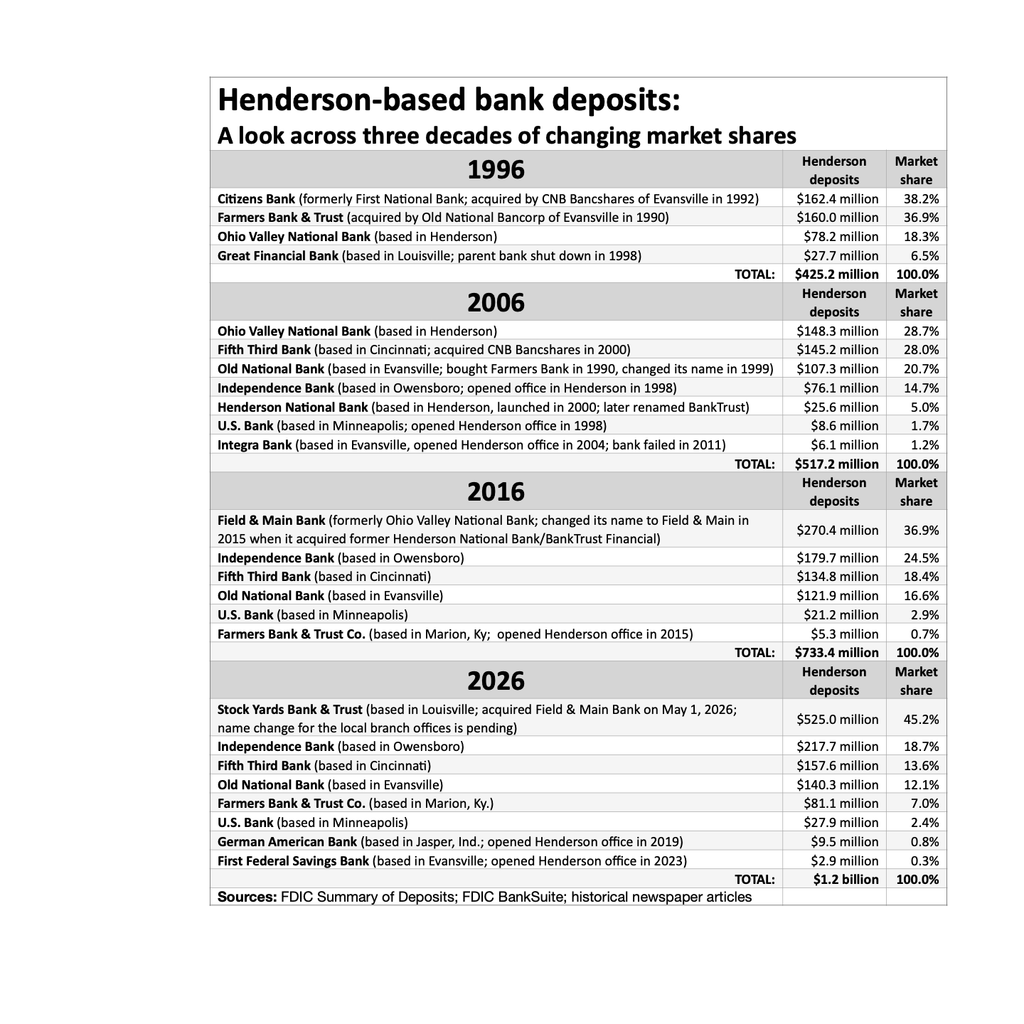
Today, Field & Main dominates the Henderson banking scene with more than a half-billion dollars in Henderson-based deposits, more than twice as much as its next competitor.

But the earth has shifted for what was Henderson’s last locally owned bank. Louisville-based Stock Yards Bancorp Inc. in late January announced that it would acquire Field & Main; it completed the $112 million purchase of Field & Main Bancorp Inc. shares on May 1 and later this month will change the name to Stock Yards Bank & Trust.
Which begs the question: As with other former locally owned banks that got bought out, will Field & Main lose business to what now must be referred to as other “near-local” banks such as Owensboro-based Independence Bank or others?
The answer, for now, is not yet.
In fact, from June 30, 2025, through June 30, 2026, Field & Main/Stock Yards grew its local deposits by nearly $24 million and increased its Henderson bank deposit market share by nearly 1.4 percentage points, to more than 45%, according to the Federal Deposit Insurance Corp.’s annual Summary of Deposits.
That’s despite the shock that Henderson’s last local bank had been sold and that some well-known employees here were retiring—notably longtime Chairman & CEO Scott Davis (though he has joined the Stock Yards board of directors)—or were being laid off, with some of them getting hired by other banks here (some of which have featured those hires in subsequent marketing materials).
“We’re very excited about the Henderson market” as well as Field & Main’s Evansville and Central Lexington markets, Clay Stinnett, Stock Yards’ executive vice president, treasurer and chief financial officer, said in a phone interview Wednesday. (He is not related to the writer of this article.)
“We’re very positive about customer retention and how it’s going so far,” Stinnett said. “We’re excited about the market and feel we can grow market share longer term. We think we can bring bigger lending capacity” as well as more capabilities in wealth management than Field & Main could.
“We’re looking forward to being part of the Henderson community for a long, long time,” he said. Stock Yards was the presenting sponsor of the Handy Festival this year, taking over a longstanding Field & Main tradition, and “certainly we’ll continue to do that for a long time.”
Both Stinnett and retired Field & Main CEO Davis cautioned against reading too much into the June 30 FDIC deposits report. It is, Stinnett noted, a look at just a single day.
“Those things ebb and flow, deposits do,” Davis said. For example, a large depositor such as city or county government or the school system could have a large change in its account when it makes a sizable payment on a bond issue.
Deposits and market share can also jump if a bank acquires another local financial institution, although that has become less common compared with the 1990s.
The longer answer to the question of how long and thoroughly Stock Yards will succeed Field & Main as the king of local banking is: we probably won’t know for years.
If local history is any indication, Hendersonians don’t move their money and loans overnight.
Some of that is somewhat baked into the equation. Some folks’ deposits are invested in certificates of deposits at a particular bank that might not mature for months or even years.
And loans, such as home and commercial mortgages, might have years or even decades left on them. Customers can move their mortgage business by refinancing their home loans with another institution. But that takes time—and money for closing costs, appraisals and other expenses that people might not want to spend.
Banking in Henderson for decades was stable, even staid. One local banker in the 1980s told a reporter that banking for years ran on the 3-6-3 rule: Pay 3% on deposits, charge 6% on loans and get to the golf course by 3 p.m.
But banking regulations were loosened in that same decade. Big Evansville bank holding companies such as CNB Bancshares (owner of what then was Citizens National Bank) and Old National Bancorp swept through the Tri-state in the late 1980s and early 1990s, buying dozens of community banks.
Old National bought Henderson’s Farmers Bank & Trust Co. in 1990.
CNB bought first the struggling Henderson County State Bank in 1990, then Henderson’s First National Bank in 1993, putting them under the Citizens brand. In 1995, it acquired Union Federal Savings Bank which, though based in Evansville, had a major branch at Second and Elm streets in Downtown Henderson.
By 1996—30 years ago—Citizens Bank branches in Henderson and Old National’s Farmers Bank each held about $160 million and controlled three-quarters of the local deposit market.
Locally owned Ohio Valley National Bank stood at a distant third place.
But soon, money flowed toward OV. In a single decade, from 1996 to 2006, Ohio Valley more than doubled its deposits base and overtook Cincinnati’s Fifth Third Bank (which had acquired CNB in 2000) to rank No. 1 in market share.
It never looked back. Its deposits nearly doubled again by 2016, helped in part by having acquired the former Henderson National Bank (which had been founded in 2000) and its approximately $60 million in deposits.
That year, OV also rebranded itself as Field & Main Bank, an homage to both its robust ag lending department and its stature as a Main Street, not Wall Street, institution.
By 2016, Owensboro’s Independence Bank, which opened its first branch here in 1998, had also vaulted ahead of Fifth Third, Old National and others to hold the No. 2 market share with nearly $180 million in deposits.
Fast forward another decade, to this past June 30, and the bank now owned (and soon to be renamed) by Stock Yards remained the dominant bank in Henderson with $525 million in local deposits, a 45% share of this market.
Independence remains No. 2 with nearly $218 million (or almost 19%), followed by the six other commercial banks with branches here.
Not only did market share change dramatically, but so did banks’ physical presence:
In 2006, Citizens Bank operated four branch offices in Henderson; today, as part of Fifth Third, it has one.
Old National in 2006 had three branches here; today, it, too, has one.
Ohio Valley National Bank in 2006 had four offices here; today as Field & Main/Stock Yards, it has three, including its Eastgate branch that has been converted to drive-thru/ATM-only.
And Independence Bank in 2006 had three branches here; it now has two.
All the other banks here have one office each.
So where will Stock Yards, Independence and the others stand here in 10 years, or 20? Who will grow its customer base and deposits?
Davis acknowledged that customers do sometimes change banks. A customer might like another bank’s CD rates or follow a trusted personal banker to another bank, and very large depositors such as local governments might be enticed by a higher interest rate offered by another institution.
Davis, for one, likes Stock Yard’s prospects here.
“Just in all candor, we’ll see some fluctuation,” he said.
“But one of the reasons we were compelled to join with Stock Yards is their commitment to the community we’re in,” Davis said. “The Colonels Corner Bank (long sponsored by Field & Main) had its opening last week and (Stock Yards representatives) were down here en masse for that. They were here en masse for the Handy Festival.
“They really are not the typical large regional bank, because they’re not. They’re domiciled in Kentucky,” and Davis said he believes Stock Yards will be more committed to Henderson than some other large banks might have been had they bought Field & Main.
Acquiring Field & Main for some regional banks might have been “more transactional and not as strategic as it is for Stock Yards,” he said, with Henderson giving Stock Yards its first strong foothold in Western Kentucky.
But what will the local banking market look like in 2036, or 2046?
Only time will tell.

