



















(This article first appeared in the November print edition of the Hendersonian on news stands now.)
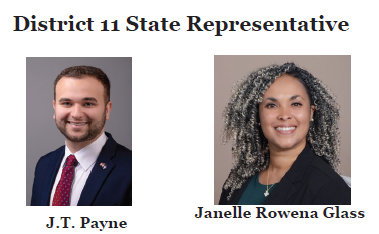
J.T. Payne says the general election is about electing someone who can get things done in Frankfort.
“I have a track record of delivering results to Henderson,” said Payne, who is finishing up his first term as District 11 state representative.
His opponent, Janelle Rowena Glass, is new to politics and said she knows “Henderson needs another voice.”

Three of Payne’s talking points through his candidacy have been increasing state government efficiency, improving education and continued advocacy for the agriculture industry.
Glass is keying in on protecting workers and finding ways for constituents to have the basic essentials to live while also keeping focus on data centers.
Payne said an efficient government is one that will save taxpayers’ money and provide residents a more affordable life. State auditors have identified $800 million in Medicaid fraud, a total that Payne said is equal to ½ of a percentage of income tax reduction.
He also said that audits of the state’s biggest school districts—Jefferson County and Fayette County—show waste and fraud, and he said that is most likely happening in other school districts. Cutting waste there will save taxpayer money, he said.
Glass said she’s pragmatic and will work on making life affordable. She said people all have certain needs in common: to be fed, clothed, sheltered, and they want livable wages and benefits and these days, to have gas prices decrease.
Payne, also the principal of the Career and Technical Education unit at Henderson County High School, said for him, “Education, of course, is a big one.” He said he wants to make sure that education is as relevant as possible, which means that an area’s education should match local workforce opportunities.
Payne serves on legislative education and postsecondary education committees. He said he rewrote a bill to clean up the previous year’s law on traceable communication among students and teachers and staff. That was HB 67. Payne also was the primary sponsor of HB 257, which reduces standardized testing, puts heavier focus on school attendance and implements an individual student growth model.
“We’re doing things to make sure students have opportunities … to be successful in life,” Payne said.
Glass said Payne did not support Gov. Andy Beshear’s pitch to give state teachers an 11% across the board raise, and local teachers were lucky to get a 2% raise. She also took issue with Payne’s vote to approve HB 1, which will eventually allow students to receive scholarships for private school tuition and other education assistance funded by donations from people receiving a federal tax credit. The scholarships can also go to students in public schools.
“The problem is we are not investing (enough) in public schools,” she said.
Payne also weighed in on the state’s current hot-button issue, data centers, saying that local communities should decide if one locates in their town or county. He said local government should decide if a data center is a fit and then residents should decide if they are OK with a data center.
At the state level, legislators in upcoming sessions will be ensuring guardrails are in place for data center companies that want to locate in Kentucky, he said. There should be utility protections and environmental protections, he said. Some of the regulations he foresees are a closed-loop water system and setting a data center away from neighborhoods and schools. He also said residents should not pay more for utilities after a data center comes to a town or county.
Payne termed AI a national security issue, and for the U.S. to remain competitive against foreign nations also pursuing the technology, data centers will have to be built across the nation. But he said we believe in local control and each community should make its own decision about data centers.
Glass is concerned about data centers diminishing the amount of energy that residents would have and mentioned everyday folks’ power supply lessened during storms and other treacherous weather events while at the same time data centers continue to receive all their needed energy. She said that has happened in other places, and while data centers kept running, regular folks were left stranded and caused hardships.
She did say, however, that if the community ends up wanting data centers, then that’s fine and she’ll be on board with it. But at the same time, she wondered “What’s the return on investment on it?” She wanted to know the specific number of jobs data centers can provide.
Payne has always been involved in some form of agriculture, from teaching at Henderson County High School and sponsoring the school’s FFA chapter at the school to now being the owner with wife Maddie of farm James Madison Acres.
On his agenda is keeping Kentucky land available as food-producing land. He said now for the first time ever less than 50% of the state’s land is in agriculture production. Payne will also continue to find incentives so that farmers can make sales to new markets within the state, and not have to search out of state or out of the country.
Glass said she wants to protect workers—agriculture workers, pharmacists, nurses, construction workers. She said there are not enough protections in place to where if a worker loses his or her job, then they can’t provide for themselves and/or they lose needed coverage.


