


















(This article first appeared in the July print edition of the Hendersonian.)
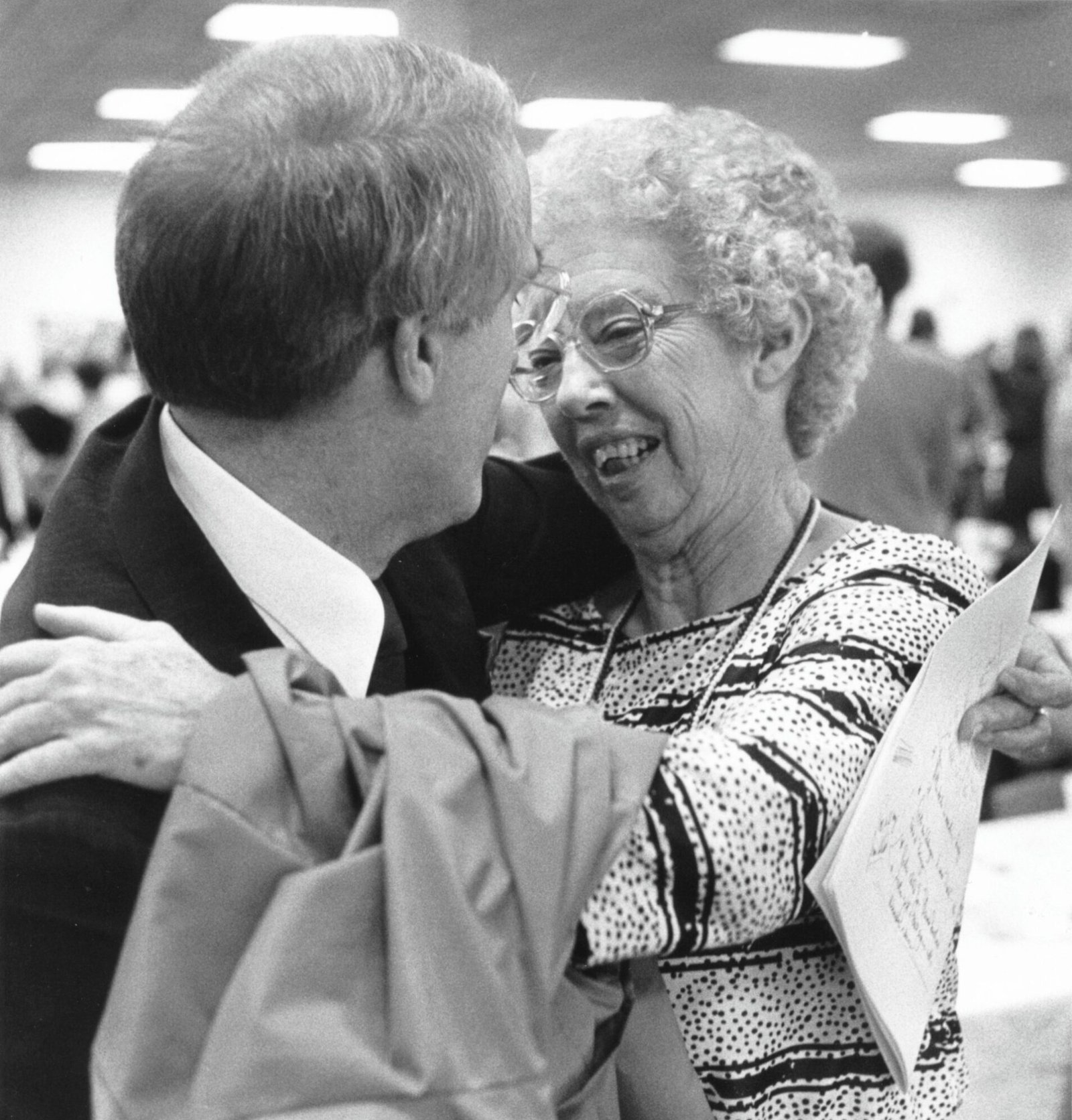
Maralea Arnett was working hard—and catching a ton of flak—during the mid-1970s. But she chalked up a couple of wins within two days in October 1976.
I set out to focus on Henderson’s Bicentennial celebration for this month’s column, largely because July marks the 250th anniversary of the signing of the Declaration of Independence. But the more I got into the research, the more I realized Arnett played a major role in the local Bicentennial celebration in 1976. In fact, she was its official historian.
She was a hard worker and played several different roles in her long life, starting as a correspondent for The Gleaner when she was in the eighth grade. Mostly, however, she was a librarian, teacher, and missionary. She and her brother, Malcolm, were also avid rockhounds; their collections are now at Western Kentucky University.

I didn’t know her well, although we attended Immanuel Baptist Temple together, but that was before I began to really get interested in local history. Since then, I have found her “Annals and Scandals of Henderson County, Ky.” invaluable.
She was born in early 1911 on a farm near Dixie, which had been in her family for six generations. And that’s how she came to write history late in life. She was researching the farm’s history and was a little miffed that E.L. Starling’s 1887 “History of Henderson County” carried no mention of Dixie.
So, she decided to write one. Her history of Dixie was a 24-page pamphlet of text and photos published in 1971 when she was 60 years old. The Henderson County Public Library has a copy.
Henderson got an early start on the Bicentennial by kicking off the Great Ohio River Flatboat Race on Aug. 24, 1973. It was originally envisioned to last only three years but didn’t sink until 1986.
Arnett began writing “Historic Scrapbook,” a weekly column of local history for The Gleaner, which began March 24, 1974, and lasted through Sept. 15.
The first and second columns discussed whether Henderson should celebrate its bicentennial in 1775, when Richard Henderson and company bought large portions of Kentucky and Tennessee from the Cherokees; 1797, when Samuel Hopkins and Thomas Allin laid out the town; or 1810, when the General Assembly incorporated Henderson’s town government.
The community had an entire series of events in 1974 to warm up for the Bicentennial. Meanwhile, Arnett began researching her book that year and in mid-August, with the help of more than two dozen people, published a 44-page Bicentennial pamphlet of text and photos called “Historic Henderson.”
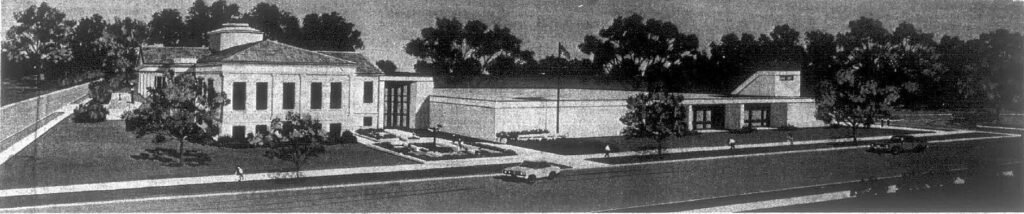
She was on the board of the Henderson City-County Library at the same time. It began looking at ways to expand and repair the original library building from 1904, which was in sad shape. The finances were no better.
In the 1973-74 fiscal year the city contributed $28,795 to the library while Henderson Fiscal Court gave $15,000 of federal revenue sharing. The city and county school systems provided much smaller sums, along with money from other sources. Usage of the library at that point was 54 percent city residents and 46 percent rural residents.
A grant of $250,000 was approved in 1975 to expand and renovate and the library board began gathering petition signatures to enact a library tax of three cents per $100 valuation. By the first of 1976 about three-quarters of the necessary 3,060 signatures had been gathered. The library district was to be created once the petition was presented to fiscal court.
Arnett was pushing the petition drive hard because she was board chair at that time. “Unless your property evaluation is more than $100,000, it will cost you less than the price of one book,” she wrote in a Gleaner letter published Jan. 4, 1976.
But things got tangled in late January. George Raymond Crafton, president of the Henderson County Farm Bureau, presented a petition asking that the library tax be placed on the ballot that November. Fiscal court accepted it at its Jan. 26 meeting. Minutes later, the library board presented its petition of more than 3,700 names.
The court was legally obligated to accept both. So, it instructed the county clerk to take inconsistent actions: Place the library tax on the tax bills. And allow the public to vote on the library tax at the Nov. 2 election.
“But I’m not going up to circuit court to argue both sides,” County Attorney David Thomason said. “One side or the other should initiate court action so they can get a ruling.”
That’s exactly what happened; the library board acted first, suing to disqualify the Farm Bureau’s petition. That was followed May 6 when Claude Watkins filed suit, saying the Farm Bureau’s ballot petition should take precedence because it was filed first. Circuit Judge Carl Melton agreed.
The lengthy legal battle wasn’t resolved until mid-1977, when the Kentucky Supreme Court ruled that the library district had been created as soon as the library’s petition was filed. It used the same reasoning as the Kentucky Court of Appeals, described by Appellate Judge William Gant in The Gleaner of Oct. 22, 1976.
“Both (the petition and the ballot methods) were intended as means of organizing a library district by statute and not as a means to oppose a library district. What we refer to as the ballot method was used to thwart the petition method. We felt it was not within the intent of the legislature to permit that.”
(The public vote was allowed to go forward because fiscal court members wanted to preserve the rights of the Farm Bureau and the library while appeals were proceeding. The issue failed by almost 600 votes on Nov. 2, despite carrying most of the city precincts. City residents were already paying a library tax of $2.41 per $100 valuation, so their tax bills would increase by only about half a cent per $100, but rural residents would pay an additional $3 per $100.)
I’m sure Arnett felt vindicated when the appellate court ruling came down. And that satisfaction was doubled two days later when her “Annals and Scandals” book went on sale.
A review of the book ran in The Gleaner of Oct. 24, 1976, in which Ronald W. Butler wrote he “would have liked to see a little more of Henderson’s seedier side, such as gambling and clubs that earned Henderson the title of ‘Little Chicago’ in the 1940s…” Overall, however, the book’s “minor flaws are unimportant.”
A lot had happened while the legal battle was waging. Arnett had resigned as chair of the library board, according to The Gleaner of Feb. 13, 1976, partially because criticism was beginning to bite and sting. Her family had been Farm Bureau members for more than five decades and the opposition was beginning to get personal.
She also said her library service was “too costly to me in time, health and money.” She was already obligated to work on The Gleaner’s July 4 Bicentennial edition; she wrote more than three-quarters of the articles in the 100-page edition – and all of the articles that followed periodically until Oct. 31, 1976. And she also had missed her self-imposed deadline for publication of “Annals and Scandals,” which initially was to publish in 1975.
She rejoined the library board in mid-April of 1977. A groundbreaking ceremony was held April 25, 1979, and the $1 million addition and remodeling opened April 1, 1980.
The Gleaner of Sept. 9, 1980, carried a story about Arnett’s press conference in which she accused the Henderson County Historical and Genealogical Society of plagiarism when it published its nearly 1,260-page history of the county ranging from 1888 to 1978.
She said the society had copied 20 pages verbatim from “Annals and Scandals” and used sections from another 41 pages. She threatened legal action unless she was paid $2,500 and notices acknowledging her contributions were sent to all 500 buyers of the book. She set a deadline of Sept. 18.
Frieda Dannheiser, editor in chief of the book, waved off Arnett’s allegation. “I have not even read her book, so I fail to see how I could have copied anything from it.” Any similarities, she said, stemmed from material taken from old copies of The Gleaner.
The showdown was anticlimactic, in that no lawsuit for copyright infringement was ever filed, according to the index at the Henderson Circuit Court clerk’s office.
Arnett died Sept. 23, 1997, at the age of 86, according to The Gleaner of two days later.
“She was a person who was devoted to education and learning and libraries,” library Director Don Wathen said at the time. “She gave a lot to Henderson County as a teacher and as a librarian.
“There was a time in the middle 1970s when she campaigned and worked diligently to aid the public library by setting it up as a countywide library district. She made a lot of enemies by doing that, but she knew it was worth the effort and persevered. She is largely responsible for the library being the way it is today.”

