










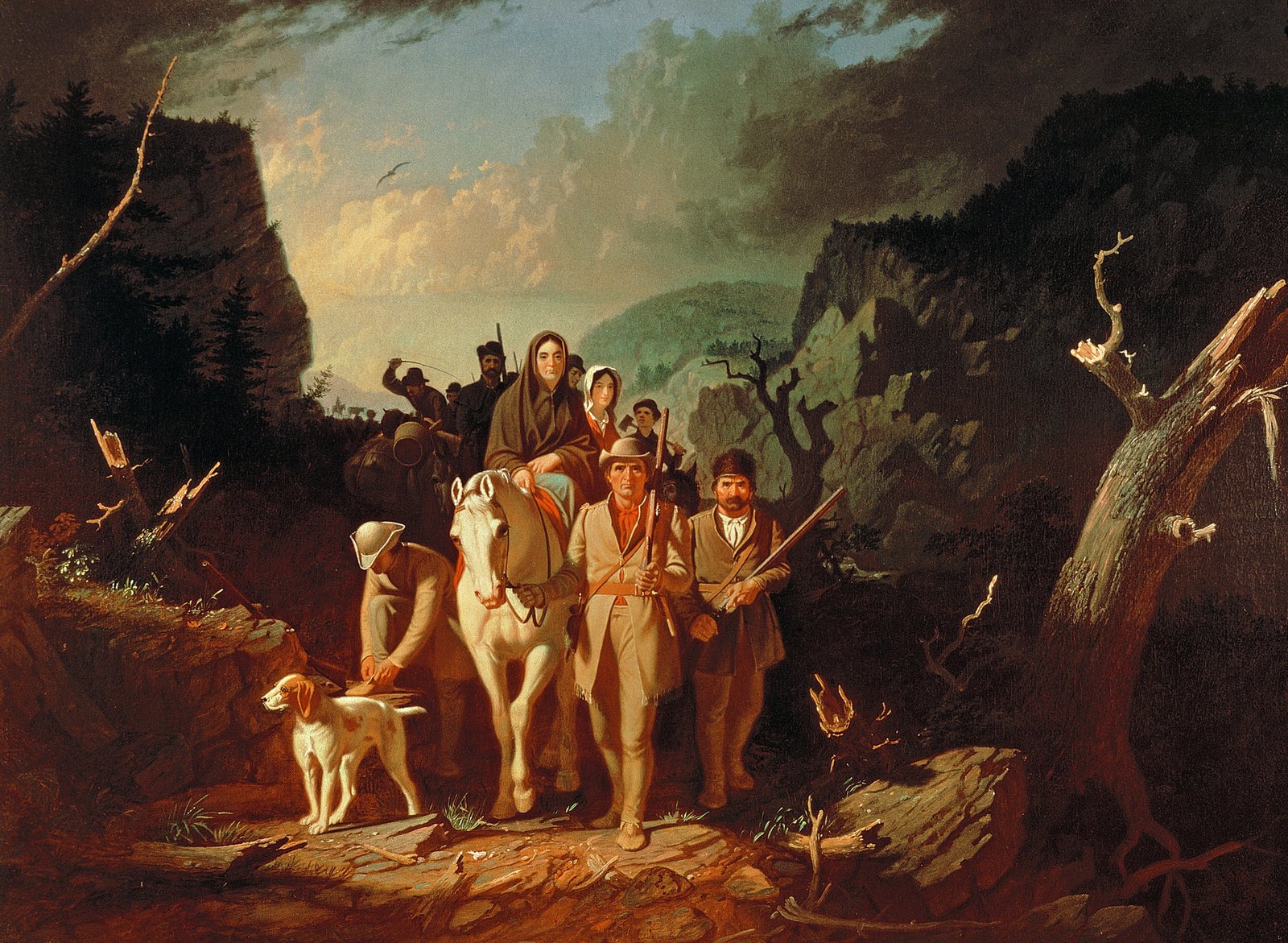
Not long ago, I gave a presentation about Henderson’s early history to a group of young professionals.
One aspect of it, from a year before the Declaration of Independence in 1776, concerned our city’s namesake, would-be frontier real estate magnate Col. Richard Henderson of North Carolina.
It was Henderson who conceived buying a huge chunk of wilderness west of the Appalachian Mountains from the Cherokee Nation with plans of making a fortune for him and his investors by selling it in parcels to settlers eager to move west from the 13 Colonies.
To help accomplish this, I told the 20- and 30-somethings, Col. Henderson in 1775 needed an experienced frontiersman.

He needed someone with experience in that place that would become Kentucky to lead ax men to cut a path through the woods (that would become the Wilderness Road) and guide settlers through the Cumberland Gap into the wilderness.
He needed someone who could develop settlements on the frontier to give Richard Henderson & Company a foothold into what they hoped would become the 14th colony — and the biggest, most profitable, subdivision in the New World.
Who, I asked, did Richard Henderson hire to lead settlers to what was, then, the West?
“Daniel Boone!” I said triumphantly.
The room responded with crickets.
I was puzzled. “Do you all know who Daniel Boone was?” I asked.
I was met by a dozen-and-a-half blank stares. If any of them were familiar with Boone, they didn’t indicate with a nod or raising of hands.
Were they being cautious, afraid of personally being asked some to answer some small and trifling detail about Boone’s long and interesting life?
Or is there actually a generation genuinely unfamiliar with the man whom historian Michael Lofaro called “the founding father of westward expansion”?
It seemed to me impossible that Kentuckians, or Americans for that matter, would be ignorant of Daniel Boone, the man who some consider America’s first folk hero.
But then, I am a man of a certain age. I grew up at the tail end of the Golden Age of Westerns —and the coonskin cap craze that was triggered by Walt Disney’s 1955 movie “Davy Crockett: King of the Wild Frontier” in which actor Fess Parker portrayed the frontiersman wearing his ubiquitous buckskin shirt and coonskin cap.
A few years later in 1964, NBC sought to mine similar ground when it debuted a new TV series called “Daniel Boone,” starring — you guessed it — Fess Parker in a coonskin cap (although the real Boone is said to have not worn caps made of raccoon fur).
By its second season, “Daniel Boone” was one of America’s Top 30 TV shows, with ratings ahead “Lassie,” “I Dream of Jeannie,” “Flipper” and “Gunsmoke.” It held a similar ranking for the next three seasons.
While I watched “Daniel Boone” starting as a kid, I don’t believe I needed a somewhat hokey TV show to make me aware of the historic Boone. At age 7, I was certainly no Boone scholar. But his was a name that everyone, even kids, knew—like Mickey Mantle or George Washington or Betsy Ross.
There was the true story of Boone rescuing his daughter Jemima and two other teenage girls who had been abducted by a Cherokee-Shawnee raiding party in 1776.
There was the legend that he carved a message onto a tree: “D. Boon Kilt a Bar, 1803.”
And there was the quote that Dad attributed to Boone: “I can’t say I was ever lost, but I was bewildered once for three days.”
Dan’l Boone and his legends were just part of the zeitgeist. I figured that hearing it was Richard Henderson, the namesake of our town (even if he never laid eyes on it), who hired Boone to bring settlers through the Cumberland Gap would astonish, or at least intrigue my audience.
Has Boone truly been forgotten by youngsters and young adults? I sent messages to some people familiar with Kentucky history who might be able to shed light.
“Whether or not people today have heard of Daniel Boone often depends on the region where they were raised and educated,” Lucas Wilder, Ph.D., an education specialist at Cumberland Gap National Historical Park, said in a statement released to the Hendersonian by the National Park Service,
“In states such as Kentucky and Tennessee, school curricula place significant emphasis on Daniel Boone and westward expansion. This means that most students have at least heard his name, even if they retain only a limited understanding of his life and accomplishments,” Wilder said.
“Millions of Americans learned about Boone in the mid-20th century through the Daniel Boone television series starring Fess Parker. This show brought the frontiersman into living rooms across the nation. As a result, familiarity with Boone extended far beyond the regions where he had historical significance.
“While still recognized as an important figure in the history of Kentucky, Tennessee, and the American frontier, he may now occupy a smaller role in the broader narrative of American history than he did during the height of his 20th-century popularity,” Wilder added.
“Most Kentucky school kids who come on field trips to the Kentucky History Center and Museums (in Frankfort) know who Daniel Boone is,” Olivia McCants, museum programs coordinator for the Kentucky Historical Society wrote in an email message.
“We have around 10,000 children a year, from all corners of the state,” mostly third- to fifth-graders, McCants wrote. “I can only remember asking one or two classes in four years to ‘name the famous frontiersman who helped open the Wilderness Road’ and not getting ‘Daniel Boone’ as the answer. In my experience, Kentucky school kids are familiar with George Washington, Abraham Lincoln and Daniel Boone, if no one else.”
She said she couldn’t speak to the awareness of Boone among young adults, but said it’s possible that they heard of him in grade school, but never in later grades and just forgot about him.
Indeed, she said, “I was a general history major who attended a Kentucky college, and don’t ever remember Boone being mentioned in class.”
Come to think of it, I don’t, either.


