














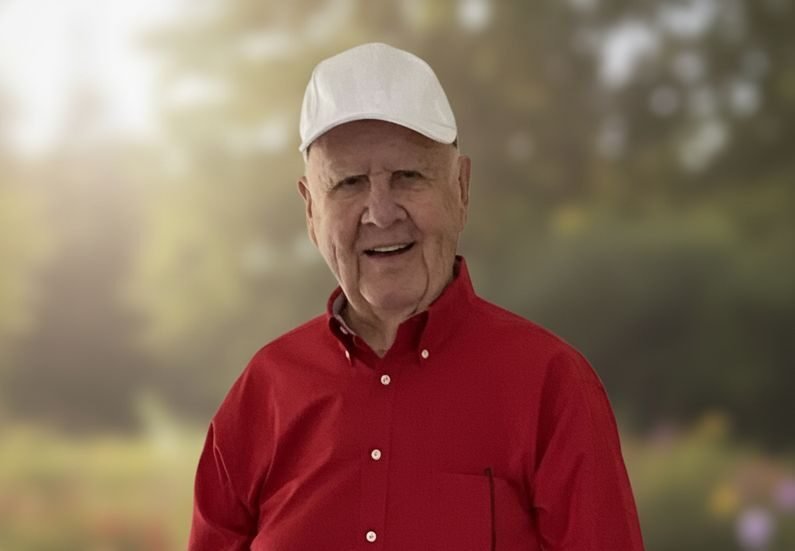
John Conn, a pastor, counselor and hospital chaplain who helped launch the hospice movement in Henderson and also guided untold numbers of alcoholics and addicts into recovery, died here Tuesday. He was 91.
Fittingly, his obituary says he died under the care of St. Anthony’s Hospice, the organization he helped start in the early 1980s after years of campaigning for hospice services here, while surrounded by his loving family.
Conn is remembered as a big guy with a big personality and a big laugh who helped people in big ways. He was also a prankster who could shock people with his colorful language.

“He was a giant of a man in more ways than one; a positive influence on more lives than we’ll ever know,” local humorist and retired educator Bob Park said. “I’m proud to say he was my friend.”
“John was a unique guy,” Dr. John Logan, the retired longtime chief of staff and later medical director at Methodist Hospital (now Deaconess Henderson), said. “He did more good for more people than any person I’ve ever known.”
“He took care of people and nothing stood in his way,” Logan said. “He could relate to anyone … He could deal with a person on top of the world or a person down in the gutter.”
“He believed in the best of people regardless of their circumstance,” Mark Chumbler, executive director of St. Anthony’s Hospice from 2005 to 2013, said.
For a time, Conn had a private counseling service at the former Atkinson Park Building on North Elm Street while Logan had a medical practice on the first floor. “He would call me and send a patient down to me and tell me, ‘Take care of him. He doesn’t have any money,’” Logan said.
At the same time, Logan said, Conn was providing counseling for “everybody and his brother free of charge,” more concerned with providing care than seeing to his own livelihood.
Logan recalled taking a trip around western Kentucky with Conn, “and he knew people everywhere. We’d walk in a restaurant and he’d see three people he knew. He loved people and did everything he could to help people.”
“He welcomed people who had probably never been welcomed before, especially in the recovery community,” family friend Rhonda Richard said. “To have a minister come in and accept them was huge, because so many of them were rejected from that structured place. He was just so open-minded during the early ’80s, which was pretty significant, and to have that in Henderson is pretty amazing.”
Richard said Conn got her father, Ron Cravens, into recovery, which helped him live eight years sober before his death. She credited Conn for “the significant impact he had on the recovery community in Henderson. If not for him, a lot of people would not be sober.”
Conn and Cravens were close friends, but that didn’t mean Cravens was free from Conn’s mischief. Once, someone stole a forklift from Cravens’ business downtown. After it was found abandoned near Sand Lane, Cravens asked Conn to follow him while he drove the forklift slowly back to downtown.
“The whole way back, John honked his horn and hollered, ‘Get off the road! You’re tying up traffic!’” Richard said.
“He was very intentional,” she said of Conn. “As much as he was a jokester, he had a lot of love. Agape love—Jesus’ never-ending love, agape love. Whenever I thought about John, that’s what I think about.”
Conn could shock the uninitiated with ribald humor not expected from an ordained pastor.
“He was able to use his humor to humanize people in order to help them,” David Park, retired legal counsel for the hospital, said. “He’s known for his humor but also his compassion. It’s a unique combination he was able to achieve. I think too many people think of him as a jokester. I think the intent was always to bring people back to earth.”
Rev. Gary Chapman knew Conn both as a fellow pastor and as a chaplain who worked at Methodist Hospital while Chapman’s father, Ron, was its administrator. (Conn also served for more than 20 years as director of Methodist Hospital’s Department of Pastoral Care and Counseling before retiring in 2021.)
Chapman knew well how outlandish Conn could seem.
“As far as I can tell, John Conn was never accused of not going far enough,” Chapman wrote about him. “Now if he were to be charged with ‘going too far’ … well, that’s another thing altogether.”
But, Chapman wrote, Conn also didn’t hold back when it came to caring for others.
“I have heard some people tell stories about John of him going way out there for you—who drove far, stayed long and dove deep with you into your life to help you, to rescue you,” Chapman wrote. “I’ve heard some people say: ‘He saved our marriage.’ ‘He got our son in rehab and it saved his life!’ ‘He visited me when I was sick, in jail, in trouble…’
“Stories like that do not accumulate around people who play it too safe…” Chapman wrote. “Stories like that cluster around a person who takes risks for the sake of others and are willing to risk going too far in order to have a chance of going far enough.”
“I knew John for 50 years or more,” retired banker Dale Sights said. “John was full of goodness, love and humor. I loved John, and Janell (his wife of 65 years) as well, and she was adored by John.
“The humor never ended,” Sights said. “I saw him a week ago, 10 days ago. He was in horrible shape, but we had some laughs. …
“So much humor. So much that can’t be told, can’t be written.”
But Conn wasn’t solely about laughs.
“We could say John saved my life by introducing me to my path to sobriety, as he did so many others,” Sights said. “He introduced me to the process of intervention. He actually did my intervention …
“I’ve traveled with him and done interventions,” he said. “I think that’s what inspired me to do some of the things I’ve done, helping people with our disease.”
One of Conn’s enduring legacies is St. Anthony’s Hospice.
In the 1970s, he was one of many people influenced by Dr. Elisabeth Kübler-Ross’ groundbreaking book “On Death and Dying,” which inspired many doctors, nurses, clergy, families and others to recognize death as a natural and inevitable process, and to embrace hospice care as a means to ease pain and discomfort, provide emotional and spiritual support, and, often, to enable the dying to live their final days at home instead of in a clinical environment such as a hospital.
Conn believed the path to establishing hospice care in Henderson was to educate the public. He approached Marianne Walker, who taught bioethics and other courses at Henderson Community College, to lead a class on hospice. After receiving training in the subject, Walker developed a continuing education class on the subject.
“For our first class, we did not know what to expect,” Walker wrote years later. “We set out eight folding chairs in the old Student Center at the college. Some 55 people showed up that night. John taught the spiritual aspect of dying and I taught the history and philosophy of hospice. The other classes were taught by registered nurses, doctors and pharmacists.”
Rev. Becki Curry had read “On Death and Dying” in seminary and “was fascinated by it.” She came to Henderson and got to know Conn.
One day, she said, “John said, ‘You know we’re going to have a hospice.’ I said, ‘John, there’s no way we’re going have a hospice.’”
How would such an organization be formed? How could volunteers be trained and organized? How could money for it be raised?
And yet, the concept of providing compassionate end-of-life care began to spread. In 1981, pediatrician Dr. Don Cantley called Walker to say there was a family with a young mother dying of a rare form of cancer and in great need for such care.
“It is time now for you to stop teaching hospice and practice it,” Cantley told her. “If there ever was a family that needed the kind of help you and John Conn have been talking about for over a year, it is this family. You must practice now what you have been preaching.”
Though startled, Walker enlisted the help of Beverly Skaggs, a registered nurse who worked in intensive care at Methodist Hospital. The two began making trips to care for the dying patient. Skaggs helped secure needed pain medications through the woman’s physician. While her death was inevitable, the patient and her family began to fare better. Walker would later declare that experience “The Day Hospice Started” in Henderson.
In 1981, St. Anthony’s Hospice was incorporated as a nonprofit organization. The following year, a part-time executive director was hired to oversee a group of volunteers. Two years later, Registered Nurse Nancy Evans stepped into the role.
Evans knew Conn as the hospital chaplain who “was as much as a source of comfort and encouragement to the staff as he was to patients in need. He always had a joke, always had time for a hug. It was a bright part in my evening.”
With St. Anthony’s, “He had the vision for this and the encouragement,” she said. “He had lots of friends he could bring on board. He understood the process of dying with dignity and wanted to make that very available for our community so we weren’t in this sterile environment of a hospital room.
“Death is a normal process,” Evans said. “We all want to leave with dignity. He had the vision and passion for it—an infectious passion for it, really.”
After Evans left to look after her own young children, Curry—the former skeptic—became the first full-time executive director, serving at St. Anthony’s for 13 years.
“Marianne Walker and John were just a force to be reckoned with,” Curry said. “When they decided they were going to do hospice, that was it.”
There were tea dance fundraisers and auctions and every manner of effort to keep hospice afloat. Eventually, St. Anthony’s became Medicare- and Medicaid-eligible. More full-time staff—nurses, social workers, a chaplain and more—came on board.
And there was outreach to help the public understand that reaching out to hospice for care wasn’t giving up—it was asking for help at a time when precious help was needed for the terminally ill and their families.
“John said the way to do it was, you educate,” Curry said. “And you educate. And you educate. And when you’re through educating, you educate some more. I do think that was key to our success …
“People in Henderson really learned what hospice was and was all about,” she said. “John was the perfect person to do that because he could blend that humor with the seriousness of death and make it all okay.”
“He was one of a kind, no question about it,” Curry said. “They threw away the key when they made him.”
Kendra Marsh, today the executive director of St. Anthony’s, released a prepared statement that lauded Conn as one of hospice’s “visionaries.”
“What started years ago as a compassionate vision to care for people and families during some of life’s most difficult moments has grown into an organization that now serves Henderson, Union and Webster Counties through hospice, palliative and bereavement care,” Marsh wrote.
“The heart behind that mission has never changed. Every day, our team continues the work John helped begin by caring for patients and families with compassion, dignity, and support,” she wrote.
“John’s impact can be seen not only in the growth of St. Anthony’s Hospice but in the thousands of lives touched through the care provided here over the years. Because of leaders like him, families in our community have experienced comfort, peace, and support when they needed it most.
“At St. Anthony’s, our mission remains the same,” she continued. “John’s vision helped lay the foundation for that mission, and we remain committed to carrying it forward every single day.
“On behalf of our Board of Directors, staff, volunteers, and the many families we have been honored to serve, we extend our heartfelt condolences to John’s family and loved ones. We will always be grateful for the compassion, leadership, and commitment he gave to this organization and to our community.”
Pursuant to Conn’s wishes, there will be a private family memorial service and burial, according to his obituary.
Read Conn’s obituary here.


