












(This history column first appeared in the June print edition of the Hendersonian.)
A huge community meeting in 1946—modeled after one held 132 years earlier—gathered input from Henderson residents to try to forge a pathway to the future.
It was amazingly successful. Multiple Henderson institutions can trace their lineage, either directly or indirectly, back to that 1946 town hall meeting.
But perhaps more significant was the way the effort brought the community together, outlined the problems it faced, and set people thinking about ways to solve them.

An article by Gail King published in The Gleaner’s Progress Edition of March 1, 1981, noted the 1946 town hall meeting saw “old and young, Black and white, laborer and capitalist, Democrat and Republican, club woman and working woman, farmer and merchant” sit down for three hours to hear the community’s problems.
It didn’t solve them right away, of course. “It did, however, force citizens to recognize problems, and it set the stage for the town’s growing up, for admitting that Henderson could be more than a sleepy little Kentucky town.”
Throughout its history Henderson has had various town hall meetings. The first, prompted by a lack of hard currency, occurred Nov. 12, 1814, according to E.L. Starling’s 1887 history of the county.
Committees were appointed to petition the General Assembly for a bank charter here, and to lobby legislators to support it. That effort was initially successful. The General Assembly authorized the creation of 46 banks in 1818, according to The Kentucky Encyclopedia, and scattered them across the state.
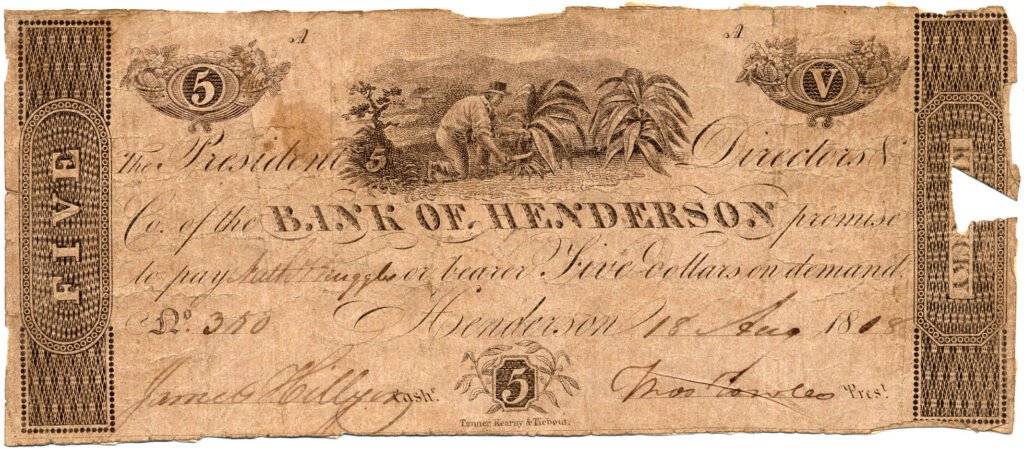
Henderson got its bank, which initially was a log cabin at the southeast corner of Second and Main streets before it built a brick structure on Main Street. But it didn’t last long. The paper money it issued was virtually worthless after the Panic of 1819. According to Starling, “the Bank of Henderson, after two years of unsuccessful business, turned her toes to the daisies, and effected a settlement as best she could.”
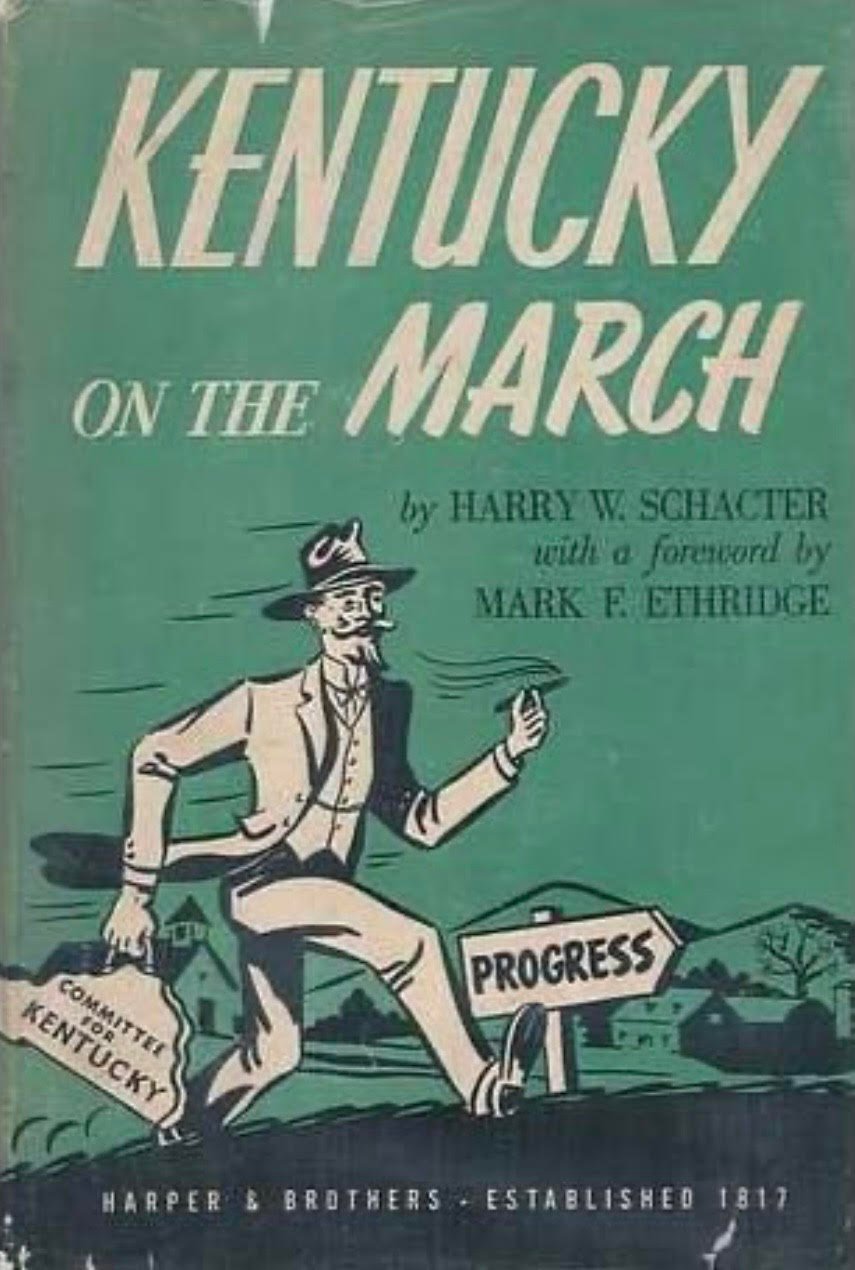
The 1946 town hall harkened back to the 1814 meeting but was more closely modeled after the Committee for Kentucky, which was the brainchild of Harry W. Schacter of Louisville. Schacter came to a meeting of community representatives at the Glass House Restaurant Feb. 9, 1946, which kicked off organizing the Committee for Henderson and Henderson County.
“We may well have made history here tonight,” Schacter said, noting Henderson would be a “guinea pig” for similar local efforts across the state. (That was not to be, according to the Committee for Kentucky entry in The Kentucky Encyclopedia.)
The Gleaner carried a story a week later, noting more than 100 local organizations had agreed to participate, including civic clubs, women’s clubs, lodges, business and professional groups, government and political officials, labor unions, churches, schools, and farmers.
A permanent Committee for Henderson was formed Feb. 22, 1946, and unanimously named insurance man Henry A. Taylor as president. He had led successful bond drives during World War II.
Schacter spoke at that meeting and listed the findings of the Committee for Kentucky, which aimed to “learn why the Commonwealth had in the past 50 years dropped from its proud place as a center of education and a great tobacco market, with an aura of prosperity and gentle living, to near the bottom nationally in education, health and status of living so that it is listed as a ‘backward state.’”
More stories followed, not only in The Gleaner, but also in newspapers in Evansville and Louisville, as well as mentions on TV station WHAS in Louisville. The effort also drew national attention with Collier’s magazine of March 23, 1947; a Gleaner editorial three days later noted a recent visit by a representative of Kiplinger’s magazine.
The town hall meeting was held March 26, 1946, in the auditorium of Barret Manual Training High School. A gavel made from a beech tree into which John James Audubon had carved his initials in 1814 brought the meeting to order, according to The Gleaner of March 24, 1946. (Audubon State Park now has that gavel.)
The auditorium could seat 2,500 people, and every seat was filled, but The Gleaner of March 27 reported there were closer to 3,000 in attendance. “Many stood in the rear of the room and crowded into the foyer, patiently, eagerly standing as they listened to the experts….”
John Cronin of the University of Louisville pointed out the shortage of housing for returning war veterans; he recommended further study and perhaps adoption of a zoning ordinance to prevent incompatible land uses. “I don’t see how this size city can continue to grow in such a topsy-turvy manner.”
Howard Beers of the University of Louisville questioned the fragmented way money was raised for various worthy causes. At that time the community experienced 14 separate fund drives every year. “Are there too many drives in the city and county? Do they pile up on you? Could you pool your donations?”
Those questions were the first to be answered. Local civic groups gathered to learn how group fundraising might work, and on July 27 The Gleaner reported six of the nine groups favored pooling fundraising efforts. The three holdouts were constrained by policies of their national offices.
A Community Chest was quickly set up before 1946 ended. In 1955 it became the United Fund and changed its name to the United Way in 1975.
Adoption of a zoning ordinance came the following year after much work by the Committee for Henderson and a near-unanimous vote by Henderson organizations, according to The Gleaner of May 16, 1947.
The Gleaner of June 3, 1947, reported the creation of the city planning and zoning commission, the authority of which extended five miles beyond the city limits. It initially was composed of Mayor Robert B. Posey, city Commissioner Otis A. Benton, city engineer Newton “Red” Neel, city school Superintendent Ted A. Sanford, John G. Conway, William R. McClain, and P.A. Melton.
That same Gleaner of June 3, 1947, reported the city commission had created the Henderson Utility Commission—and began the process of issuing $2.6 million in bonds to pay for a new power plant. That idea was defeated by voters 2,226 to 1,529 that November.
The Committee for Henderson helped turn that around with its periodic town hall meetings. The 1948 vote was 1,874 to 1,424. The result was the former Station 1 power plant on Water Street, which cost $3 million by the time it was completed in 1951.
For many years the city’s sewer system dumped raw sewage straight into the Ohio River or Canoe Creek. New federal regulations were requiring a treatment plant, but groundwork by the Committee for Henderson helped persuade city voters to approve a bond issue in 1954 to pay for the city’s first sewage treatment plant.
One of the more troubling reports issued by the Committee for Henderson was about the state of the community’s schools. The Gleaner of Oct. 18, 1946, reported: “Of the seven school buildings in the city, five were constructed before 1900, and of these four were found unsatisfactory in 1941.”
Getting the school systems into adequate order took some doing. “Teacher pay was pitiful, according to Francele Armstrong’s report about the Committee for Henderson’s accomplishments, which appeared in The Gleaner’s Sesquicentennial Edition of June 24, 1960. “As a direct and immediate result of the committee’s study, teachers in the city and county were given raises” that—although low by national standards—were listed high among Kentucky school districts.
“In the city it took three attempts to get a special tax voted for school building purposes. In the county it took five attempts.” But by 1960, Armstrong noted, the county had a consolidated high school in a new building and the city district likewise had a new high school. Also, there were seven new elementary schools locally and four others had been remodeled and/or added on to.
Adult education began at the YMCA in cooperation with Murray State University, according to The Gleaner of Oct. 24, 1946, which gave the Committee for Henderson credit for bringing them together.
“The significance of this experiment means the bringing direct into (the) community formal college instruction for the advantage of teachers and others who desire college education which they cannot go after. It means that people who cannot go to college will have the college brought to them at both the graduate and undergraduate level.”
The idea of a campground/trailer park at Audubon State Park appeared in The Gleaner of April 28, 1948. The announcement of 25 campsites and spaces for 10 trailers followed in The Gleaner of Oct. 25, 1961. “The facility will be ready for the 1962 tourist season.”
The committee also tackled the ideas of a city manager form of government and merger of the city and county school systems, according to The Gleaner of March 10, 1949. Those ideas also took some time to come to fruition.
Henderson voters approved the city manager form of city government by a margin of 1,995 to 952 at the Nov. 6, 1963, election, placing day-to-day operation of city government in the hands of a full-time professional administrator. The Henderson City Commission went from three to five members at the first of 1966 because of the change. James Robey was Henderson’s first city manager.
Merger of the two school systems came a decade later. The city Board of Education voted 3-2 April 17, 1976, to merge the city and county school systems effective at the end of the school year. The county Board of Education rejected that plan 4-1 on May 5. The state Board of Education mandated merger June 16.